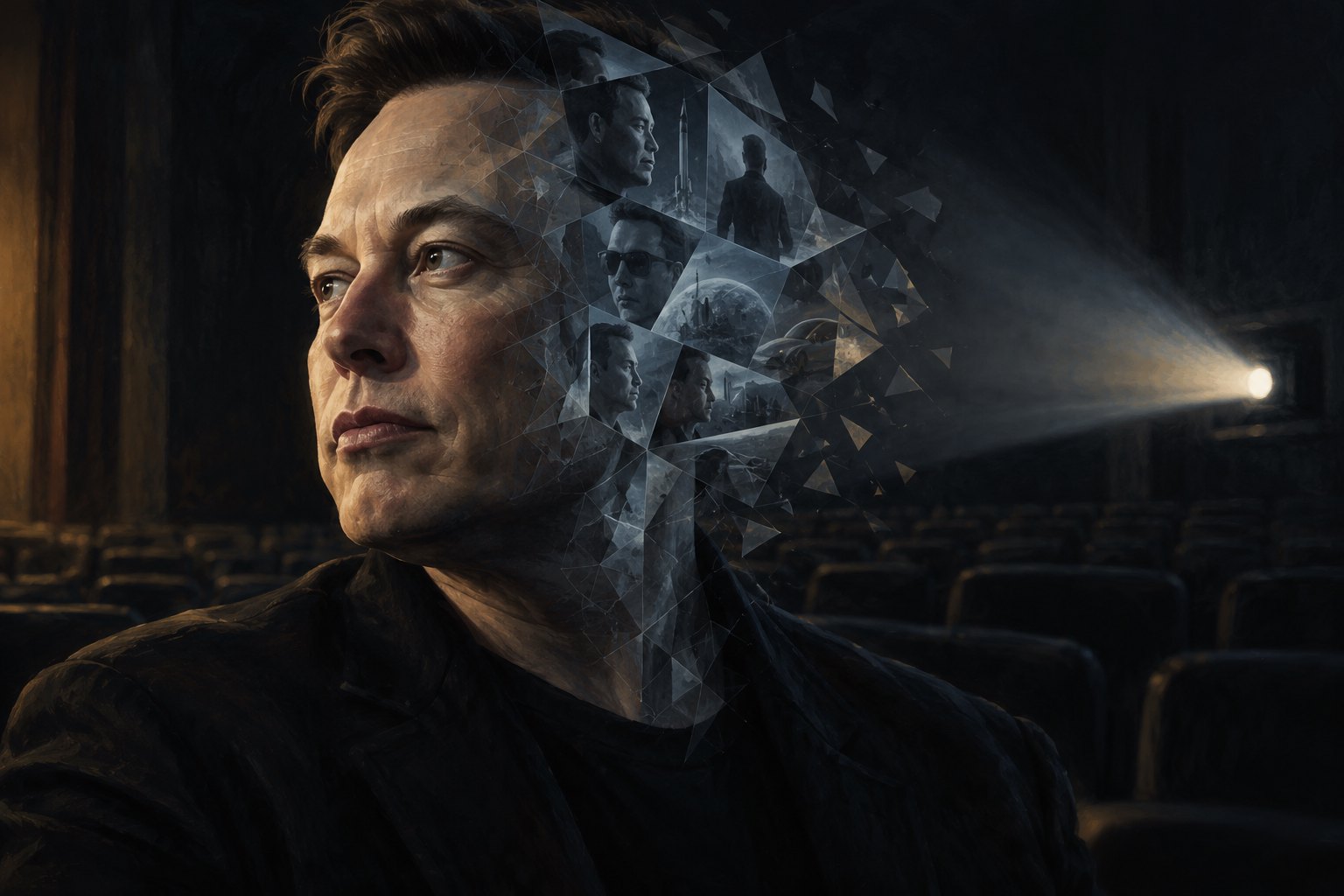
Elon Musk’s transformation into a cinematic villain raises a problem that a compelling biography cannot automatically solve: making someone recognizable is different from making him understood. Alex Gibney’s documentary Musk brings that distinction into unusually sharp focus through its digital version of the man himself. A constructed interviewee offers a provocative way to examine a constructed public identity. It also gives the filmmaker exceptional control over both sides of the conversation.
Spoiler notice: This critical essay discusses reported interview material and visual devices. It analyzes those documented elements rather than presenting a firsthand assessment of the complete film.
The missing interview becomes a character
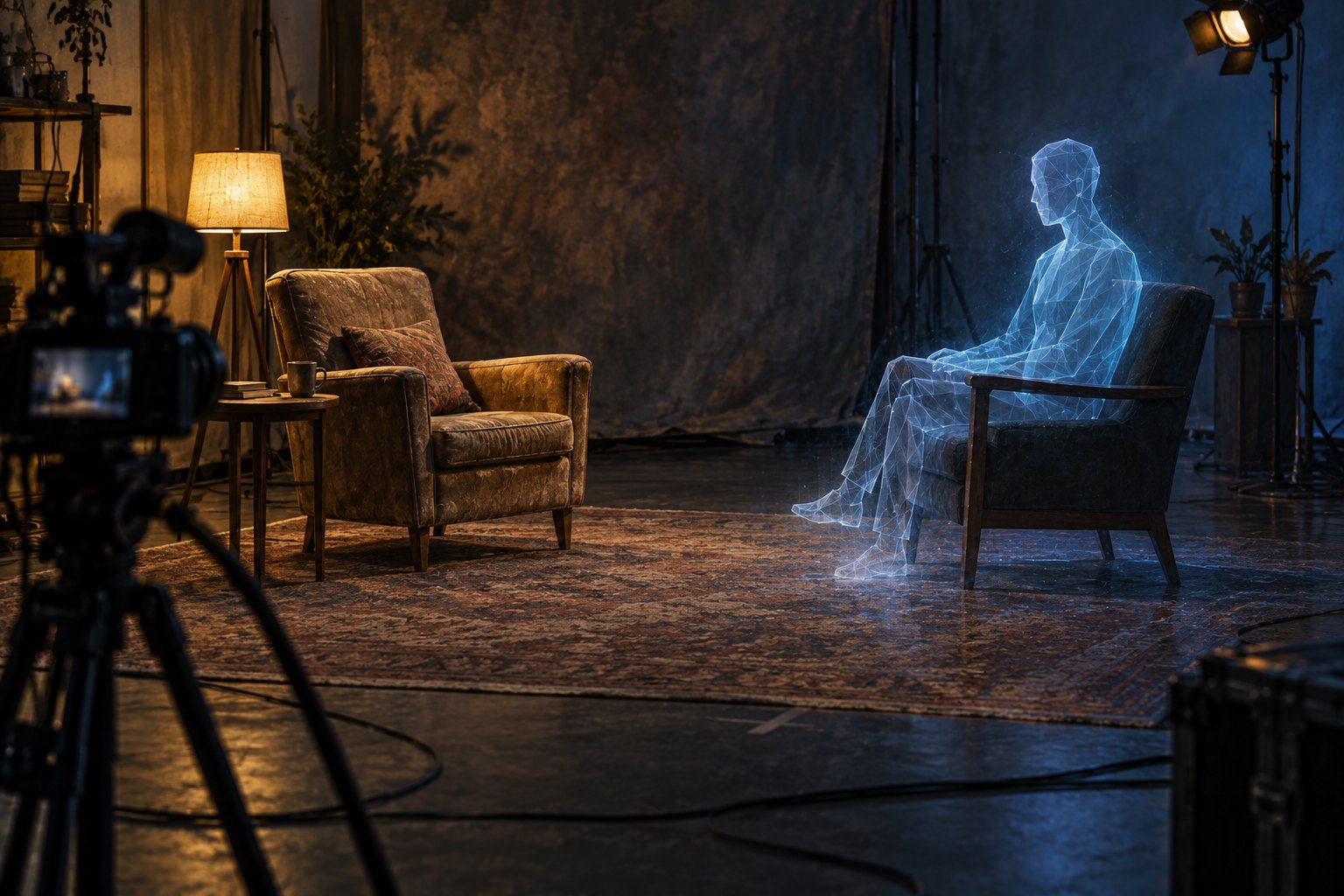
According to Kenji Fujishima’s account in Slant, Musk declined an interview. Gibney instead introduces a computer-generated avatar whose responses are assembled from Musk’s public remarks, disclosing the device at the beginning. The distinction matters: this is a representation built from existing statements, not a newly obtained exchange with the subject. [Slant’s account of the documentary](https://www.slantmagazine.com/film/musk-documentary-review-alex-gibney-elon-musk/).
As a storytelling choice, the avatar has an intelligible purpose. It prevents absence from becoming silence. A subject who refuses an interview should not acquire veto power over a documentary, and public statements remain legitimate material for scrutiny. There is also an obvious thematic fit between a technology entrepreneur and a technologically manufactured screen presence.
But an interview consists of more than words. A question creates circumstances: someone hears it, interprets its implications, and chooses a response. Combining an earlier statement with a later question changes that relationship, even when the statement itself is authentic. The viewer needs to distinguish what Musk actually said from what the arrangement suggests he has answered.
My concern is therefore about dramatic authority. The digital character can appear available for cross-examination while the real person remains absent. That gives the film an encounter it could not obtain, with a degree of coherence that a difficult, evasive, or contradictory live interview might never provide.
Who gets to be a person, and who becomes scenery?
One reported line provides a useful way into the film’s character logic. Journalist Kara Swisher describes a worldview in which “everyone else is an NPC in a videogame.” Serena Seghedoni’s account also identifies video-game references and health bars among Gibney’s visual devices. The gaming vocabulary is therefore more than a passing joke: it supplies a model for thinking about the subject’s relationship to other people. [Loud and Clear’s discussion of the film’s dialogue and imagery](https://loudandclearreviews.com/musk-film-review/).
An NPC—a nonplayer character—exists inside a game without being controlled by the player. Applied to a real person’s worldview, the metaphor suggests a troubling hierarchy: one individual experiences himself as the active protagonist, while everyone else becomes assistance, resistance, or background.
That is an interpretation offered within the documentary, not direct access to Musk’s thoughts. Its value depends on whether individual accounts make the metaphor more precise. A vivid comparison can help organize evidence; it should not be allowed to replace evidence.
It also creates a challenge for Gibney. A film criticizing a protagonist-centered worldview must give the surrounding people meaningful identities. Their experiences should matter beyond what they reveal about the famous man. Otherwise, the documentary risks reproducing the same imbalance it wants viewers to recognize.
Personal testimony needs room to resist the thesis
The reported inclusion of Tesla co-founder Martin Eberhard and Musk’s father, Errol, introduces different kinds of proximity. Fujishima describes Eberhard disputing the allocation of credit at Tesla and Errol appearing in a section about Musk’s childhood. These are distinct vantage points, carrying different interests and limits. Neither should be treated as an all-purpose explanation of the central figure.
From a former colleague’s perspective, the dramatic stakes concern authorship, recognition, and the difference between building something and becoming its public face. From a parent’s perspective, the stakes concern memory and the family’s account of itself. A documentary becomes more revealing when those perspectives remain particular rather than merging into an apparently unanimous verdict.
Disagreement can be valuable. So can hesitation, incomplete knowledge, or a witness whose explanation does not fit the filmmaker’s preferred pattern. Those qualities remind us that documentary participants are people with experiences, not supporting characters written to deliver a theme.
This is where the distinction explored in our analysis of documentary evidence in Brother Joseph Again becomes useful: the emotional force of a presentation and the reach of its proof need separate consideration. A persuasive witness can establish what happened to them without establishing everything about someone else.
An origin story can make choice disappear
The attraction of a villain’s origin story is its promise of retrospective order. Earlier experiences appear to contain the adult’s eventual identity. Details become clues. Contradictions become stages in a transformation. By the end, the audience feels that the outcome was waiting inside the beginning.
That structure is satisfying drama, but it can weaken an argument about responsibility. If every later action becomes the inevitable expression of an earlier wound, choices begin to look predetermined. A childhood explanation may provide context without proving why a particular adult decision occurred.
The more demanding character analysis preserves alternatives. It asks where someone could have acted differently, what objections were available, and what competing priorities were dismissed. Responsibility becomes clearer when the story allows the possibility of another course.
Our earlier commentary on explaining Musk’s power considered the breadth of that larger question. Here, the issue is narrower: whether a documentary’s portrayal leaves enough space for a person to remain inconsistent, accountable, and resistant to a tidy dramatic arc.
The deeper tension is control of the image
My reading of these reported techniques is that Musk poses a compelling question about representation even before its broader argument is settled. Who controls the encounter when one person supplies the public statements and another supplies their new context, visual embodiment, and apparent conversational setting?
The avatar makes that struggle visible. It can puncture a polished persona, but it can also replace one controlled image with another. Recognizing this does not invalidate the documentary’s testimony or excuse its subject. It gives viewers a more exact way to assess how the film turns material into character.
The strongest interpretation is therefore less final than a completed villain portrait. A documentary can hold someone accountable while leaving parts of his psychology unresolved. Indeed, that restraint may sharpen its judgment: viewers do not need a complete theory of a person’s inner life to examine his choices. What they need is clarity about where the evidence ends and the film’s explanation begins.
Original content by this site's editorial team. Published: October 10, 2026 at 14:23:13 PDT (Los Angeles time)