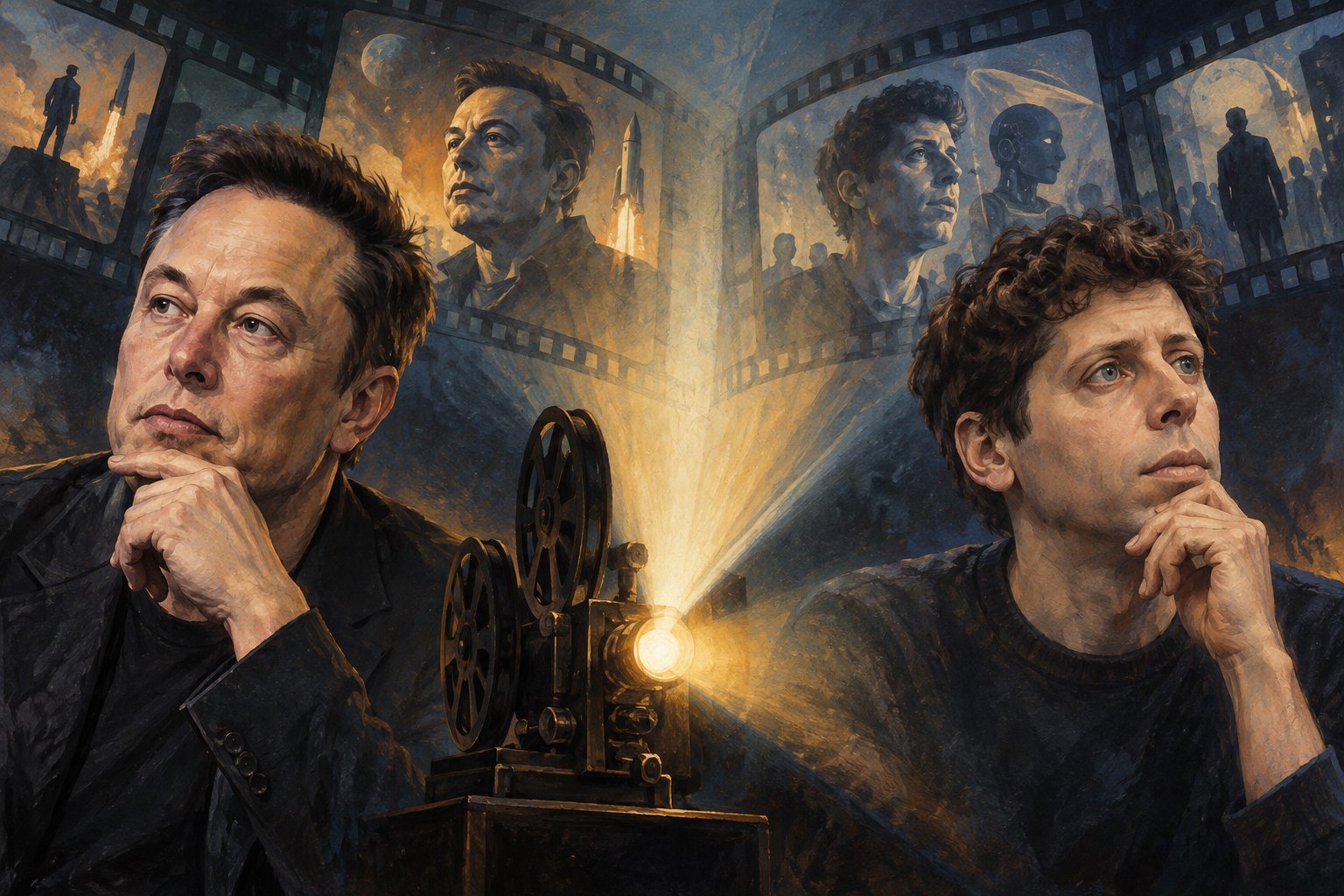
Elon Musk and Sam Altman have reservations about becoming movie subjects, but their objections deserve to be understood separately. According to Forbes, Musk has attacked Alex Gibney’s documentary Musk, calling it a “hit piece” and challenging its selection of interviewees. Altman has questioned the accuracy of Artificial, the dramatization of his brief removal from OpenAI’s leadership in 2023.
Neither response settles whether the films succeed. They do, however, identify two different problems for viewers: how a documentary builds its portrait through witnesses, and how a dramatic performance makes an interpretation of a living person feel authentic.
This is analysis of the reported reactions and characterization questions, rather than a review based on a full screening. It discusses the premise of Artificial and one reported trailer detail; no ending spoilers follow.
Musk’s objection puts the witnesses on trial
Forbes reports that Musk’s criticism includes objections to Gibney’s choice of people interviewed for the documentary. That matters because a documentary character is assembled differently from a fictional one. The subject may appear in footage, but other people’s memories, the placement of their testimony, and the filmmaker’s selection of material help determine who that person becomes on screen.
From the subject’s perspective, there is an obvious vulnerability here. An encounter that felt incidental to one participant may have remained defining for another. A former intimate may remember a private interaction that complicates a carefully maintained public identity. The resulting portrait can be recognizable in its details while feeling alien in its emphasis.
That possibility does not establish that Musk’s objections are justified. Nor does an interviewee’s difficult relationship with a subject automatically discredit the account. Conflict can create resentment; it can also give someone relevant knowledge. The useful question is what supports a particular statement.
My critical standard for a documentary portrait is therefore specific: does it distinguish recollection from corroborated events, and does it give viewers enough context to assess both? Several people expressing similar feelings can establish a pattern of experience. It does not necessarily establish every factual allegation accompanying those feelings.
The broader issue connects with our discussion of who shapes an artist’s legacy in Nureyev. A person’s story changes when other people become its custodians. Cinema should examine that transfer of authority as carefully as it examines the famous individual.
Altman’s response separates resemblance from accuracy
In his Vanity Fair interview, Altman said he had watched the Artificial trailer. He questioned the film’s accuracy, disputed its depiction of a firearms-filled bunker, and acknowledged that Andrew Garfield had captured his walk. Those are revealingly different assessments: recognition of a physical mannerism alongside resistance to the larger portrait.
The distinction is essential to watching performances of real people. An actor can reproduce posture, vocal rhythm, or an awkward gesture with remarkable precision. That achievement makes a character immediately legible. It cannot independently verify the screenplay’s account of what the person wanted, feared, or did.
Indeed, convincing physical detail can make speculative characterization harder to notice. Once an audience accepts the body on screen, it may become more willing to accept the private motives attached to it. Performance supplies continuity between what viewers recognize and what they have no way of knowing.
My view is that this is where biographical acting becomes most interesting—and where viewers should remain most attentive. A recognizable walk is a craft achievement. A private conversation is a claim of a different order, even when both appear in the same seamless scene.
Altman’s response also needs its proper scale. Comments prompted by a trailer should not be treated as a detailed assessment of an entire finished film. Equally, identifying a disputed detail does not resolve every question about the wider characterization.

Why a disputed prop can change a character
The reported bunker disagreement illustrates how production design can carry an argument. In a hypothetical scene, a room full of emergency supplies could suggest prudence, anxiety, isolation, or a desire for control. Lighting, editing, and the actor’s behavior would help determine which interpretation dominates.
That is a general observation about film language, not a description of how the completed Artificial handles the material. The important point is that a prop need not speak to become characterization. An object can encourage viewers to infer an entire worldview.
This makes factual disputes about apparently minor details worth examining. A compressed timeline may simply help an audience follow events. An invented setting that implies a particular psychological condition can change the moral meaning of a portrait. Both are creative choices, but their consequences differ.
For character-focused criticism, the question should be what an alteration does. Does it clarify an established conflict? Does it make uncertainty visible? Or does it quietly supply a motive the story has otherwise failed to demonstrate?
The danger of making the billionaire explain everything
The premise of Artificial places a recognizable individual at the center of an institutional crisis. Dramatically, that offers a strong organizing principle: a person whose authority is threatened gives the audience something immediate to follow. The challenge is preserving the other participants as people with their own reasoning.
A film about leadership becomes thinner when colleagues exist only to admire, obstruct, or betray its central figure. Decisions made by groups involve competing information, responsibilities, and fears. Reducing those tensions to one personality may produce a clean narrative while weakening its explanatory value.
The same concern applies to a documentary centered on Musk. A powerful subject can dominate the viewer’s attention so thoroughly that everyone else becomes evidence for or against him. A richer portrait would allow surrounding people to retain experiences that matter beyond their usefulness to the central argument.
This concern also informs our analysis of Digger’s treatment of the savior story: concentrating enormous problems in a commanding personality can be dramatically effective, but it also risks making the surrounding world disappear.
How to judge the films beyond the reactions
For viewers approaching these portrayals, three distinctions offer a useful starting point:
- Separate the objection from its proof. A subject’s complaint identifies a dispute. Assessing it requires the specific claim, its context, and supporting evidence.
- Separate performance from documentation. An actor’s convincing resemblance cannot establish the accuracy of a scene.
- Separate dramatic focus from complete explanation. Following one character closely should not make everyone else’s agency irrelevant.
These distinctions leave plenty of room for forceful filmmaking. A documentary can reach an unfavorable conclusion. A drama can portray a subject critically. Neither needs its central figure’s approval to have artistic value, but confidence of presentation should remain open to scrutiny.
The deeper conflict is over the meaning of a life
Musk’s and Altman’s reported objections bring the same underlying tension into view: a living person recognizes that cinema can make an interpretation feel permanent. Images, performances, and narrative structure can outlast the qualifications attached to them.
For me, the strongest character portrait leaves viewers with a more precise understanding of choices and consequences. It shows enough of a person’s reasoning to make behavior intelligible without treating that reasoning as the final explanation. It also recognizes that other people inhabit the same story.
The test for these films is ultimately more demanding than whether their subjects object or audiences feel persuaded. It is whether the portraits earn their conclusions—and whether viewers can tell where the evidence ends and interpretation begins.
Original content by this site's editorial team. Published: October 13, 2026 at 21:31:13 PDT (Los Angeles time)