Movies by Moonlight at Sandy Creek Park offers an appealing reason to turn movie night into an outing: an outdoor screening with other people sharing the experience. Athens-Clarke County has publicized the event, but the screening date, featured film, admission arrangements, and weather contingency are not confirmed here. Check those details with the county before making plans.
That distinction matters. A familiar event name does not establish which movie is playing or whether arrangements from another screening still apply. For viewers considering an evening at Sandy Creek Park, the useful questions are practical and cinematic: what should you confirm, what will make the screening comfortable, and what might watching together add to the film?
What to Confirm Before Heading to Sandy Creek Park
Start with the specific event listing. Make sure it identifies Sandy Creek Park, gives the intended date and year, and names the feature. An outdoor movie announcement is an invitation to investigate the program, not enough information by itself to choose an arrival time.
Keep these questions together when checking the arrangements:
- What is showing? Confirm the full title and version, along with the rating and running time. Similar titles, remakes, and alternate editions can make a difference.
- When should you arrive? Distinguish the admission or check-in time from the actual screening time, and ask whether late entry is permitted.
- What does attendance require? Verify any admission charge, parking charge, reservation, or capacity restriction.
- What happens if conditions change? Find out how a postponement or cancellation will be communicated and whether a replacement date is planned.
- What facilities and accommodations are available? Ask about the route from parking, accessible seating, restrooms, captioning, and any assistance your group needs.
For families, the title and running time deserve particular attention. An outdoor setting does not automatically make a film suitable for every age. Consider the movie’s content and the likely finish time together; an appropriate story can still be an impractical late evening for a younger viewer.
Pack for Watching, Not Just Arriving
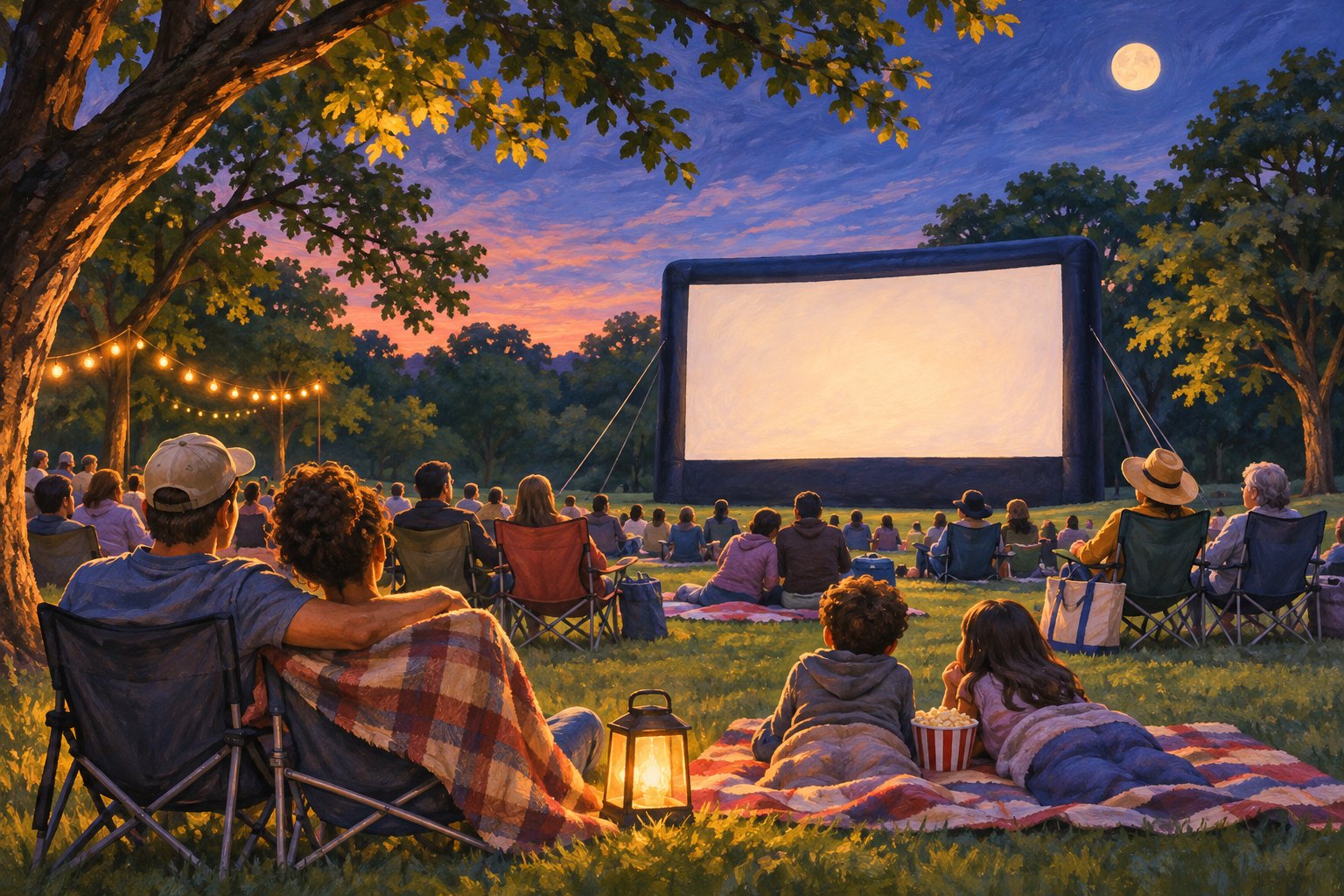
A successful outdoor screening starts with being comfortable enough to pay attention. Subject to the event’s rules, a portable seat, a blanket, and an extra layer are sensible things to consider. Check the forecast close to departure, then think about how sitting still might feel compared with walking from the car.
Choose equipment that is manageable for the whole trip. A comfortable chair becomes less useful if carrying it leaves no free hand for other belongings. Anyone who needs a firm seat or an easier walking route should confirm the available arrangements beforehand rather than relying on an illustration or a previous visit.

Food and drink require a separate check. Do not assume concessions will be available or that every picnic item is permitted. If refreshments are allowed, quiet packaging is a small courtesy with a real payoff: nobody should have to compete with a crackling bag during an important conversation on screen.
A small flashlight can help when leaving, where permitted, but keep its beam aimed at the ground. Once the screening begins, put the phone away. Bright screens pull attention from the movie, especially when everyone nearby is looking toward the same patch of light.
Why a Shared Screening Can Change a Familiar Film
The attraction of Movies by Moonlight is easy to understand even before the feature is confirmed. Watching with a crowd gives a film another rhythm. A joke you barely noticed at home may land differently when someone nearby laughs; a tense pause may feel longer when the people around you become quiet.
My view is that this shared attention is outdoor cinema’s strongest promise. The setting can make a routine viewing feel like an occasion, while the audience can reveal reactions that a solitary watch leaves unexplored. That does not guarantee a better film, but it can produce a more interesting encounter with one.
There is a useful distinction between enjoying an evening and judging the movie that anchors it. Our commentary on whether movie pleasure is enough explores a related question: how do enjoyable moments add up to a satisfying whole? At an outdoor screening, atmosphere becomes another part of that judgment. You can love the occasion while still finding the story uneven.
The reverse is possible, too. A quiet performance might reward more concentration than the surroundings allow. When discussing the film afterward, separate what the movie does from what the viewing conditions made easy or difficult to notice.
Watch the Characters Behind the Biggest Moments
Until the featured movie is verified, assigning it a plot, quoting dialogue, or explaining its ending would be speculation. A character-focused approach, however, can make the eventual screening more rewarding without spoiling anything.
Begin with a simple question: what does the central character want, and what are they unwilling to admit? Those answers often diverge. Someone may ask for recognition while needing reassurance, or insist on independence while fearing rejection. Watch for the decisions that expose that gap rather than accepting every explanation a character gives.
Next, notice who absorbs the consequences. A protagonist’s triumph can look different from the perspective of a friend, parent, rival, or stranger caught in the action. Our character analysis of Dutch and its uneasy family dynamics uses that kind of scrutiny to examine the relationship between affection and winning an argument.
Finally, listen for changes in how characters speak to one another. A memorable line earns its force through context: who says it, who hears it, and what has happened between them. If a line stays with you after the screening, ask whether it expresses genuine change or merely announces a lesson the character has yet to demonstrate.
Let the Conversation Continue After the Credits
The most worthwhile discussion afterward need not start with a score. Ask which character your companions understood best, which choice frustrated them, and whether the ending felt earned. Different answers can uncover the movie’s competing loyalties more effectively than a quick agreement that it was good or bad.
For Sandy Creek Park’s Movies by Moonlight, the deeper appeal lies in that possibility: a public outing can become a shared act of interpretation. The screen gives everyone the same images, but people bring different experiences to them. Confirm the program, prepare for the setting, and leave room for those differences. They may be what makes the evening memorable.
Original content by this site's editorial team. Published: November 25, 2026 at 13:34:08 PST (Los Angeles time)