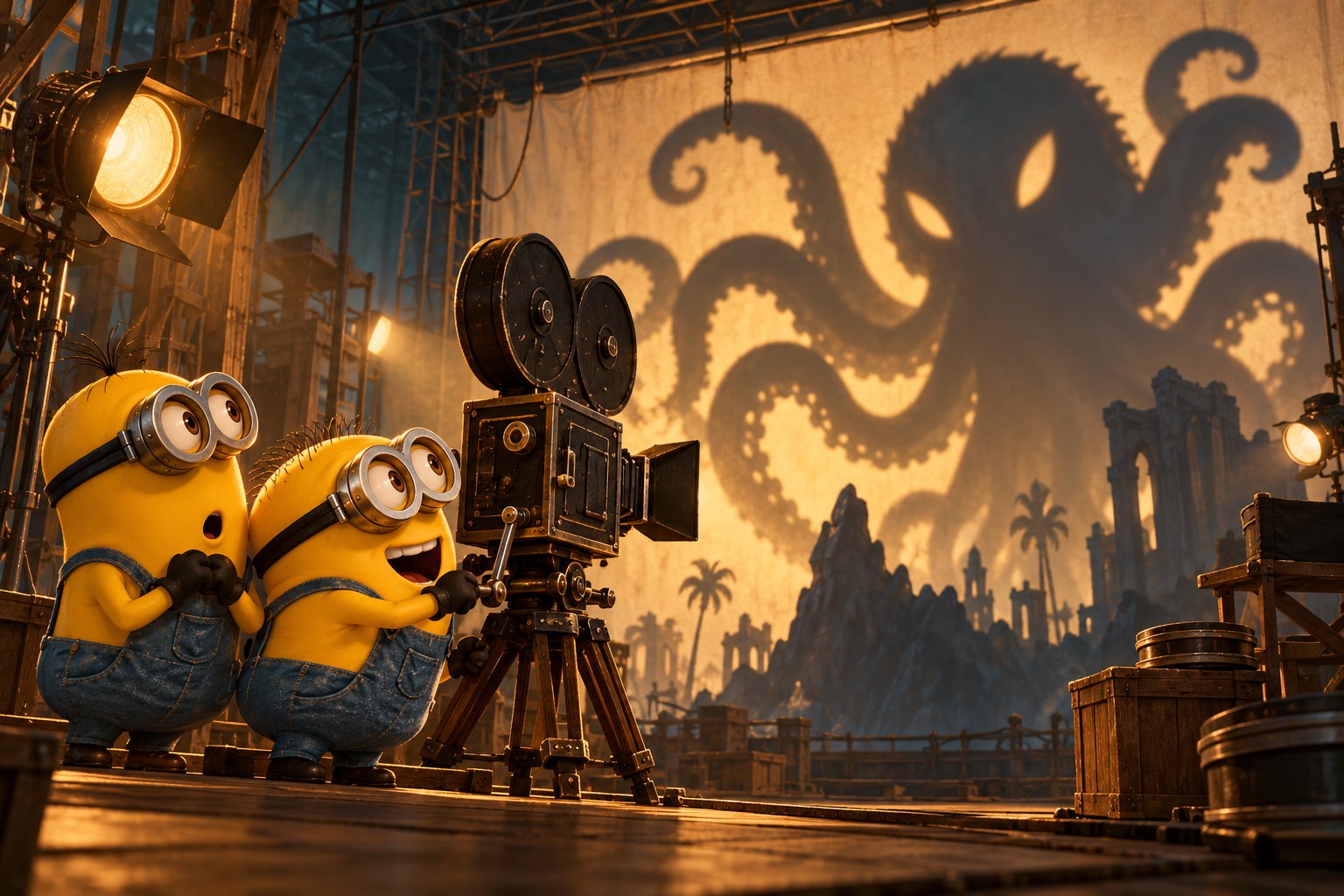
Minions & Monsters gives its yellow troublemakers a particularly fitting ambition: making movies. James and Henry discover a place where their disruptive behavior can become entertainment, then confront the difference between attracting attention and controlling what they create. The most compelling idea here is that finding your audience does not necessarily mean finding your purpose.
Spoiler notice: This story-focused critical reading discusses the Hollywood setup, the monster-making premise, and thematic developments. It draws on verified story information and published accounts rather than a firsthand screening assessment.
Hollywood gives James and Henry a new identity
Illumination’s official synopsis identifies James and Henry as members of a new Minion tribe. After arriving in 1920s Hollywood, the group becomes successful through an accidental appearance on camera. Their fortunes collapse when talking pictures arrive: speaking Minionese becomes a professional disadvantage. James and Henry respond by pursuing their own monster movie. [Illumination’s story synopsis](https://www.illumination.com/movie/minions-monsters/)
That trajectory gives the familiar search for an evil master a useful variation. A master supplies orders and a place in a hierarchy. Filmmaking offers something more complicated: the possibility of deciding what deserves to exist. James and Henry’s ambition therefore changes the central question from whom they should follow to what they might contribute.
The distinction matters because celebrity alone cannot answer it. Being welcomed into an industry may feel like discovering a home, but an employer’s enthusiasm can disappear when its needs change. The Minions’ rise and rejection make that instability unusually easy to understand. Their personalities have not become less expressive; the conditions under which those personalities are valued have changed.
James: the appeal and danger of creative ambition
James’ filmmaking project is interesting because it gives persistence an uncomfortable edge. Making something after rejection can be an act of independence. It can also become an attempt to force the world to reverse its verdict. Those motivations are close enough to coexist, and the monster-movie premise places pressure on the boundary between them.
His dream invites a sympathetic reading: an outsider wants the chance to tell a story. But sympathy does not make every decision in pursuit of that dream sensible. Once real creatures become the proposed solution to a production problem, imagination begins to outrun judgment.
This is where the film’s premise earns more attention than a simple message about following your dreams. A creative goal does not remove obligations to other people. The desire to make an extraordinary film can become a reason to ignore ordinary limits. Our analysis of the human cost of spectacle in The Prestige explores a much darker version of that tension: the work becomes dangerous when everything around it starts looking expendable.
Henry: friendship as an audience of one
Henry makes the story’s ambitions more personal. Published descriptions establish James and Henry as misfits whose friendship precedes their Hollywood success. That order is significant. Their connection does not originate in fame, professional usefulness, or public approval. [Common Sense Media’s story overview](https://www.commonsensemedia.org/movie-reviews/minions-monsters)
Viewed through Henry’s place in the partnership, filmmaking becomes a shared activity as well as an individual dream. Someone has to understand why an idea matters before a paying audience ever sees it. A friend can provide that first recognition.
The emotional question is whether companionship remains valuable when it stops producing results. Hollywood can measure the pair through popularity; friendship needs a different standard. A collaborator deserves consideration even when the project is going badly. That distinction gives the relationship potential weight beyond the familiar reassurance that teamwork helps heroes win.
It also changes how to read the Minions’ communication. Fluency in an industry’s preferred language is not identical to the ability to connect. The characters’ mutual understanding offers a counterpoint to the professional rejection built into the talkies storyline.
Why silent cinema is more than a costume change
The setting connects the Minions to a tradition built around bodies, objects, timing, and visible misunderstanding. Pierre Coffin, who directs and voices the Minions, discussed friendship as a concern in developing this installment; reporting on the production also identifies its engagement with silent-comedy figures including Charlie Chaplin and Harold Lloyd. [Associated Press’s interview with Coffin](https://apnews.com/article/65f236dec8a3798516b306bf161eae95)
There is an appealing contradiction in placing such expressive characters inside a story about their supposed communicative inadequacy. The audience can understand a gesture, an anxious pause, or an enthusiastic mistake while the fictional industry treats their speech as an obstacle. The joke therefore works in two directions: the Minions struggle to adapt, and Hollywood struggles to recognize what they already do well.
Even the tiny exclamation “Fantastico,” noted in the Associated Press review, illustrates how little translation an emotion may need. The similarly brief “vamos” supplies momentum without elaborate explanation. These verbal fragments fit characters whose expressive force comes from delivery and context rather than polished speeches. [Associated Press’s film review](https://apnews.com/article/20f06af5081712ead0ff6658c4206ab4)
When the monster stops being a production solution
The studio’s synopsis confirms that James and Henry use a former master’s spellbook to summon monsters for their film, and that the resulting danger requires the Minions to work together. It is a neat collision between two incompatible assumptions: filmmakers want controllable performances, while monsters bring their own capacity for disruption.

My reading is that the central mistake is treating another being as a missing ingredient. A production needs something frightening, so something frightening is acquired. The danger exposes what that practical calculation leaves out: having a use for a creature does not mean understanding it.
This makes responsibility the necessary companion to creativity. Repairing the consequences of an idea matters as much as having the idea. The strongest thematic interpretation of the monster crisis is therefore a change in attention—from the movie the characters want to make to the world their decisions affect.
That is also a useful standard for judging spectacle. Bigger destruction can increase scale without increasing emotional meaning. The revealing question is what the crisis demands of the friendship. Our commentary on the difference between immediate success and lasting movie appeal considers why attention and attachment are separate achievements.
Classic-film references worth watching for
Published accounts identify references to Buster Keaton and Citizen Kane, alongside the film’s old-fashioned Universal opening. These are useful viewing cues, although recognizing a reference is not a requirement for understanding James and Henry’s story.
The more rewarding approach is to ask what a reference contributes. Does it make a movement funnier, reveal a character’s self-image, or connect their predicament to another kind of screen performance? An allusion becomes more than decoration when the borrowed cinematic language does fresh work.
The deeper question: who are you creating for?
The premise’s strongest achievement is to make creative independence inseparable from connection. James and Henry want something beyond service to a master, yet making a movie still involves other people, shared risks, and consequences that cannot be edited away.
That gives Minions & Monsters a meaningful interpretive center beneath its comic catastrophe. Recognition may open a door, but it cannot tell the characters how to treat one another once they enter. Their most consequential production is the relationship that allows them to imagine, fail, and take responsibility together.
Original content by this site's editorial team. Published: October 20, 2026 at 22:47:34 PDT (Los Angeles time)