Elizabeth Holmes can inspire sympathy and still face difficult questions about her credibility. That is the tension sharpened by Theranos whistleblower Tyler Shultz’s response to You Can See Everything. His accusation that she is “still lying,” highlighted by the Los Angeles Times, challenges viewers to examine what a documentary’s emotional intimacy actually establishes.
The distinction matters because another reported reaction from Shultz sounds, at first, very different. CBS News describes him saying Holmes looks like “a broken woman.” Those observations can coexist. One concerns his impression of her condition; the other concerns his assessment of her honesty. Treating either as an answer to the other would flatten the most consequential question in this debate.
This is spoiler-light critical commentary on the reported dispute surrounding the documentary. The quoted phrases are attributed public reactions, not verified dialogue from the film.
The whistleblower’s perspective changes the question
A viewer approaching a documentary about a controversial person may ask whether it reveals an unfamiliar side of its subject. A whistleblower has a different reason to pay attention: whether the account makes disputed claims easier to evaluate. Those interests overlap, but they do not always lead to the same judgment.
Shultz’s challenge matters because it shifts attention from Holmes’s ability to hold an audience to the audience’s grounds for believing her. Someone can be fascinating on camera without becoming a reliable narrator. Equally, an unflattering presentation does not automatically prove that a particular statement is false. Charisma and discomfort both require interpretation.
His allegation deserves clear attribution. “Still lying” is Shultz’s accusation, and readers should understand it as such. It is also a claim that invites specific examination: which statement is disputed, what evidence bears on it, and whether the competing accounts can be reconciled. Repeating the accusation more forcefully cannot substitute for answering those questions.
My critical judgment is that this is the most useful contribution a whistleblower’s perspective can make to the conversation. It asks viewers to move from an overall impression of a person toward judgments about individual claims. That movement can make a documentary less emotionally tidy and more intellectually valuable.
Holmes: vulnerability and credibility are separate judgments
The phrase “a broken woman” has immediate emotional force. It encourages an audience to consider suffering, diminished confidence, or the distance between someone’s public image and present appearance. But it remains an observer’s characterization. It cannot establish an internal psychological state, much less resolve questions about truthfulness.
For a character-centered reading, Holmes presents an especially difficult interpretive problem because audiences may arrive with a settled opinion. Some may interpret any vulnerability as calculated. Others may experience sympathy as a reason to reconsider everything they previously believed. Both responses allow an emotional conclusion to get ahead of the evidence.
A more demanding response leaves room for compassion while assessing statements independently. Pain does not have to be fabricated to influence an audience. A moment can be emotionally sincere while offering little help with the factual question under discussion. Recognizing that distinction preserves the subject’s humanity without making suffering a credential.
This is where documentary criticism needs more precision than a simple question about whether Holmes comes across well or badly. A revealing portrait may complicate our feelings. Its factual arguments still need their own support. The value of emotional complexity lies in helping us understand a person more fully, rather than making verification feel unnecessary.
What the camera can show—and what remains to be established
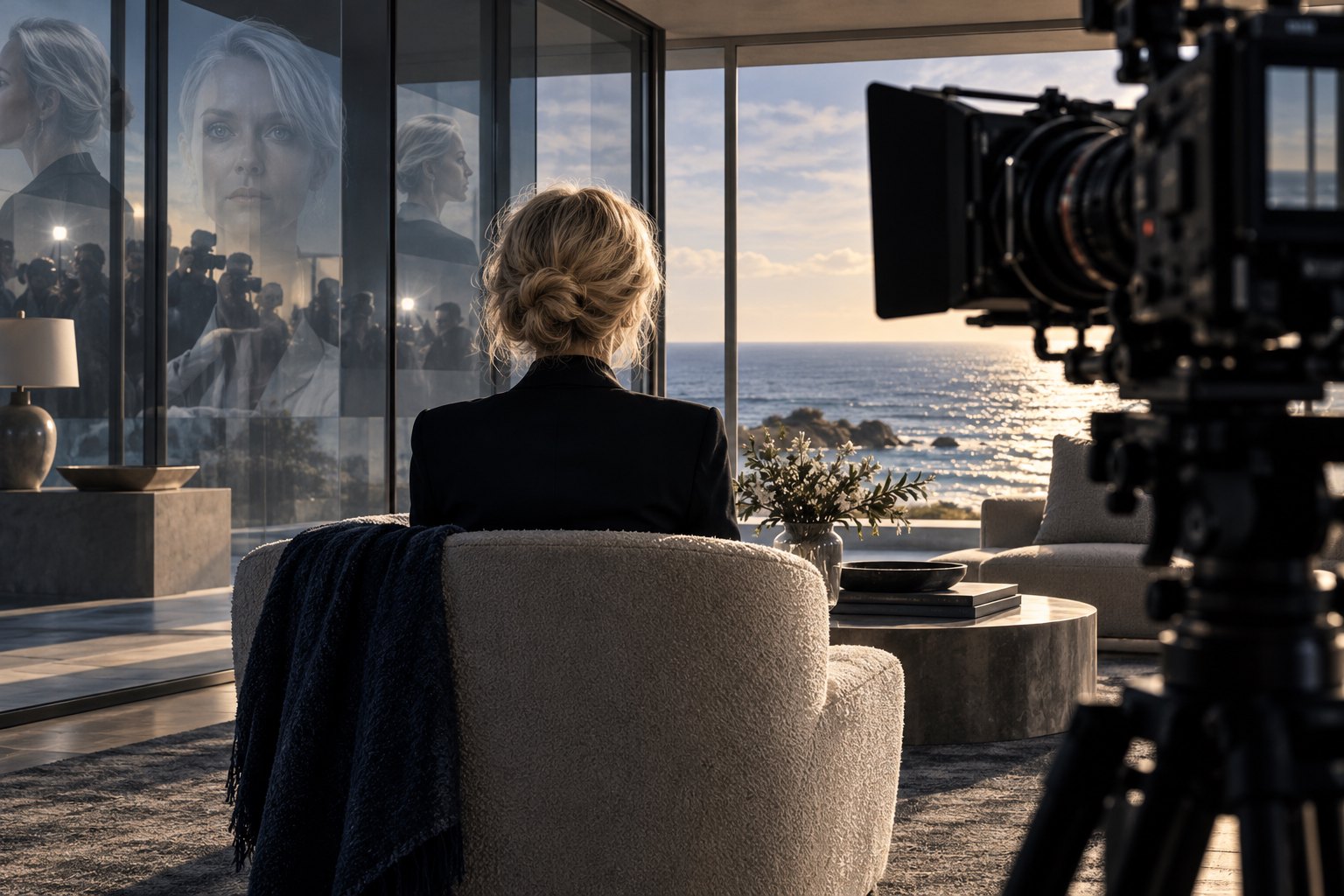
The title You Can See Everything makes an unusually expansive promise when considered literally. Every camera has a position. Every recorded encounter has a beginning and an end. Every finished film organizes a larger body of material into a sequence that directs attention.
Those ordinary conditions of filmmaking do not establish deception. They explain why visible detail and complete knowledge are different things. A close view can reveal an expression, a hesitation, or a change in tone. Understanding what caused that behavior often requires information beyond the image.

Our earlier discussion of who controls the story in the Elizabeth Holmes documentary considers the broader problem of narrative authority. Shultz’s response brings a narrower test into focus: when an account becomes persuasive, what makes it persuasive? The answer might involve corroboration, personal identification, dramatic structure, or some combination of all three.
My view is that documentary criticism should identify those mechanisms separately. A film can make an audience feel close to its subject through duration and attention. Whether that closeness produces justified confidence is a further question. The feeling of having witnessed something can be powerful even when the meaning of what was witnessed remains unsettled.
How to evaluate the dispute while watching
Viewers do not need to choose between accepting every accusation and dismissing criticism as hostility. A few concrete distinctions make the debate easier to assess:
- Identify the claim. Separate statements about events from impressions of personality. An assertion about what happened can be checked differently from an observation that someone seems remorseful.
- Identify the support. Ask whether confidence comes from corroborating material, the speaker’s demeanor, or the emotional placement of a moment.
- Identify the remaining uncertainty. A question left open can be artistically effective. Consider whether the uncertainty reflects genuinely conflicting evidence or information the film has not established.
- Reconsider the emotional conclusion. Notice whether sympathy, irritation, amusement, or discomfort has changed your assessment of a factual claim without adding evidence.
These distinctions also help avoid an unfair expectation: a documentary does not have to answer every possible question to deserve attention. It does, however, invite scrutiny of the conclusions its selection and arrangement encourage. The stronger the impression of revelation, the more useful it becomes to ask exactly what has been revealed.
The deeper issue is the audience’s desire for resolution
The debate around Holmes offers several tempting endings. A viewer might want a decisive exposure, an unexpected rehabilitation, or a moment of vulnerability that finally makes a difficult person understandable. Each supplies emotional closure. None is automatically the most accurate account.
There is a useful parallel with our analysis of attention and revelation in The Prestige: watching closely and interpreting correctly are separate activities. In nonfiction, the distinction carries an additional responsibility because the people being interpreted exist beyond the story’s ending.
The most productive reading of Shultz’s challenge is therefore an invitation to tolerate an unresolved emotional response while demanding precision about facts. Holmes may appear vulnerable to a viewer who remains unconvinced by her account. Shultz may express concern about her appearance while continuing to dispute her credibility. Neither position is inherently contradictory.
For me, the essential critical question surrounding You Can See Everything is whether the experience of seeing encourages further examination or creates a premature sense of certainty. A camera can bring us close enough to feel that we know someone. Responsible viewing begins with asking what, exactly, that closeness has taught us.
Original content by this site's editorial team. Published: October 20, 2026 at 23:59:38 PDT (Los Angeles time)