Francisco C.M.’s Lightning Rod Lighthouse is the Grand Prize winner of the Minecraft Movie Build Challenge. Minecraft’s announcement also names Copper Badlands Castle by Rosanna C. and Tranquil Taiga Tower by Iola Y. as finalists, with Ben V.’s Tree Village receiving an honorable mention. All four builds are slated for inclusion in A Minecraft Movie Squared or its end credits; their exact placement remains undisclosed. [Minecraft’s official winner announcement](https://www.minecraft.net/en-us/article/minecraft-movie-build-challenge-winner-announcement)
For moviegoers, that distinction matters. Recognition in the credits and a building that characters actually inhabit offer different experiences. Either can celebrate a creator, but only the finished film will reveal whether these contributions become part of its storytelling.
The announcement also invites a useful reconsideration of A Minecraft Movie. Beneath the noisy comedy sits an appealing idea: making something can change how a person sees themselves. My judgment is that the film communicates that idea more convincingly through Henry’s curiosity than through its biggest jokes.
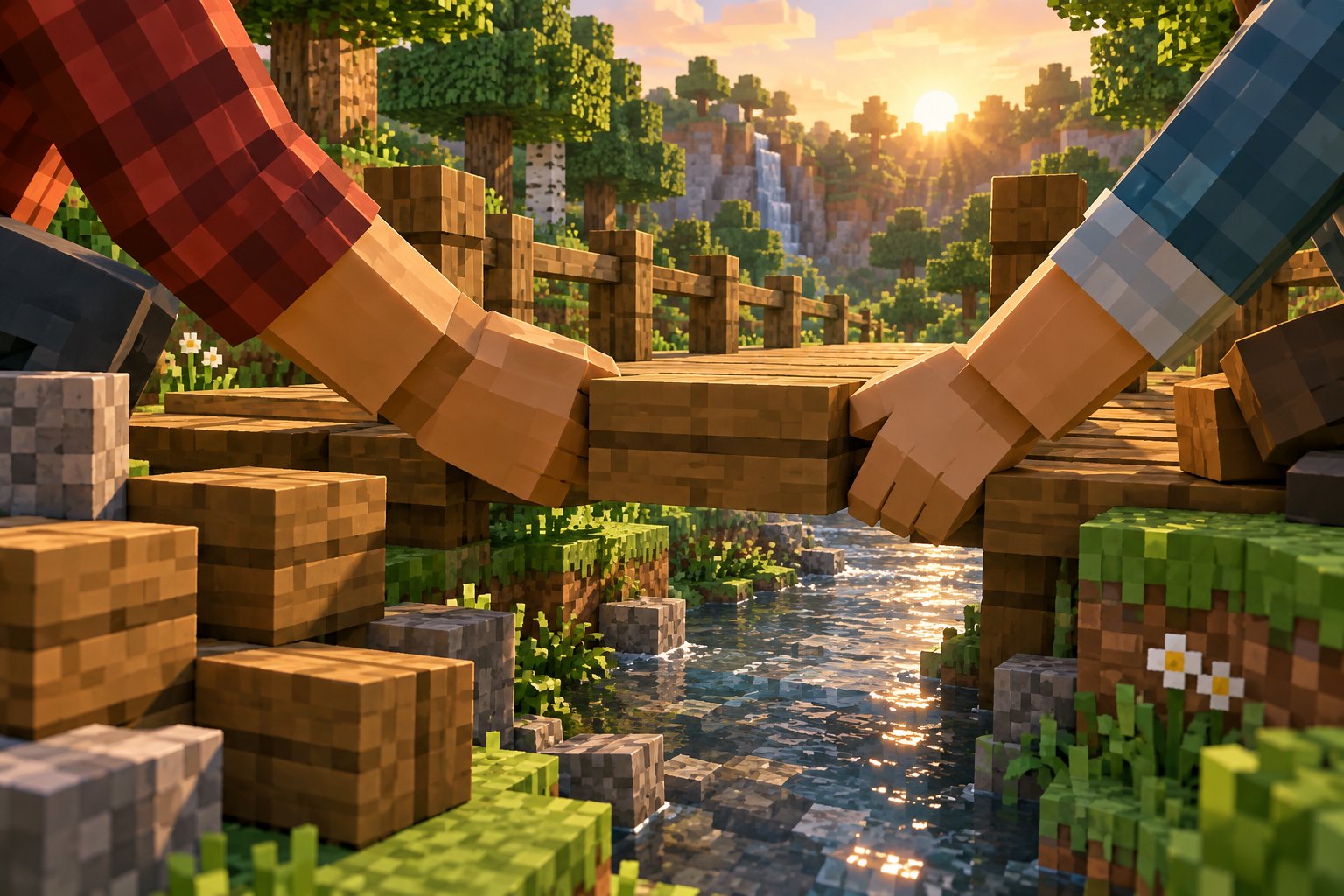
Spoiler notice: The following review discusses character development and the ending of the first film. The accompanying artwork consists of conceptual illustrations, not contest submissions or movie stills.
What the winner announcement actually promises
The winning lighthouse is described as a tundra-inspired home on an icy foundation. Its appeal, according to the announcement, includes its use of materials and attention to detail. The organizers also acknowledge an eligibility oversight: Tree Village combined blocks from multiple biomes, removing it from Grand Prize consideration. Tranquil Taiga Tower entered the final roster, while Tree Village retained recognition through its honorable mention.
That correction should remain separate from any judgment about the buildings’ artistic merits. Eligibility determines whether a submission meets a contest’s conditions; visual invention asks what its creator accomplished within a particular design. One does not automatically settle the other.
From a film perspective, the interesting question is how an individual design survives translation into a larger production. A memorable silhouette may be readable in a passing shot. A distinctive entrance might suggest an inhabitant’s personality. But those are possible cinematic uses, not announced scenes.
Henry makes the case for a world worth building
Directed by Jared Hess, A Minecraft Movie follows Henry, Natalie, Garrett and Dawn into the Overworld, where Steve becomes their guide. Its central adventure requires the newcomers to learn how this unfamiliar environment works while trying to return home. [The film’s official synopsis](https://www.minecraft-movie.net/synopsis/)
Henry provides the clearest emotional route into that premise. His experimentation gets him into trouble at school; in the Overworld, his ability to manipulate blocks helps protect the group. The change is more interesting than a simple upgrade from ordinary kid to action hero. The same impulse acquires a different value depending on who recognizes it and what circumstances demand.
For me, this is the film’s strongest connection to the build challenge. An entry begins with someone deciding that an arrangement of familiar materials could become something particular. Henry’s appeal likewise comes from possibility becoming action. He gives the audience a reason to care about crafting beyond the pleasure of identifying a game mechanic.
The weakness is how quickly the movie often moves past that process. Discovery needs a little room: time to notice a problem, imagine a solution and understand why an experiment succeeds. When the pace rushes toward the next gag, creativity can feel like another special effect. Henry is most compelling when his thinking remains visible.
Steve’s enthusiasm works best when it makes room for someone else
Jack Black’s Steve approaches the Overworld with expansive enthusiasm. That energy is useful: a guide to an impossible place should make discovery feel inviting. His theatrical certainty also supplies much of the comedy.
The exclamation “Chicken jockey!” captures the attraction and limitation of that approach. Recognition becomes a performance, with the name itself carrying much of the joke. Later, “First we mine, then we craft” turns a practical sequence into a rallying cry. [The film’s dialogue](https://en.wikiquote.org/wiki/A_Minecraft_Movie)
I find these moments amusing in bursts. Sustained at the same volume, however, the approach leaves less space for surprise. If everything receives an emphatic announcement, the audience has fewer opportunities to discover something independently.
Steve becomes more valuable as a character when his expertise helps another person participate. A knowledgeable guide can demonstrate mastery; a generous guide makes mastery seem attainable. That distinction gives the build challenge its strongest thematic connection to the movie. The pleasure lies in seeing what another builder brings to a shared set of possibilities.
Garrett’s swagger exposes the limits of winning
Garrett, played by Jason Momoa, brings a different relationship to accomplishment. A former gaming champion with a struggling store, he measures himself against earlier success. His interest in Steve’s diamonds also pulls attention away from the group’s immediate needs. Those details establish an effective contrast with Henry’s curiosity. [Character and plot reference](https://en.wikipedia.org/wiki/A_Minecraft_Movie)
Momoa’s oversized swagger makes Garrett an obvious comic target, but there is a useful emotional contradiction underneath it. He wants the authority of an expert while resisting the vulnerability of being a beginner. In an unfamiliar world, that becomes an obstacle.
Read alongside the contest announcement, Garrett suggests why a prize cannot be the only meaningful outcome of making something. Winning identifies an achievement. It cannot supply an enduring creative identity all by itself. The film is more persuasive when competence becomes something characters share than when it becomes another occasion for boasting.
That emphasis connects with our discussion of the relationships that give franchise spectacle emotional weight. Recognition gets viewers through the door; character interaction determines what stays with them.
Buildings need a purpose beyond looking familiar
My main reservation about A Minecraft Movie is that its imagination sometimes feels more abundant in the surroundings than in the dramatic situations. The familiar quest structure supplies momentum, but it can reduce an unusually flexible world to a route between action sequences.
A building offers an opportunity to resist that flattening. Where is its entrance? What can someone see from its upper floor? Does its layout encourage cooperation or leave someone isolated? These are practical questions that can turn architecture into drama.
The same principle appears in our analysis of how locations become meaningful screen geography. A setting gains force when it affects what characters can do. For the challenge’s selected creations, that would be an especially satisfying form of recognition, although the announcement does not promise it.
The deeper meaning: creativity must survive the trip home
The first film’s most worthwhile idea is that creative confidence should travel beyond a welcoming fantasy environment. An extraordinary world can reveal a person’s abilities, but the more difficult achievement is continuing to use them amid ordinary frustrations.
That is why Henry supplies the most useful lens for this announcement. A finished build records choices: what to attempt, what to revise, and when an imperfect idea is worth pursuing. Its significance begins before anyone awards it a prize.
A Minecraft Movie is, in my view, an uneven comedy with a more affecting creative premise than its loudest moments suggest. The build challenge gives that premise a tangible expression. The next film’s opportunity is to let these individual contributions retain some personality within the larger spectacle—enough that viewers notice a place someone imagined, rather than simply another object they recognize.
Original content by this site's editorial team. Published: October 6, 2026 at 10:50:20 PDT (Los Angeles time)