New York’s inaugural Muslim film festival has unveiled its lineup and jury, with an ambition that gives the announcement significance beyond the usual festival reveal: moving past counter-narratives. As described in Variety’s reporting, that ambition invites a discussion about the freedom Muslim filmmakers have to determine what their stories are about—and whom those stories address.
The most compelling possibility is artistic. A character should be able to want something, make a mistake, misunderstand another person, or change direction without every action becoming an argument about an entire community. For this festival, moving beyond rebuttal could mean creating room for precisely that kind of complexity.
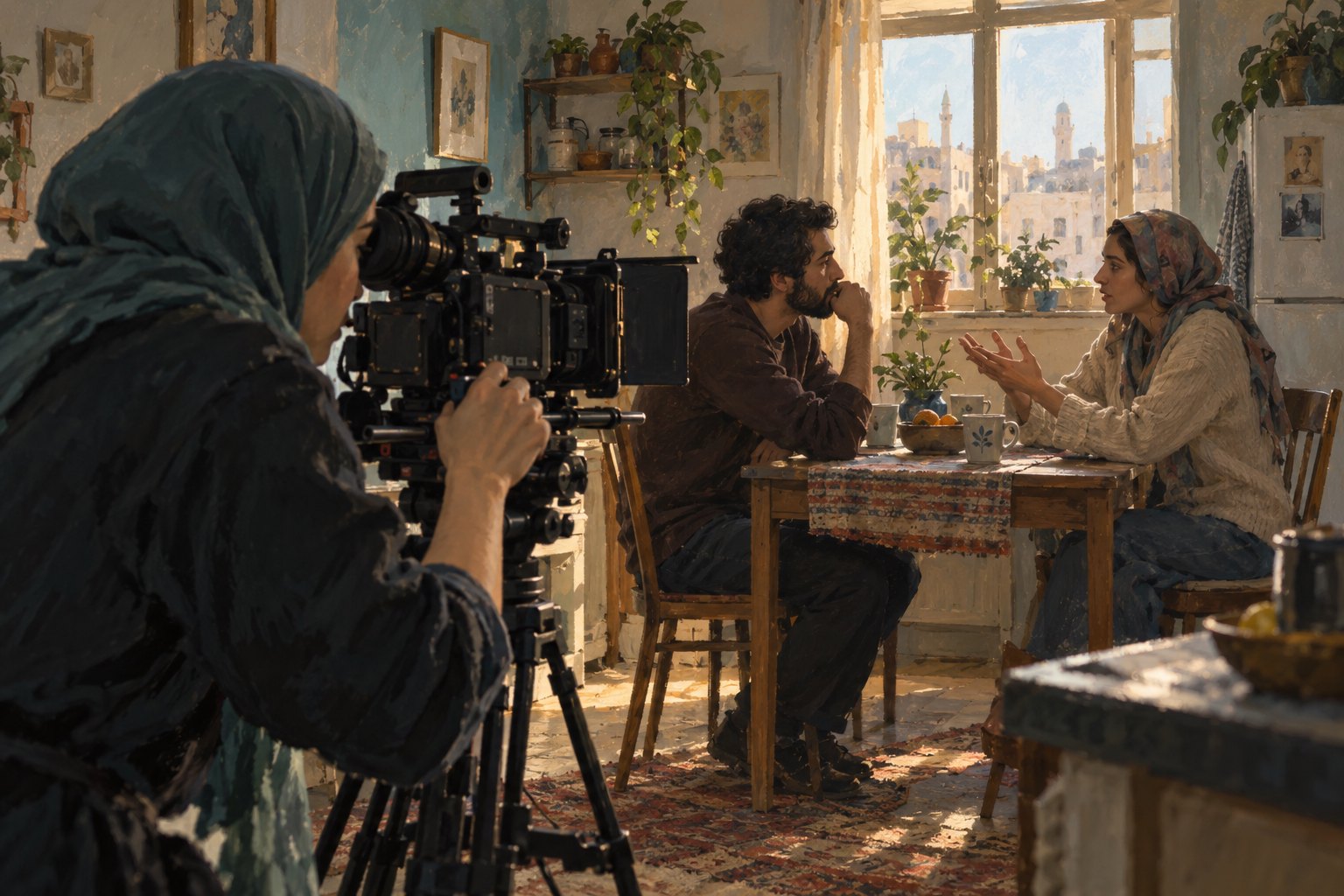
This is a spoiler-free examination of the festival’s announced direction, not a review of its selected films. The accompanying illustrations are conceptual scenes, not images of the event or its program.
What moving beyond counter-narratives could mean
A counter-narrative answers an existing story. In discussions of representation, it often challenges a reductive portrayal by introducing experiences and perspectives that portrayal excludes. Such work can be powerful. A film that confronts prejudice directly may have urgent political purpose, emotional force, and considerable formal invention.
But rebuttal also carries a creative constraint: the original accusation can continue setting the agenda. A filmmaker may feel pushed to demonstrate innocence, explain a religious practice, or make a protagonist especially admirable before allowing the story to become difficult. The imagined skeptical viewer remains present in the room, even when the film wants to look elsewhere.
My reading of the festival’s stated ambition is that it opens a more expansive possibility. Muslim lives can supply the starting assumptions of a story. A film can trust its characters’ world to be worth entering without first defending its existence. Faith might organize every decision, sit quietly inside a daily routine, or become the subject of disagreement. None of those approaches should be compulsory.
This distinction also protects explicitly political filmmaking. Moving beyond counter-narratives should not become another rule demanding that artists avoid discrimination, conflict, or public controversy. Creative freedom includes the decision to confront those subjects, as well as the decision to make something else.
Character perspective is where the ambition becomes visible
For viewers, the clearest test is to follow a character’s attention. What does this person notice? What do they overlook? Which relationship matters enough to make them act against their better judgment? Those questions help distinguish a fully imagined protagonist from a figure whose main function is to deliver an explanation.
Consider a hypothetical family disagreement. A scene built primarily for an outsider might pause to define every custom before the argument can proceed. A scene rooted in the participants’ perspectives could instead let an unfinished sentence, a withheld answer, or a familiar gesture carry the tension. The audience learns through the relationship. Neither approach is automatically superior; the question is whether the explanation serves the drama.
Specificity matters here. Calling a character a representative of Muslim experience can erase the very distinctions that make the performance interesting. Age, temperament, money, place, family history, and personal conviction can shape competing desires. Two characters who share a faith need not share an interpretation of the same event.
That emphasis on relationships also informs our examination of performance and connection in AI-hybrid filmmaking: a production’s defining premise cannot substitute for believable interaction. Here, too, the decisive evidence will be the work onscreen—how actors listen, how scenes develop, and how choices accumulate consequences.
A lineup can create room for disagreement
The announcement of a lineup makes the festival’s ambition concrete, but an announced program alone cannot establish how successfully the films realize it. That judgment requires watching them individually and considering how they work together. A mission statement offers a useful question to bring into a screening; it does not supply the answer.
One productive way to assess the selection will be to look for differences in sensibility. Do the films invite distinct kinds of attention? Does one depend on restraint while another embraces excess? Can contrasting understandings of family, obligation, or belonging coexist without being forced into a single message?
These are criteria for evaluating the program, not claims about its contents. Their value is that they allow a festival to be more than a collection of statements agreeing with its introduction. A strong selection can complicate the very language used to promote it.
The same principle applies to accessibility. Some films welcome viewers through familiar dramatic structures. Others ask audiences to tolerate uncertainty or unfamiliar rhythms. An inclusive platform need not require every artist to make an immediately legible film. Part of the pleasure of a festival is discovering a way of seeing that takes time to understand.
What the jury can recognize—and what audiences should ask
The jury announcement introduces a second question: which artistic qualities will receive recognition? Whatever a festival’s cultural purpose, its awards can encourage viewers to look closely at particular achievements. An incisive performance, an expressive use of offscreen sound, or an ending that changes the meaning of an earlier scene deserves specific discussion.
That specificity is essential to useful criticism. Praising a film only for offering visibility tells readers little about the experience of watching it. Equally, declaring a character a positive or negative image can collapse a complicated dramatic construction into a public-relations judgment.
Our commentary on festival recognition for Flesh and Fuel considers a related distinction between an award’s attention and a film’s artistic achievement. Recognition can start a conversation; criticism should explain what the work does to earn, challenge, or exceed that attention.
For this festival, three viewing questions offer a practical starting point:
- Whose perspective shapes the scene? Notice whose knowledge the film shares and whose uncertainty it preserves.
- What makes the character particular? Look for desires, contradictions, and relationships that cannot be reduced to a broad identity label.
- How does the filmmaking express that perspective? Consider framing, editing, sound, duration, and performance alongside the subject matter.
The deeper promise: freedom from being exemplary
The most interesting implication of moving beyond counter-narratives is permission for characters to be difficult. A protagonist might be funny and vain, loving and unreliable, devout and uncertain. Such contradictions do not automatically make a portrayal perceptive; they still need convincing dramatic development. But excluding them in the name of favorable representation would narrow the possibilities before the filmmaking begins.
New York’s inaugural Muslim film festival has put an important artistic proposition into circulation. Its promise will be tested through the specificity of the films and the quality of the conversations they generate. The strongest outcome would be an audience leaving with distinct characters, images, and unresolved questions in mind—enough individual experiences that no single story is expected to speak for everyone.
Original content by this site's editorial team. Published: October 6, 2026 at 11:27:49 PDT (Los Angeles time)