
Mike Leigh has said he has made his last film. The Guardian’s interview frames that decision against 55 years of filmmaking and his blunt resistance to suggestions that he should continue. For viewers who value his work, the temptation is to ask for another movie. A more rewarding response is to look closely at what he has already given us.
Secrets & Lies, his 1996 family drama, makes an especially revealing companion to that news. Its characters repeatedly confuse loving someone with knowing what that person needs. Watching them struggle offers a useful perspective on the impulse to tell an artist when he should keep working.
Spoilers follow for Secrets & Lies, including its family revelations and ending. This is a retrospective of that film, not a review of Leigh’s final production.
Hortense wants answers, but she also wants a relationship
Hortense, played by Marianne Jean-Baptiste, is a Black optometrist who searches for her birth mother after her adoptive mother’s death. Her search leads to Cynthia, a white factory worker played by Brenda Blethyn. Cynthia already lives with another daughter, Roxanne, whose relationship with her is strained. The film’s premise and central cast are documented by [Janus Films](https://www.janusfilms.com/films/2070).
The discovery could have powered a movie built around a single sensational revelation. Leigh instead makes it the beginning of an awkward negotiation. Finding Cynthia answers a question about identity; it does not establish how these women should speak, what they owe each other, or how quickly affection can develop.
Jean-Baptiste’s performance is the film’s steadying force. Hortense listens carefully, but listening does not make her passive. She initiates contact and keeps moving toward an encounter that could hurt her. Her composure is particularly affecting because the story gives her so little control over the response she receives.
To my eye, this is one of Leigh’s strongest distinctions: emotional restraint can contain as much dramatic activity as an outburst. Hortense is continually deciding whether to wait, press forward, or let an uncomfortable moment pass. The viewer has to pay attention to those decisions.
Cynthia’s chatter keeps loneliness at a distance
Blethyn makes Cynthia exhausting and vulnerable at the same time. Her conversation reaches urgently toward other people, while her distress can make genuine exchange difficult. She wants reassurance so badly that she sometimes leaves little space for anyone else’s feelings.
When Cynthia and Hortense meet, Cynthia initially cannot reconcile the woman before her with the child she gave up. Their encounter turns an apparently settled fact into an emotional experience neither can manage neatly. The scene’s power comes from the time it allows confusion, embarrassment, and recognition to occupy the same space.
There is a risk in describing Cynthia only as lonely: it can turn every hurtful action into something the audience must forgive. Leigh’s drama is more demanding. Understanding her hunger for affection does not require Roxanne to stop finding her difficult. Nor does it make Hortense responsible for repairing her life.
This is where the retrospective connects most directly with Leigh’s decision to stop. Affection can become intrusive when it refuses to hear a boundary. The connection is an interpretation, not a claim that Cynthia represents her creator. His film simply gives us unusually good practice at noticing the difference between concern and insistence.
Roxanne changes the meaning of the reunion
For Hortense, meeting Cynthia opens a door. For Roxanne, discovering that she has a sister unsettles the family history she thought she understood. Leigh keeps both experiences in view. A development that feels hopeful to one person can arrive as a betrayal to another.
Claire Rushbrook’s Roxanne matters because she prevents the central reunion from becoming too comfortable. Cynthia’s newfound tenderness exists alongside the friction of the relationship already in her home. It is easier to imagine a fresh beginning than to change an established pattern of irritation.
The film consequently asks a harder question than whether mother and daughter will accept each other. Can a family accommodate a new relationship without treating its existing members as obstacles? That question makes the later gathering feel dangerous before anyone raises a voice.
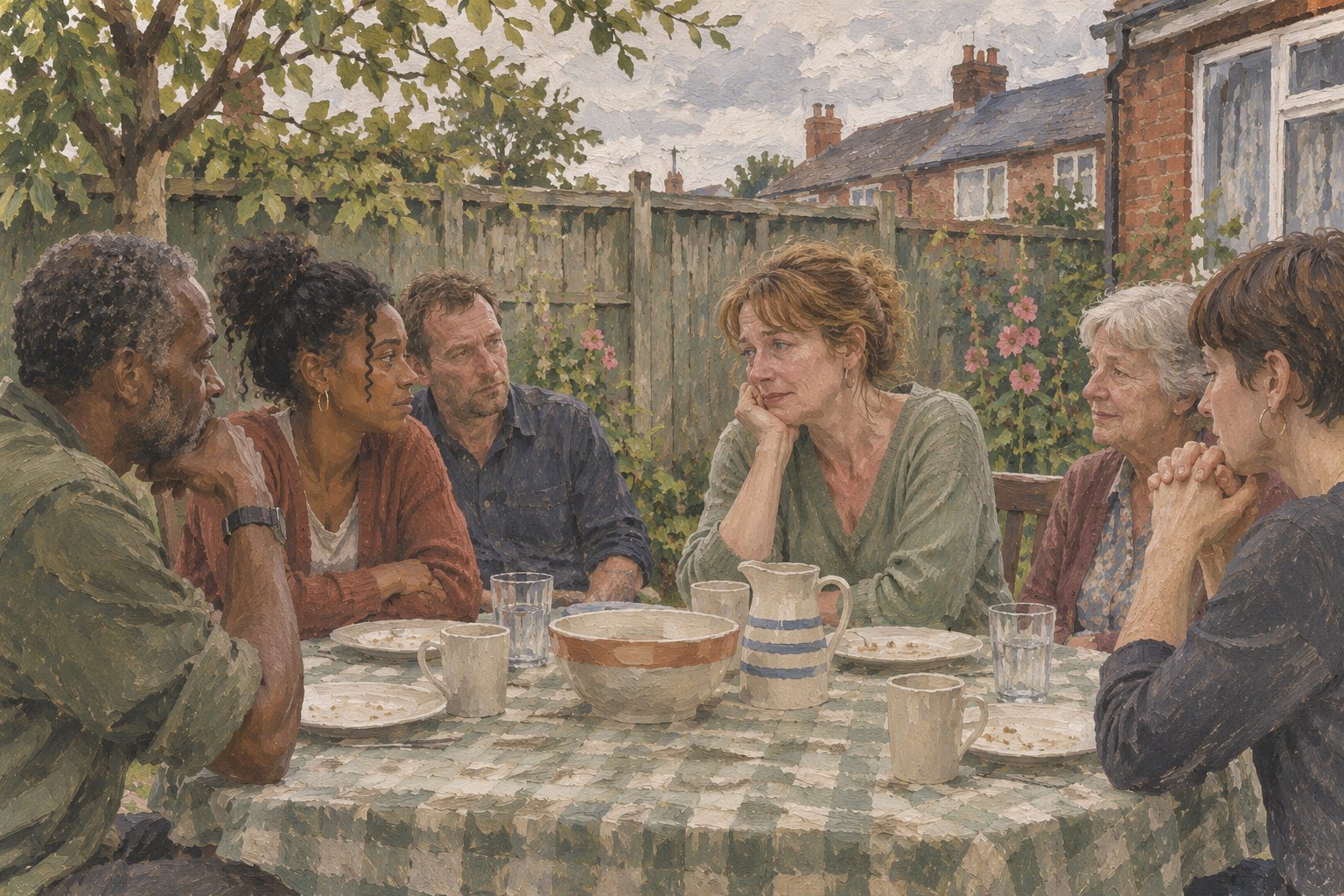
Maurice can arrange a photograph, but not a happy family
Cynthia’s brother Maurice, played by Timothy Spall, is a photographer. He and his wife Monica host the barbecue for Roxanne’s twenty-first birthday where the family’s tensions come to a head. Film4’s [production synopsis](https://www.film4productions.com/productions/1996/secrets-and-lies) establishes that gathering as the collision point for the intertwined stories.
Maurice’s profession gives his role an expressive irony. A photograph can preserve the appearance of togetherness. A family has to endure whatever happens after everyone stops smiling. His efforts to keep people happy leave him caught between people whose grievances cannot be resolved through pleasantness.
His cry, “We’re all in pain!”, briefly removes the distinctions everyone has been defending. Then comes the more difficult question: “Why can’t we share our pain?” These lines matter because Spall makes them sound like the failure of a coping strategy, not a polished statement of the movie’s theme.
Still, sharing pain does not make its distribution equal. Hortense has entered this family without creating its resentments. Roxanne has not chosen the timing of the revelation. Maurice’s appeal is moving partly because it is insufficient: a necessary beginning, with no guarantee attached.
Readers drawn to that uneasy relationship between kindness and obligation may also appreciate our analysis of hospitality in Planes, Trains and Automobiles. Both films make room for compassion without pretending that other people become easy company.
Where the film’s compassion becomes uncomfortable
My reservation about Secrets & Lies is closely related to its strength. Hortense’s patience allows the family drama to unfold, but it can also make her seem burdened with everyone else’s emotional development. The question is not whether she should be less generous. It is whether the film gives her needs the same force it gives Cynthia’s distress.
That tension deserves attention, particularly because race is integral to the initial encounter. The pleasure of seeing a family move toward acceptance should not make us overlook how much composure the newcomer supplies. Jean-Baptiste keeps Hortense from becoming merely a reassuring presence, even when the surrounding drama threatens to pull attention away from her.
The ending nevertheless earns its warmth for me because it offers the possibility of ordinary companionship. A revelation has changed what these people know. What they do with that knowledge remains a daily responsibility. Our reading of memory and second chances in Eternal Sunshine of the Spotless Mind explores a related problem: understanding a relationship’s failures does not automatically prevent their return.
What Leigh’s farewell asks of an audience
The deeper achievement of Secrets & Lies is its refusal to make recognition effortless. People have to revise explanations that once protected them. Viewers have to revise judgments formed from a voice, a room, a profession, or an uncomfortable first impression.
That is a substantial legacy to leave behind. Leigh’s decision to stop need not turn every earlier film into a farewell message. This one retains its own subject: the difficult, imperfect work of allowing another person to become more complicated than the role we assigned them.
Its relevance to the present moment lies there. We can wish for more films while accepting that the filmmaker gets to decide. Returning to his work with renewed attention is a form of appreciation that asks nothing further of him.
Original content by this site's editorial team. Published: November 28, 2026 at 12:31:17 PST (Los Angeles time)