Making a film about Iran raises a question that reaches beyond the politics depicted on screen: who has the power to turn someone else’s life into a story? A director chooses where we look, an editor determines how long we listen, and an audience decides whose behavior deserves sympathy. Those decisions can expose unequal power. They can also reproduce it.
TIME’s headline, What Making a Film About Iran Taught Me About Power, brings that relationship into focus. Its premise invites a useful distinction between what filmmakers learn through production and what viewers can establish from a finished film. A personal account may illuminate artistic intentions; a review must examine how those intentions become character, action, sound, and image.
This is spoiler-free critical commentary, rather than a review of an identified film. Without a verified film title and account of its contents, assigning characters, quoting dialogue, or explaining an ending would substitute invention for criticism. The question of power nevertheless deserves close attention—particularly because it shapes how we approach an unfamiliar story before its first scene begins.
Start With a Person’s Choices, Not a Country’s Symbolism
A film about Iran should not have to make every character represent Iran. That burden can flatten a person before we understand what they want. A daughter becomes a symbol of change; a father becomes an emblem of authority; a disagreement becomes an explanation of an entire society. Such readings may eventually prove persuasive, but they need to emerge from dramatic evidence.
A more revealing starting point is practical: what can this person do, and what would each choice cost? Power becomes legible when one character can leave a conversation while another must remain, or when one person can make a mistake that someone else will have to absorb. These are analytical possibilities, not descriptions of scenes from the unidentified film.
Character-centered criticism also separates desire from freedom. Someone may know exactly what they want while lacking the means to pursue it. Conversely, a character with considerable authority may describe every harmful decision as unavoidable. The interesting dramatic question is whether the film lets us see the alternatives that the character refuses to acknowledge.
Our discussion of listening for the character behind the star approaches a related critical problem: attention should ultimately return to the person within the story. Here, that means resisting the temptation to let a national label explain every gesture.
The Camera Distributes Attention—and Credibility
Point of view is more than the identity of the protagonist. It determines whose uncertainty we experience and whose behavior we observe from a distance. When a film stays close to one character, their suspicions can begin to feel like facts. When another character appears only through brief reactions, their motives may seem simpler than they are.
That imbalance is not automatically a flaw. Restricted perspective can make a story tense, intimate, or deliberately unsettling. The question is whether the film understands the limits of its own viewpoint. Does it leave room for the possibility that its central character has misunderstood someone? Does another person’s response complicate the account we have accepted?
For a film concerned with Iran and power, these formal decisions deserve as much attention as overt political statements. An argument delivered in dialogue tells us what someone believes. A reaction held on screen can show who must live with that belief. In my view, the latter often provides the stronger basis for criticism because it connects an idea to a relationship.
Editing Can Clarify a Conflict or Manufacture Certainty
Editing gives a filmmaker enormous interpretive authority. Place a reaction after a statement and viewers will tend to connect them. Remove a hesitation and a speaker may appear more assured. End an exchange before a response and one person effectively receives the final word.
In fiction, these choices organize performance and dramatic emphasis. In documentary, they also raise questions about the relationship between the recorded encounter and the account presented to viewers. Neither form offers an unmediated window into a country or a person. Both require decisions about what belongs inside the frame and what remains outside it.
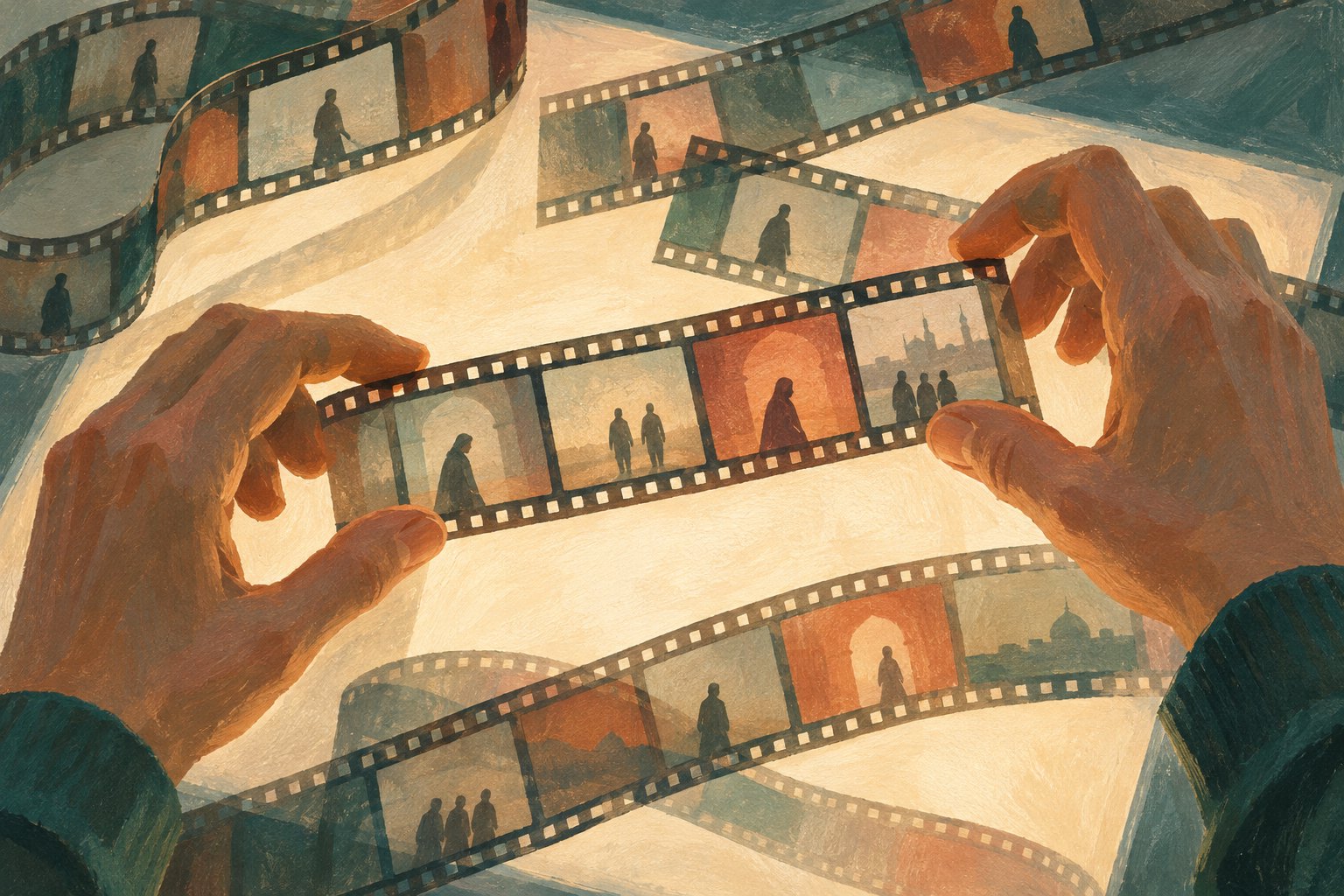
A useful viewing habit is to notice when your judgment changes. What caused the shift: new information, a performance detail, music, or the order of shots? This does not mean treating emotion as suspicious. It means understanding how a movie earns an emotional conclusion—and recognizing when it asks atmosphere to do the work of evidence.
Silence Needs Context Before It Becomes Resistance
Silence is especially vulnerable to overinterpretation. A quiet character might be afraid, calculating, exhausted, unconvinced, or simply unwilling to explain themselves. Calling every silence defiance can be as reductive as calling it submission.
The surrounding action matters. Who has asked the question? Is a reply genuinely invited? Can the silent person safely disagree? What happens after they withhold an answer? These questions help distinguish an interpretation grounded in the film from one imported by the viewer.
Dialogue needs the same care. A memorable line gains force from its speaker, its listener, and its consequences. Quoting a declaration about freedom means little if we ignore whom the speaker subsequently controls. Conversely, an ordinary request can carry extraordinary weight when another person possesses the authority to deny it. That is why verified wording and scene context are essential to any review built around memorable lines.
Filmmaking About Iran Is Not One Uniform Position
Being the subject of a film, appearing in it, and directing it are different relationships to storytelling. Likewise, a film made about Iran is not necessarily a film made in Iran. Those distinctions should be established for each production rather than filled in through assumptions about nationality, location, or artistic intent.
The ethical question is concrete: who controls the account, and who bears the consequences of being represented? A filmmaker’s access may allow an important story to be told, but access alone cannot establish that every participant has equal influence over its telling.
This connects with our examination of looking beyond regional labels in international cinema. Categories help viewers discover films; close criticism asks what those categories leave unexplained. A person’s humor, vanity, affection, and contradictions deserve attention alongside the political circumstances surrounding them.
The Deeper Test: Can the Film Question Its Own Authority?
My strongest standard for cinema about power is whether it permits people to exceed the argument being made about them. Can a sympathetic character behave badly without losing their humanity? Can someone recognize an injustice while remaining implicated in it? Can the film acknowledge uncertainty without surrendering its moral judgment?
These are demanding standards because a clean message is easier to deliver than a complicated relationship. Yet complication need not mean confusion. A film can be precise about harm while allowing the people experiencing it to remain difficult, funny, inconsistent, and surprising.
The most valuable lesson suggested by making a film about Iran is therefore a question of responsibility: what does possessing the camera allow someone to decide for others? A persuasive answer would emerge through the finished work—through whose choices matter, whose account is challenged, and whose experience survives the edit. That is where an intention to examine power becomes a cinematic achievement worth judging.
Original content by this site's editorial team. Published: November 10, 2026 at 03:18:55 PST (Los Angeles time)