
Hexed has a magical world to introduce, but the most interesting promise in its producers’ latest interview concerns something more familiar: the difficulty of understanding your own family. Disney’s animated adventure follows teenage Billie Doe into a magical realm, while producers Roy Conli and Yvett Merino emphasize the relationship between Billie and her mother. That combination gives the film a potentially compelling center. Spectacle can make an adventure exciting; conflicting perspectives can make it matter.
This is a spoiler-free preview and critical analysis of the producers’ comments, not a review of the finished film. Their account offers insight into creative priorities, but it cannot establish whether the eventual character arcs, comedy, or emotional payoff succeed.
What the producers reveal about Hexed
During a studio visit, Conli describes animation as an iterative process, with the developing film revisited roughly every 12 to 14 weeks as drawings gradually give way to animation. Merino identifies the complicated mother-daughter relationship as the emotional connection she expects audiences to recognize, drawing on her experiences as both a daughter and a parent. The reported premise has Billie opening a portal into another world. These details come from [ABC7’s interview with the Hexed producers](https://abc7.com/post/hexed-producers-take-us-behind-magic-disneys-new-animated-adventure/20028239/).
The useful distinction is between a premise and a dramatic argument. A portal explains how an adventure begins. A relationship explains why its events might hurt, delight, or change the people experiencing them. My interest in Hexed rests on how closely those two elements will connect: whether the fantasy creates meaningful pressure on the family relationship, rather than merely providing a colorful setting around it.
Billie’s perspective needs more than a rebellious label
Calling a teenager rebellious describes how other people might experience her behavior. It does not necessarily explain how she experiences herself. For a character-centered reading of Hexed, that distinction will be essential. What looks like defiance from a parent’s position might feel like a demand to be heard from a child’s position. Neither interpretation automatically settles who is right.
The strongest version of this setup would give Billie a desire specific enough for viewers to understand, even when they question her decisions. Wanting independence is recognizable, but drama becomes sharper when independence involves a concrete choice, a responsibility, or a consequence. Those are criteria for evaluating the finished story, not claims about scenes already established.
Agency will matter just as much as likability. A protagonist can run through a remarkable world and still remain dramatically passive if everyone else explains the danger, makes the decisions, and solves the problems. I would look for whether Billie’s choices change the direction of the adventure—and whether she has room to reconsider those choices without losing her individuality.
Her mother needs an inner life, too
A mother-daughter story becomes less interesting when the adult exists only to impose restrictions. Concern can be loving and still be poorly expressed. Experience can provide judgment without granting perfect understanding. Giving the parent that complexity would allow Hexed to engage adults without requiring younger viewers to accept authority as its own justification.
There is an equally limiting shortcut on the other side: making the teenager correct about everything and reducing the parent’s growth to an apology. Mutual understanding requires two distinct perspectives. The question is whether each character can recognize something she has misunderstood while retaining legitimate needs of her own.
This is where an adventure can do work that a family argument alone cannot. Unfamiliar circumstances can unsettle established roles. The person accustomed to giving instructions may have to listen; the person demanding freedom may discover what responsibility feels like. Whether Hexed uses those possibilities remains open, but they explain why the relationship deserves attention alongside the magical premise.
For a darker exploration of the boundary between care and control, our analysis of love and possession in the Madoka Magica trilogy considers that tension in a very different kind of animated fantasy. That article contains spoilers for those films.
Why revising animation is also revising performance
Conli’s description of repeated screenings is useful because it directs attention toward development rather than polish alone. When assessing an animated performance, I pay attention to when a character looks away, how long a reaction lasts, and whether a gesture contradicts what the character says. Emotional meaning often lives in those small discrepancies.
Consider the difference between a character turning away before someone finishes speaking and turning away after a pause. The first might suggest impatience; the second might suggest hurt. Neither requires an explanatory speech. This is an illustrative example of performance analysis, not a description of a moment in Hexed.
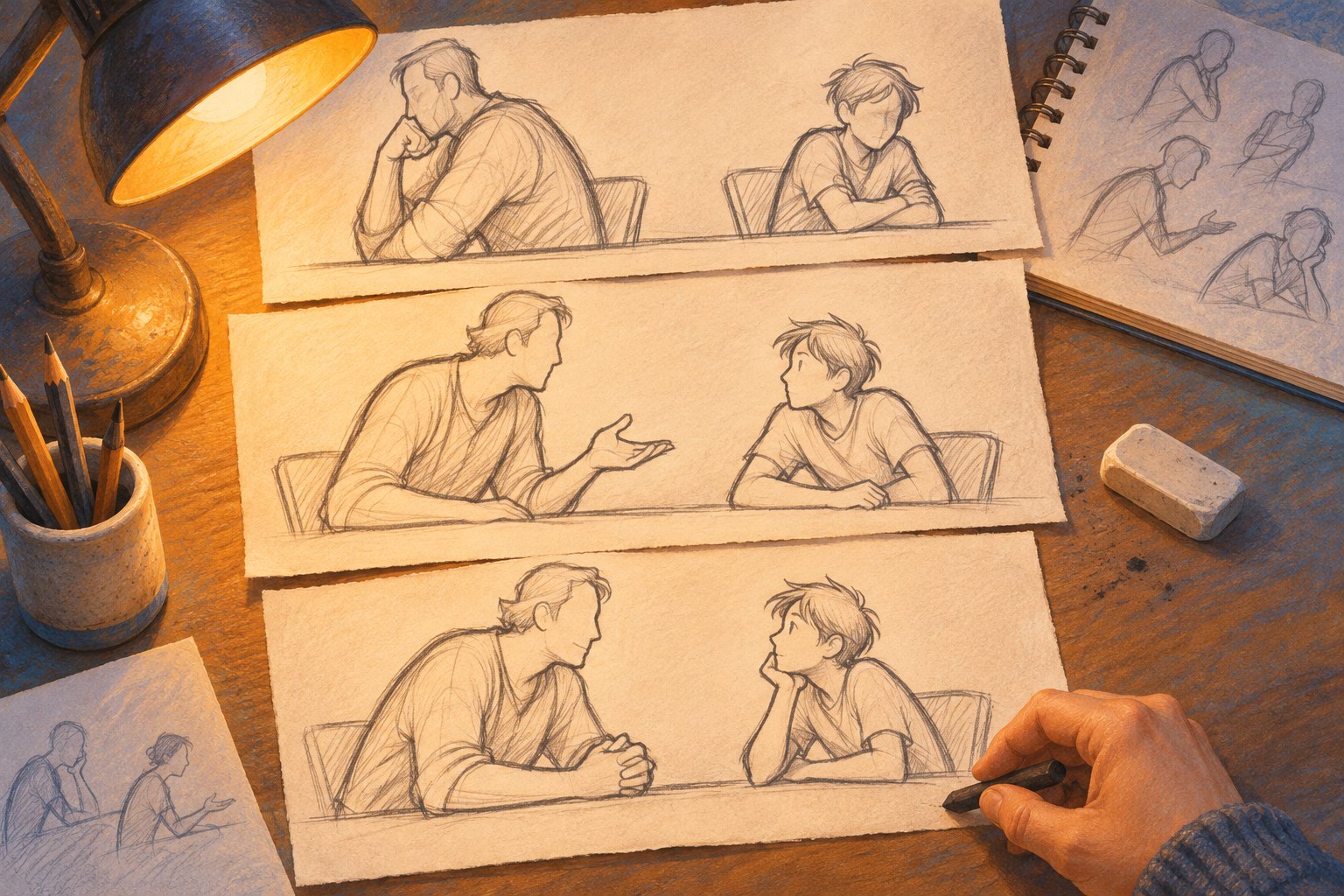
Revision creates opportunities to test such distinctions. It does not guarantee that they survive into an effective finished sequence. An emotional beat can become clearer through adjustment, but it can also become overexplained. My preference is for animation that trusts posture, timing, and silence enough to let viewers participate in understanding a character.
The magic should change the stakes of the relationship
A useful question for watching Hexed will be whether its fantasy and family story feel inseparable. If the magical obstacles could be replaced with ordinary inconveniences without changing the characters’ emotional journey, the world may be functioning largely as decoration. If those obstacles force difficult decisions particular to these people, the adventure gains dramatic purpose.
That does not mean every creature or visual joke must carry a lesson. Playfulness is part of the appeal of animation. The balance I value is freedom within a story whose major turning points have consequences. A delightful detour can enrich a world; repeated detours can weaken the pressure that makes a relationship develop.
Our discussion of why human choices matter within large-scale spectacle approaches a related critical question through monster movies. Here, the scale is different, but the standard remains useful: impressive imagery becomes more involving when somebody’s decision gives it meaning.
The deeper possibility behind the adventure
The most promising interpretation of Hexed at this stage is that entering an unfamiliar world could provide a way to reconsider a familiar person. Growing up involves discovering that a parent has fears and limitations; parenting involves recognizing that a child’s interior life cannot simply be managed from outside. A fantasy can give those changes a visible form without reducing them to a lecture.
That is a possibility suggested by the producers’ emphasis, not a conclusion about the film’s ending. No assessment of its resolution, memorable dialogue, or hidden references belongs in a preview without evidence. For now, the meaningful reason to watch Hexed is the prospect of an adventure in which discovery applies equally to the world and to the people closest to its heroine. The finished film’s challenge will be making both discoveries feel earned.
Original content by this site's editorial team. Published: November 10, 2026 at 00:53:08 PST (Los Angeles time)