Kick On has an attention-grabbing introduction: Nick Kozakis, Toronto’s Midnight Madness, and a claim that real stunts make screen brutality convincing. Variety’s coverage frames the film with the phrase “John Wick cracked out on meth.” That comparison establishes an expectation of extreme action, but the more interesting question concerns the people inside it: can physical spectacle make their fear, decisions, and exhaustion feel specific?
Kozakis’s reported emphasis on real stunts offers a useful starting point. A convincing physical action can communicate distance, resistance, and vulnerability in an instant. Whether those qualities become compelling drama depends on how the film connects them to character.
This is spoiler-free commentary on the film’s reported filmmaking approach, not a screening-based review. It does not assess unverified scenes, performances, dialogue, or the ending. The distinction matters because an ambitious production method and a successful finished sequence are separate things.
What the John Wick Comparison Actually Establishes
The comparison is vivid shorthand, carrying expectations of force, speed, and escalating intensity. It gives a prospective audience an immediate impression of the experience being advertised. It cannot establish how Kick On structures a confrontation, develops its characters, or balances excitement with discomfort.
It also risks setting an overly simple standard: more violence equals more impact. In my view, that is a weak way to evaluate action filmmaking. A sequence can become more elaborate while becoming less involving. Once the audience stops understanding what a person wants or fears, another spectacular collision may add little beyond visual noise.
The useful question for Kick On is therefore how its physical action expresses a particular predicament. Does movement suggest confidence, panic, calculation, or desperation? Those qualities give violence its dramatic identity. A comparison can attract attention; recognizable human behavior gives that attention somewhere to settle.
Why Real Stunts Can Make Brutality Legible
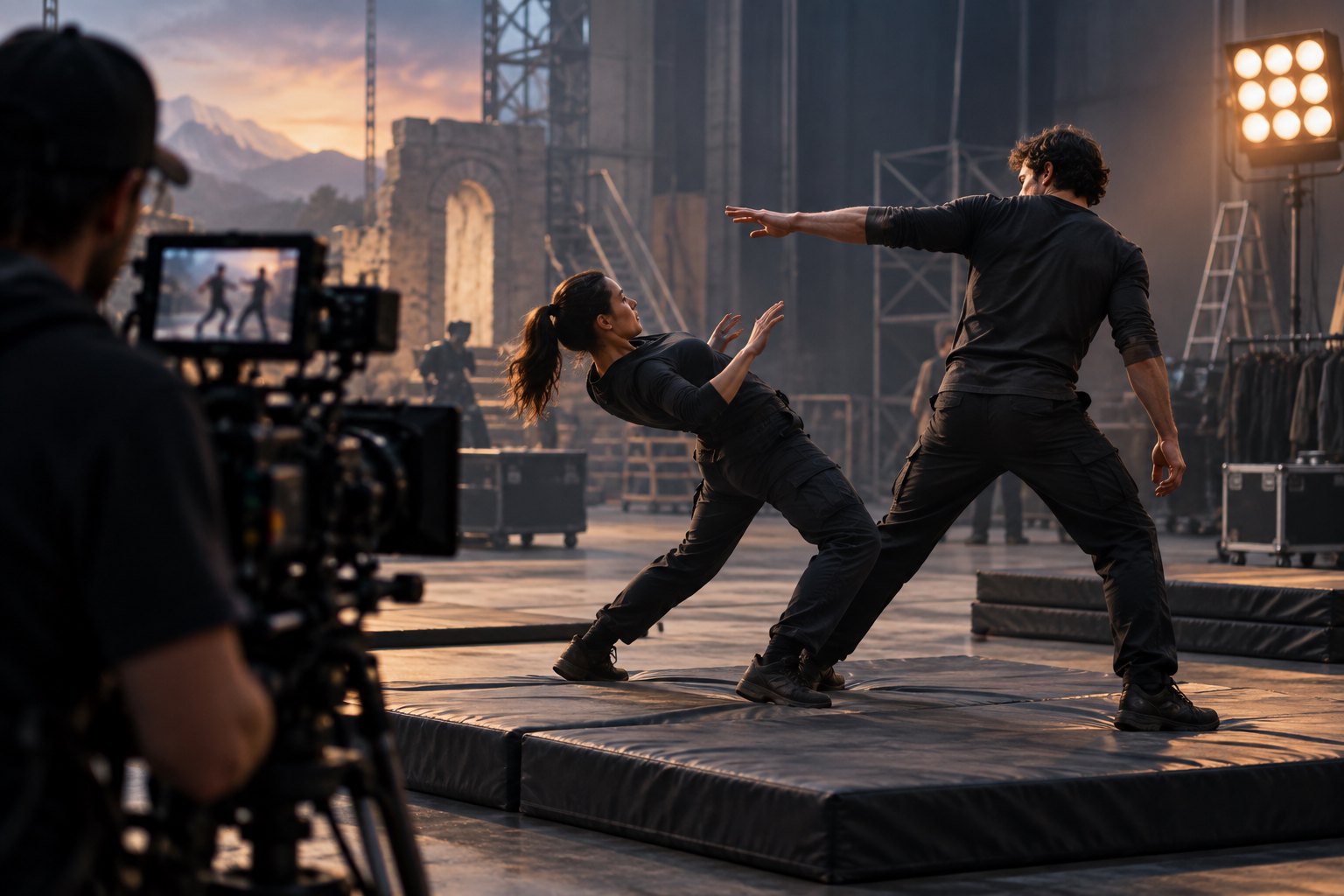
Practical stunt performance gives a camera physical relationships to record. A body occupies space. A movement changes balance. A landing has a direction and a duration. When a sequence preserves those relationships clearly, viewers can understand what happened without consciously reconstructing every shot.
That clarity can increase suspense. Knowing how far someone must move, where an obstacle sits, or how little room remains gives an audience a way to anticipate trouble. The physical layout becomes part of the storytelling rather than a decorative background.
But practical execution alone does not guarantee that effect. Camera placement, editing, sound, and performance determine what reaches the viewer. A carefully rehearsed stunt can lose its shape through confusing coverage. A brief movement can feel enormous when the surrounding scene gives it significance.
Kozakis’s reported position is most interesting as a commitment to physical credibility. It should not be expanded into an unsupported claim that every effect in Kick On is practical. Nor does convincing screen violence mean that performers must actually get hurt. The craft involves constructing the appearance of danger through controlled performance.
Character Begins With the Response to Impact
For a character-centered assessment of Kick On, the crucial unit would be the action and its response together. The strike, fall, or escape creates an event. What the person does immediately afterward tells us how that event has changed their situation.
Consider a general filmmaking example, not a scene attributed to this movie. After narrowly avoiding danger, a character might immediately advance, pause to locate a companion, or struggle to regain composure. Each response communicates a different priority. The stunt supplies the physical fact; the behavior supplies its meaning.
This is where action can become characterization without explanatory dialogue. Hesitation may reveal uncertainty. An economical movement may suggest familiarity. A rushed decision may expose someone’s inability to think beyond the next second. Such details are worth watching because they make bodies expressive rather than interchangeable.

The importance of response also connects with our discussion of how reaction and attention can deepen screen characters. During physical action, a face can establish the stakes that movement alone leaves uncertain. The image above illustrates that critical idea; it is not a scene or production image from Kick On.
Consequences Give an Action Sequence a Memory
My strongest criterion for judging this approach would be continuity of consequence. Does a difficult encounter affect what a character can attempt next? Does fear change their judgment? Does the experience alter how they respond to another person?
These questions extend beyond visible injury. Consequence can take the form of lost confidence, reduced options, or a new understanding of danger. A film gives action narrative weight when an encounter leaves the story in a different state.
Without that accumulation, brutality can become repetitive even when individual stunts are impressive. The audience learns that each confrontation effectively resets the situation. With accumulation, a comparatively small obstacle can become suspenseful because the viewer remembers what reaching it has cost.
For Kick On, this offers a more revealing standard than simply counting extreme moments. The issue is whether its physical vocabulary develops alongside its characters. That remains a question for the finished film, rather than an achievement established by the director’s stated approach.
What to Watch for Beyond the Festival Pitch
The Midnight Madness association gives Kick On a clear festival context. It does not supply a critical verdict. As with the expectations surrounding fellow Midnight Madness title River, the story around a film can shape anticipation before viewers encounter its actual choices.
Three questions provide a practical way to evaluate Kozakis’s promise:
- Can you follow the physical problem? Clear relationships between people and space help turn movement into suspense.
- Does the action reveal a person? Decisions and reactions should distinguish characters beyond their ability to withstand punishment.
- Does the encounter change what follows? Consequences give a sequence a place in the story rather than leaving it isolated.
The Deeper Stakes of Physical Credibility
The most compelling possibility in Kozakis’s real-stunt emphasis is that it could make vulnerability tangible. A body with weight and limits gives a character something concrete to negotiate. Survival becomes a succession of demanding decisions, each made under pressure.
That is an interpretive possibility, not a confirmed theme or verdict on Kick On. Still, it explains why the filmmaking claim deserves attention beyond its provocative comparison. Real stunts can establish the physical terms of danger. Character determines why those terms matter. The strongest version of Kozakis’s approach would make the audience remember both the impact and the person who has to keep going afterward.
Original content by this site's editorial team. Published: September 14, 2026 at 23:14:27 PDT (Los Angeles time)