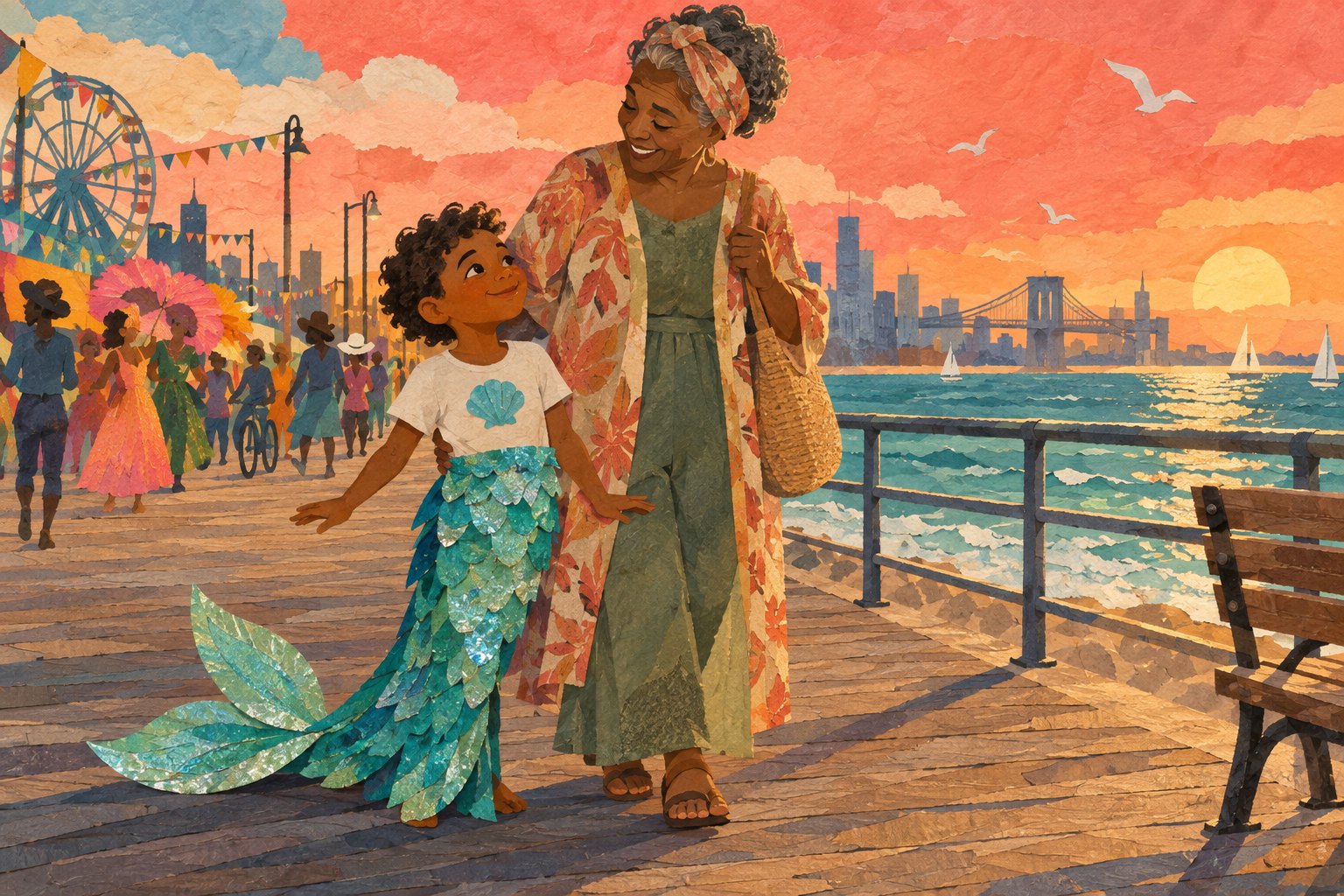
Julián turns the wish at the heart of Jessica Love’s Julián Is a Mermaid into a larger question: what happens when someone who loves a child has to reconsider who that child might become? Directed by Louise Bagnall and written by Juliany Taveras, the animated adaptation builds its story around a summer with a grandmother, a fascination with mermaids, and the pleasures and uncertainties of being seen.
Mashable’s enthusiastic review presents the film as a successful expansion of the picture book. The most interesting critical question is how that expansion works. A feature needs to give Julián experiences beyond his initial wish while preserving the simplicity that makes the wish meaningful. His relationship with his grandmother offers the strongest foundation for doing that.
Spoiler note: This critical companion discusses the premise, reported character conflicts, and the Mermaid Parade storyline. Its interpretations draw on the official synopsis and published festival reviews; they are not a firsthand screening verdict.
A summer that makes family unfamiliar
Cartoon Saloon’s official synopsis establishes a productive contradiction: Julián spends the summer with a grandmother he barely knows. Family connection precedes personal familiarity. Her Brooklyn apartment, Caribbean heritage, and surrounding neighborhood become things he must discover rather than things he automatically understands.
That matters because stories about discovering one’s roots can make belonging seem effortless. Here, the premise allows affection and awkwardness to coexist. Being related does not mean sharing habits, tastes, or expectations. Julián arrives as a particular child, with interests already taking shape.
DiscussingFilm’s review records the brief line “Thank–Gracias,” a small verbal adjustment that captures this uncertainty. The child is finding his footing inside a family language. My reading is that the hesitation matters more than perfect fluency: it makes connection an attempt, something practiced in ordinary exchanges.
From his grandmother’s perspective, familiar customs may seem like obvious ways to welcome him. From his perspective, those same customs require adjustment. Neither experience cancels the other. The dramatic opportunity lies in letting them discover that shared heritage does not guarantee identical lives.
Julián’s costume gives an inner wish a public shape
Festival accounts describe Julián’s interest in marine life, his friendship with three girls, and their plans to participate in the Coney Island Mermaid Parade. These details give his imagination a practical destination. Wanting to be a mermaid leads toward making something, joining friends, and entering a public celebration.
A costume is particularly useful here because it occupies the space between private imagination and social recognition. Julián can picture himself however he likes, but clothing makes that picture visible to other people. Their reactions introduce a vulnerability that private play can postpone.
The most persuasive interpretation keeps his immediate experience central. He wants beauty, movement, participation, and the pleasure of looking the way he imagines. Those desires carry meaning without requiring him to deliver an adult explanation of identity.
Olivia Popp’s festival review observes that the film does not assign him an explicit identity label. That leaves room for queer readings while preserving the difference between interpreting a character and declaring facts the story has not established. His self-expression deserves attention on its own terms.
Abuela’s most meaningful response is participation
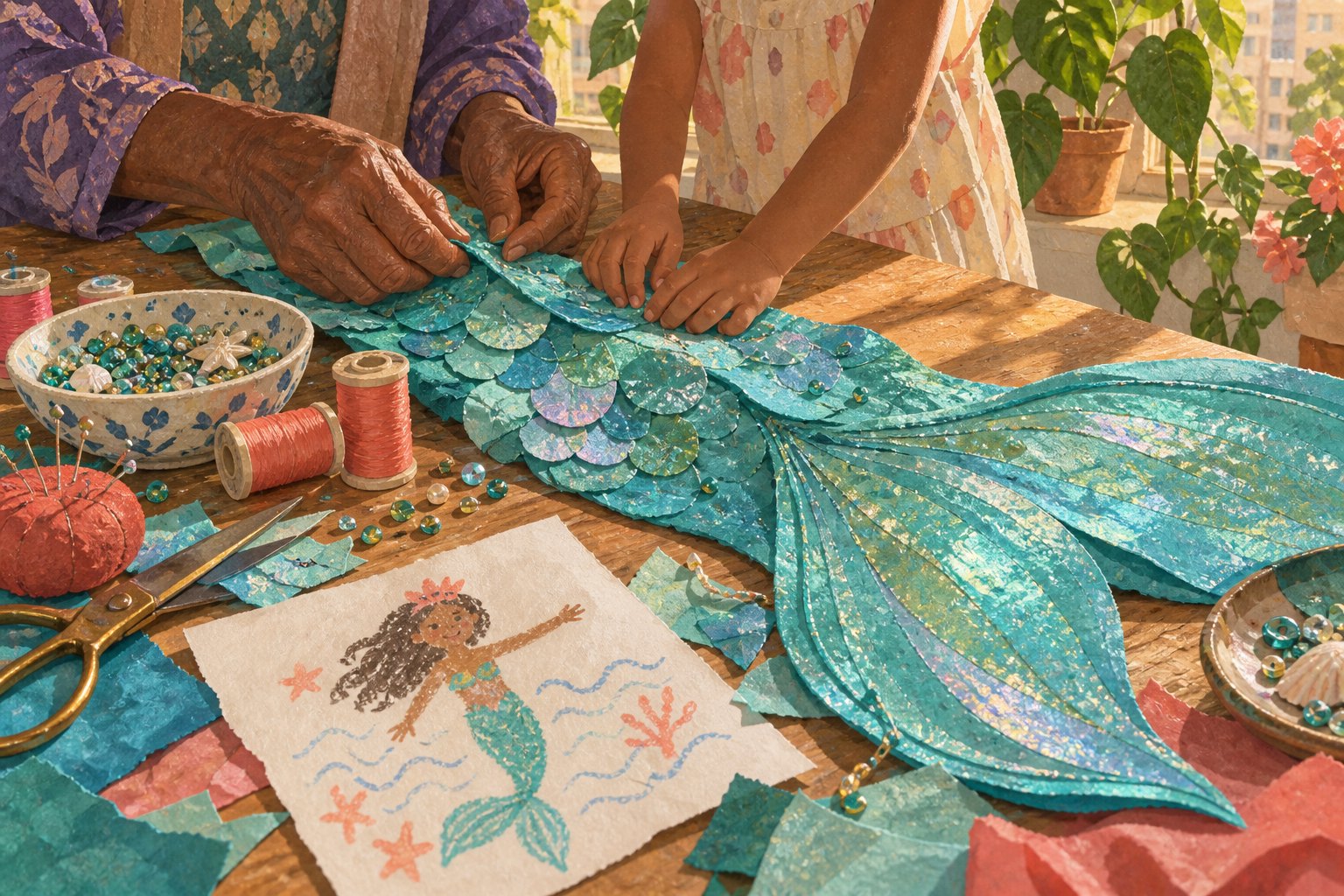
Bagnall’s discussion of the adaptation with Cartoon Brew describes the grandmother’s growing understanding and the pair’s creation of a costume. This is an especially promising choice: sewing turns acceptance into an activity with time, materials, and attention attached.
Helping a child make something requires listening to what the child wants. It also gives an adult a role beyond approving or disapproving. The grandmother can contribute her knowledge while allowing Julián to direct the purpose of their work. Their relationship gains a shared project.
There is a useful connection to our discussion of older characters’ capacity for change in Place to Be. A grandmother becomes more interesting when she has something to learn, rather than existing solely to provide wisdom. Her experience can be valuable without making her first impression infallible.
The costume also offers a concrete measure of care. Affection becomes easier for a child to trust when it takes a form the child can recognize. Joining the work communicates an investment in his happiness that a general statement of love may leave abstract.
Why imagination belongs inside this family story
Published accounts describe underwater fantasy and an animated fish emerging from a drawing. These elements make Julián’s imagination part of the film’s action. They give the audience a way to encounter the intensity of his interests, rather than merely hearing other characters describe him as imaginative.
The distinction matters for character perspective. An adult looking at a homemade costume sees fabric. A child may experience possibility, transformation, and a whole environment opening around him. Animation can hold both perceptions together without requiring one to invalidate the other.
Cineuropa’s review also identifies the grandmother’s stories about the sea figure Yemayá as part of the film’s cultural texture. That gives the ocean imagery another function: it can connect Julián’s imaginative life with stories inherited through his family. Personal discovery and cultural connection need not pull him in opposite directions.
Can reassurance carry a feature?
The film’s reception includes a substantive reservation. DiscussingFilm praises its visual qualities while questioning how quickly conflicts resolve; In Review Online finds the lack of sustained resistance more damaging. Those responses identify an issue worth considering alongside the enthusiastic notices.
A gentle story still needs consequences. If a misunderstanding disappears before either character has to reconsider anything, reconciliation can feel automatic. The viewer needs enough uncertainty to understand what an act of trust costs.
Yet prolonged hostility is not the only way to create meaningful drama. For a child, waiting to discover whether a beloved adult understands can be significant in itself. My view is that the fair test is whether reassurance follows an observable change in behavior. The duration of a disagreement matters less than what the characters learn through it.
That distinction also informs our commentary on audience expectations and the demands placed on filmmakers. Criticism should examine whether a film fulfills its chosen emotional purpose, while still asking whether its storytelling earns the response it seeks.
The parade makes belonging visible
The Mermaid Parade gives Julián’s wish a social setting. Other people’s costumes establish that imaginative expression can be shared, and his friends make participation a collective endeavor. A child who might otherwise feel conspicuous can recognize that visibility also creates opportunities for connection.
For families, the reported bullying and disagreements around gender expectations are useful discussion points. The most revealing conversation may begin with how Julián understands those encounters: why would something that brings him pleasure trouble someone else? Adults can then consider how their responses either ease that confusion or deepen it.
The deeper promise of Julián lies in reciprocal recognition. A child discovers family history and a wider community; a grandmother discovers the child beyond her assumptions. Returning to the little hesitation in “Thank–Gracias,” belonging emerges as something people learn to express together. The mermaid costume gives that process color and shape, but the essential transformation is relational: love becomes more useful when it pays closer attention.
Original content by this site's editorial team. Published: September 13, 2026 at 17:46:39 PDT (Los Angeles time)