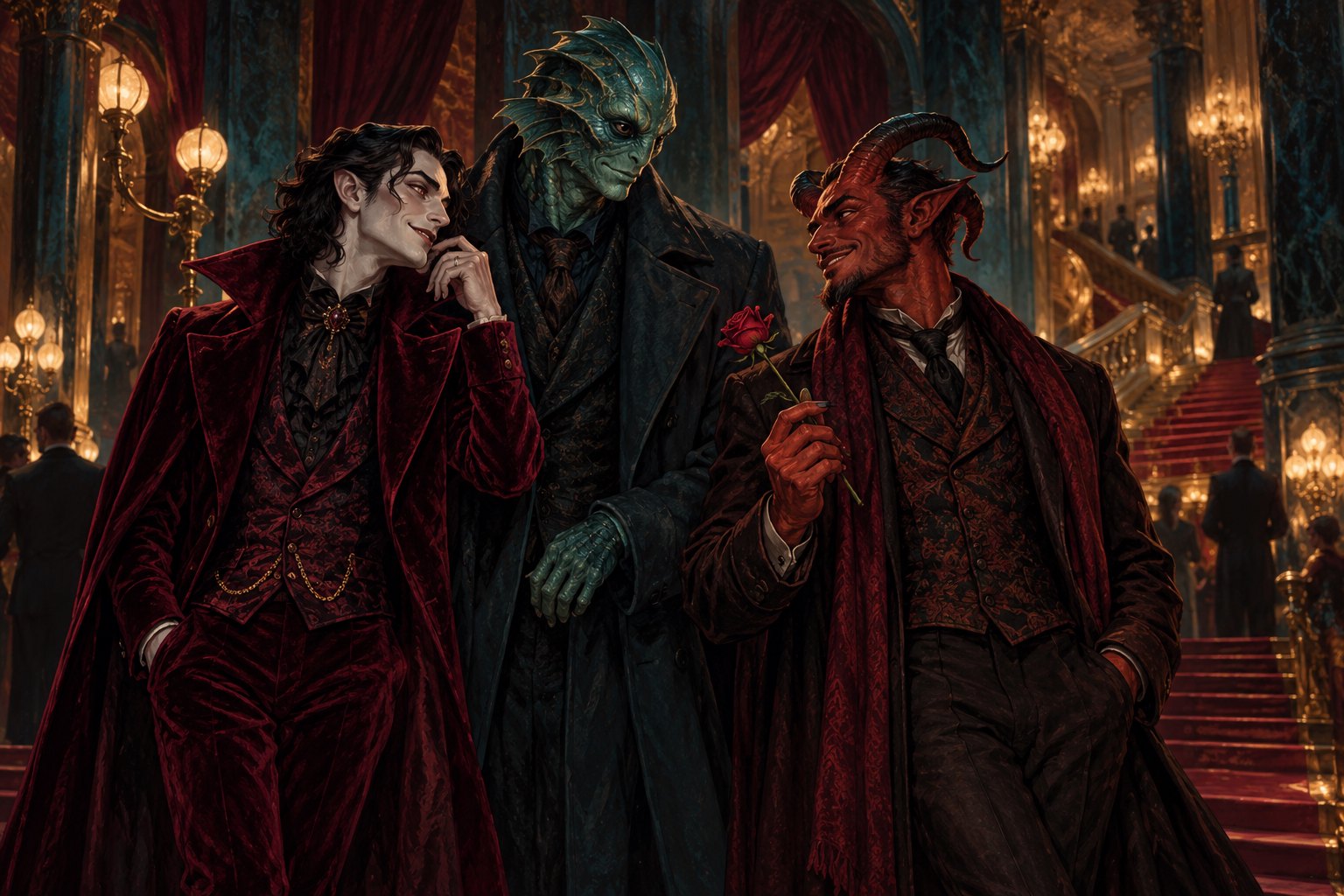
Thirteen movie monsters I would mash? My answer starts with the Amphibian Man, makes room for several beautifully dressed vampires, and requires an embarrassing number of qualifications. Screen attraction is about movement, voice, costume, and the feeling that someone extraordinary might finally understand you. Practical compatibility tends to arrive several scenes later, carrying a wooden stake.
These are my own thirteen picks, chosen for their cinematic magnetism. The interesting question is what their movies do with that attraction: invite us closer, expose our wishful thinking, or make both responses possible at once.
Spoilers follow for every film discussed, including endings. These are subjective character readings, not a ranking of relationship prospects.
The monsters whose appeal begins with recognition
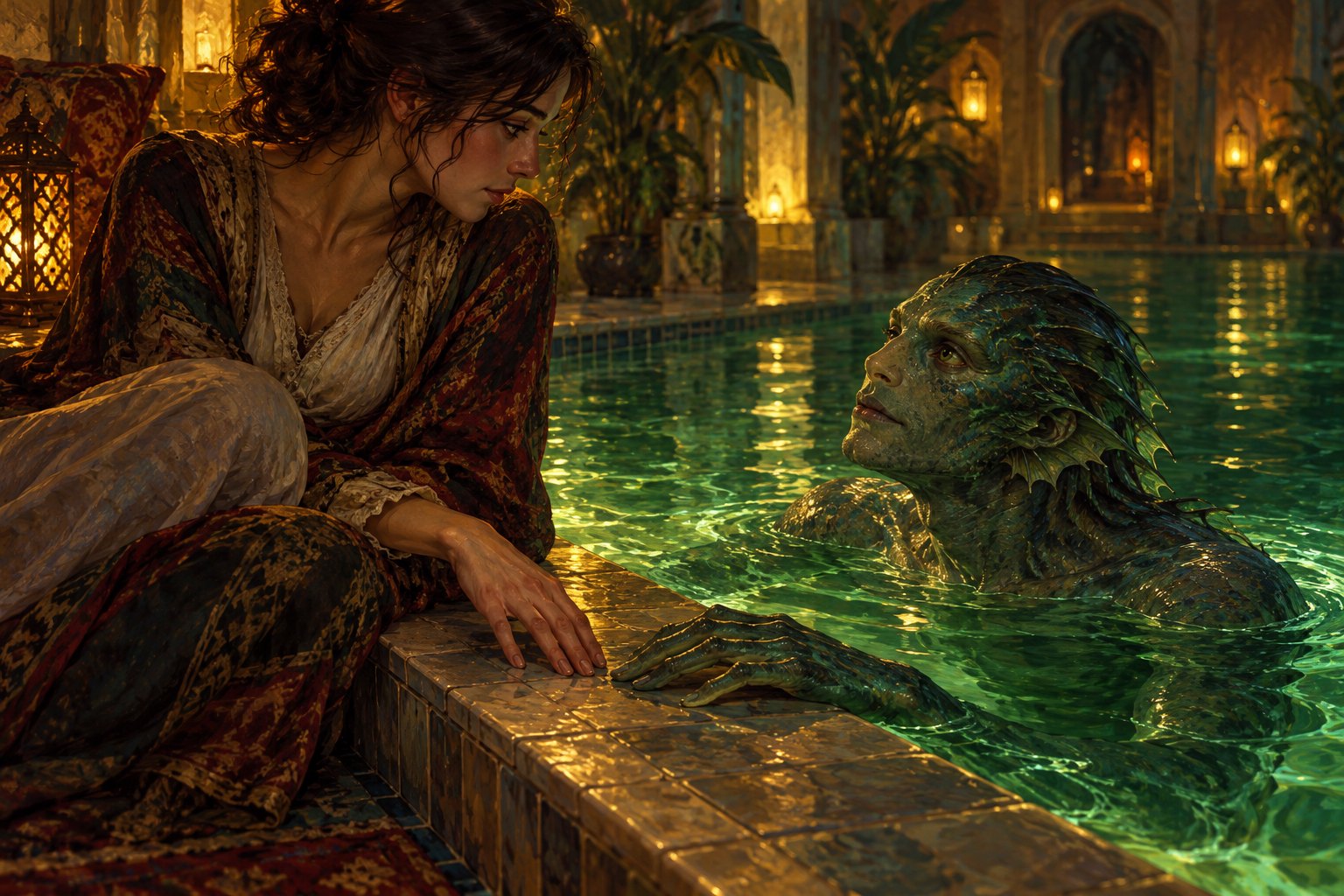
1. The Amphibian Man — The Shape of Water
The strongest candidate earns his place through attention. Elisa approaches the captive creature with food, music, and communication; their connection develops through shared encounters rather than an explanatory speech about his hidden goodness. Doug Jones makes stillness expressive, allowing a turn of the head to suggest curiosity.
From Elisa’s perspective, this relationship offers recognition without treating her inability to speak as a deficiency. Yet the creature’s killing of Giles’s cat prevents him from becoming a harmless fantasy accessory. The film asks her—and us—to love something whose nature cannot be reduced to familiar manners.
2. Hellboy — Hellboy II: The Golden Army
Hellboy has the appeal of someone who can fight a supernatural army and still be painfully awkward at home. His relationship with Liz gives his physical confidence a useful counterweight: being powerful does not make him attentive, mature, or easy to live with.
I find that friction more attractive than invulnerability. Ron Perlman’s performance lets wounded pride sit beside affection. Through Liz’s eyes, the question is whether the person beneath the heroic spectacle can become a dependable partner. The movie wisely lets that remain work.
3. Abe Sapien — Hellboy II: The Golden Army
Abe brings a quieter appeal: intelligence, delicacy, and the unmistakable vulnerability of someone surprised by love. His attachment to Princess Nuala unsettles his usual composure. The film’s companionship between Abe and Hellboy also makes romantic embarrassment feel pleasantly ordinary.
His feelings, however, affect decisions with consequences beyond himself. That makes him a character rather than a decorative gentle soul. My attraction survives the complication; my reading of his judgment becomes less charitable.
4. The Beast — Beauty and the Beast
Jean Cocteau’s film gives the Beast a magnificent contradiction: an imposing animal face and a manner burdened by shame. Jean Marais makes the creature’s formality feel like an attempt to contain feelings that might otherwise overwhelm him.
Belle’s experience complicates the enchantment because her arrival involves an unequal bargain. Still, the Beast’s vulnerability gradually changes the emotional atmosphere. When the transformation comes, I miss the creature’s presence. Conventional beauty feels less distinctive than the face through which we learned to recognize longing.
Vampires with excellent style and difficult emotional lives
5. Dracula — Bram Stoker’s Dracula
“I have crossed oceans of time to find you” is an outrageous romantic proposition, and Gary Oldman gives it the conviction it needs. The costumes and shifting physical appearances make desire feel theatrical, unstable, and enormous.
But Mina’s perspective matters more than Dracula’s account of his suffering. His longing does not erase the violence surrounding it. I find him compelling because the film makes romantic grandeur and predation coexist so uneasily. The attraction works; the justification does not automatically follow.
6. Louis — Interview with the Vampire
Louis offers beauty accompanied by a very long confession. His reluctance to accept vampiric killing gives his narration emotional weight, but conscience is not the same thing as innocence. Other people still suffer inside the story he tells about his suffering.
Brad Pitt’s restraint makes Louis seem suspended between appetite and disgust. I respond to that tension, while remaining skeptical of his self-presentation. Listen from Claudia’s position and the supposedly sensitive adult becomes someone whose anguish cannot repair what has happened to her.
7. Lestat — Interview with the Vampire
Tom Cruise makes Lestat entertaining in ways that should immediately raise suspicion. He treats immortality as permission to perform, indulge, and dominate every room. His energy supplies a wicked answer to Louis’s exhaustion.
Turning Claudia helps bind Louis to him, making family formation inseparable from control. That choice is essential to understanding the performance: charm is one of Lestat’s instruments. I would watch him hold court indefinitely, which is precisely how his trap begins.
8. Adam — Only Lovers Left Alive
Adam’s appeal is intensely specific: a reclusive musician surrounded by objects he loves, radiating the conviction that civilization has disappointed him personally. Tom Hiddleston gives his weariness enough humor to keep it from becoming purely ornamental.
From Eve’s perspective, loving Adam includes recognizing when his cultivated despair has become dangerous. The romance works because she knows him beyond his pose. My reservation is equally specific: sharing his record collection sounds wonderful; becoming responsible for his entire relationship with existence sounds exhausting.
9. Eve — Only Lovers Left Alive
Eve is my stronger choice from the same marriage. Tilda Swinton makes accumulated experience look like curiosity rather than fatigue. Her pleasure in books, conversation, and discovery suggests that longevity need not mean emotional withdrawal.
She understands Adam without simply echoing his pessimism. Their scenes make familiarity feel sensuous: the attraction lies in knowing how another person thinks. The film eventually reminds us that this cultivated couple still has predatory needs, leaving their elegance beautifully compromised.
10. Selene — Underworld
Selene initially attracts through precision: controlled movement, watchfulness, and the impression that every gesture has a purpose. Kate Beckinsale gives the film’s elaborate supernatural conflict a clear physical center.
Her involvement with Michael matters because it disrupts inherited loyalties. From her perspective, desire becomes entangled with discovering that the authority she trusted has concealed the truth. The appealing quality is her capacity to revise her allegiance when the evidence changes. The leather coat certainly helps.
The crushes that become harder to defend
11. The Gill-man — Creature from the Black Lagoon
The underwater movement is the attraction. Watching the creature swim beneath Kay creates an uncanny visual duet, although she does not know she has a partner. His body seems perfectly adapted to a world the human visitors can only enter temporarily.
That distinction keeps the scene troubling. From Kay’s perspective, this is surveillance rather than mutual courtship. I can admire the creature’s grace while recognizing that the camera’s invitation to fascination does not establish her consent.
12. Imhotep — The Mummy
Arnold Vosloo gives Imhotep a commanding physical presence, while his determination to recover Anck-su-namun supplies a recognizable emotional motive beneath the supernatural destruction. Devotion makes the villain legible.
It does not make him considerate. His plan requires Evelyn’s sacrifice, turning another person into a resource for his preferred ending. From Evelyn’s perspective, the grand love story is a threat. My attraction is to the performance’s certainty; the film exposes how terrifying certainty becomes when nobody else’s life counts.
13. Candyman — Candyman
Tony Todd’s voice does extraordinary work. “Be my victim” sounds intimate because of its delivery, even as the words state the danger plainly. His composure gives the character a presence that frantic menace could never achieve.
Helen’s encounter with him draws her into a story whose violence she cannot control. The film connects his legend to racist brutality, but suffering does not make his demands benign. This is the most unsettling attraction on my list because the invitation and the threat occupy exactly the same sentence.
What these monster crushes reveal
The best monster romances allow another person’s perspective to interrupt the fantasy. Elisa’s recognition, Belle’s uncertainty, Liz’s frustration, and Helen’s fear prevent spectacular bodies from becoming the entire argument. Our analysis of fear beneath fairy-tale beauty approaches a related tension: enchantment becomes richer when its emotional cost remains visible.
These films also show why intensity alone cannot explain attraction. A quiet exchange may reveal more than an overwhelming spectacle, a question explored in our commentary on immersion and character in horror.
My favorite monsters make difference feel desirable without making personality disappear. The deepest fantasy is being recognized in a form the world has taught you to hide. The most disturbing films turn that wish around: someone promises to see you completely, then insists you exist only for them. A memorable monster crush lets us feel the pull—and gives us enough perspective to understand it.
Original content by this site's editorial team. Published: October 28, 2026 at 20:37:11 PDT (Los Angeles time)