Judi Dench’s description of Cats as a waste of “goodwill and talent,” reported by Variety, lands particularly hard because talent is also the movie’s organizing obsession. Its characters sing, dance, boast, and reminisce before a leader who can grant one of them a new life. Everyone wants to be seen. The film’s recurring problem is deciding what being seen should accomplish.
Tom Hooper’s 2019 adaptation of Andrew Lloyd Webber’s musical offers an unusually revealing contradiction: it frames renewal as a competition, then finds some of its strongest material when the cats stop competing. Looking at Macavity, Gus, and Mr. Mistoffelees brings that contradiction into focus. My reading is that Cats becomes more compelling whenever performance creates a relationship, rather than functioning as an application for a prize.
Spoiler warning: This review discusses the kidnappings, Old Deuteronomy’s rescue, and the final choice. Dench’s reported assessment provides the occasion for the review; the interpretation of the characters below is our own.
The Jellicle Ball makes every introduction feel like an audition
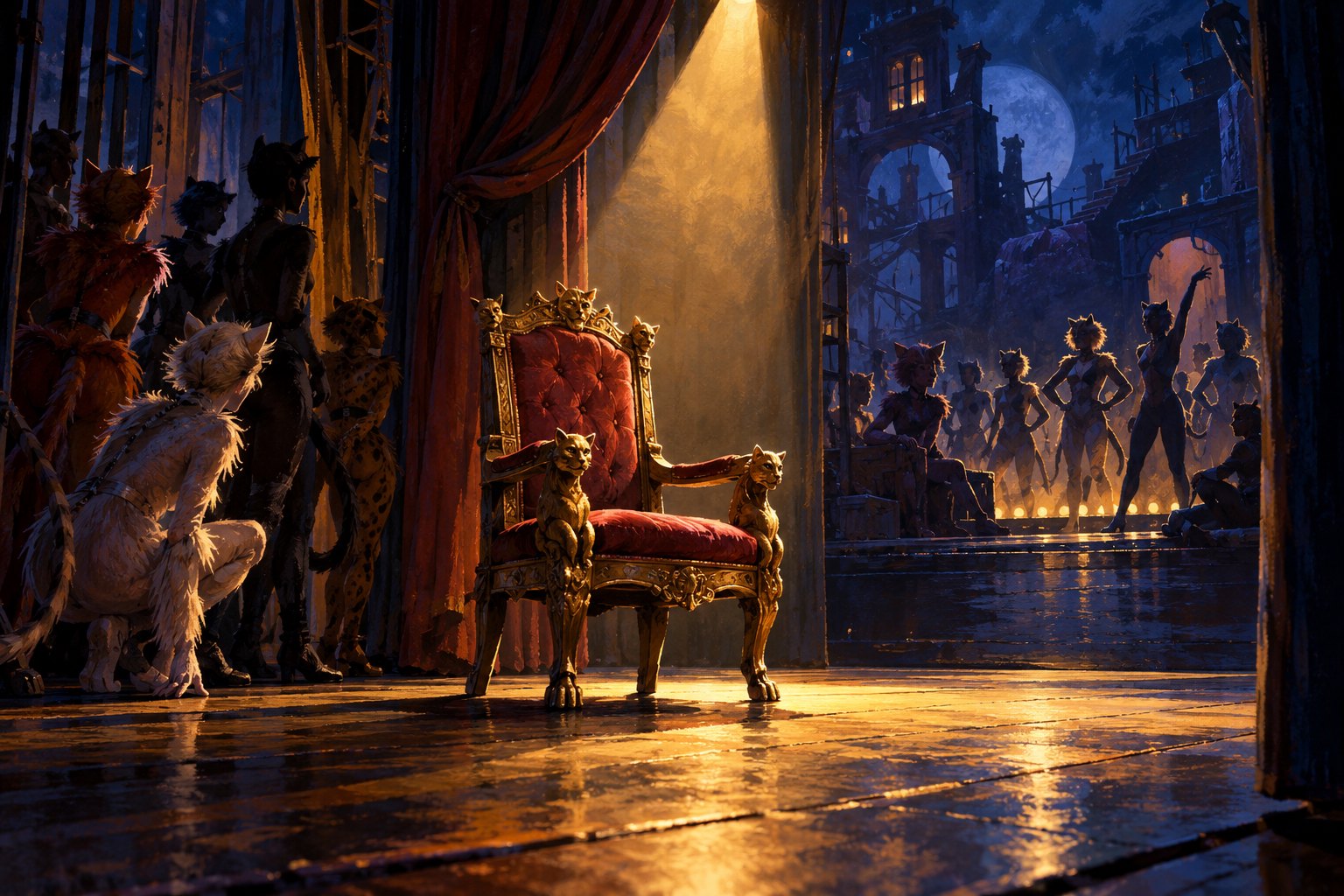
The central ritual is straightforward enough beneath the unusual vocabulary. The Jellicles gather for a ball, and Old Deuteronomy, played by Dench, chooses a cat to ascend to the Heaviside Layer and receive a new life. Victoria, an abandoned newcomer played by Francesca Hayward, gives viewers a way into this unfamiliar community.
That framework changes how we hear the individual songs. A character describing a habit or profession is also making a case for recognition. Bustopher Jones advertises appetite and social distinction; Gus remembers his theatrical career; Skimbleshanks presents the railway as a world sustained by his vigilance. Their identities become little performances of usefulness, reputation, or charm.
The difficulty is that these qualities do not establish a shared basis for judgment. Should the chosen cat be the most accomplished, the most entertaining, or the one most in need? The uncertainty can be fruitful: compassion should resist a scoring system. But the film repeatedly pushes the excitement of a contest without giving that contest enough emotional definition. From a contestant’s perspective, the stakes are enormous and the criteria obscure.
Macavity turns recognition into elimination
Idris Elba’s Macavity responds to that uncertainty by trying to control the field. He abducts potential rivals and eventually takes Old Deuteronomy herself after she refuses his demand to be chosen. His approach makes the film’s competitive premise brutally literal: if approval cannot be earned reliably, remove the alternatives and pressure the person who awards it.
This is a useful character idea. Macavity possesses extraordinary abilities, yet power does not satisfy him. He wants an authority beyond himself to validate his importance. His actions suggest someone who can command attention but cannot tolerate an independent judgment.
The recurring lyric “Macavity’s not there” becomes especially pointed in this context. Absence is his advantage: he evades accountability while making other characters disappear. Bombalurina’s number, performed by Taylor Swift, gives his reputation a seductive public presentation. His menace travels through performance as well as magic.
For me, the weakness is that his interference supplies more incident than insight. Each disappearance moves the plot forward, but the movie gives limited space to the fear or resentment that would make his hunger for selection emotionally specific. We can understand his strategy without feeling we know him. He is an effective expression of competitive selfishness, but an intermittently engaging antagonist.
Gus asks what remains when applause becomes memory
Ian McKellen’s Gus offers a quieter account of recognition. The elderly theater cat looks backward, recalling the roles that once defined him. Where Macavity wants to force the future into submission, Gus wants his past to remain meaningful to somebody else.
That makes his number more than another introduction. A performer’s history depends partly on witnesses. Achievements can survive in stories, but the person telling those stories still needs a listener. Gus’s recollections expose the vulnerability beneath professional pride: what happens when your most important work belongs to a world your audience never experienced?
McKellen’s presence gives that question weight. The appeal of the scene lies in its sense of accumulated experience, rather than an escalating demonstration of ability. Gus does not need to outdance the younger cats for his life to count. The film briefly allows a different measure of value to emerge.
This also makes him an illuminating companion to the questions raised in our commentary on artistic praise and the work behind it: recognition can direct attention toward an achievement, but it cannot replace a thoughtful encounter with that achievement.
Mr. Mistoffelees makes encouragement part of the action
Mr. Mistoffelees, played by Laurie Davidson, provides the clearest alternative to Macavity. Both characters have magical powers. Their relationship to other cats, however, gives those powers different meanings. Macavity uses his abilities to isolate people; Mistoffelees must overcome his uncertainty to bring someone back.
His declaration, “I’m a magic cat,” sounds simple beside the pressure of proving it. When Old Deuteronomy needs rescuing, identity alone is insufficient. He has to act, with Victoria and the others encouraging him through his attempts.
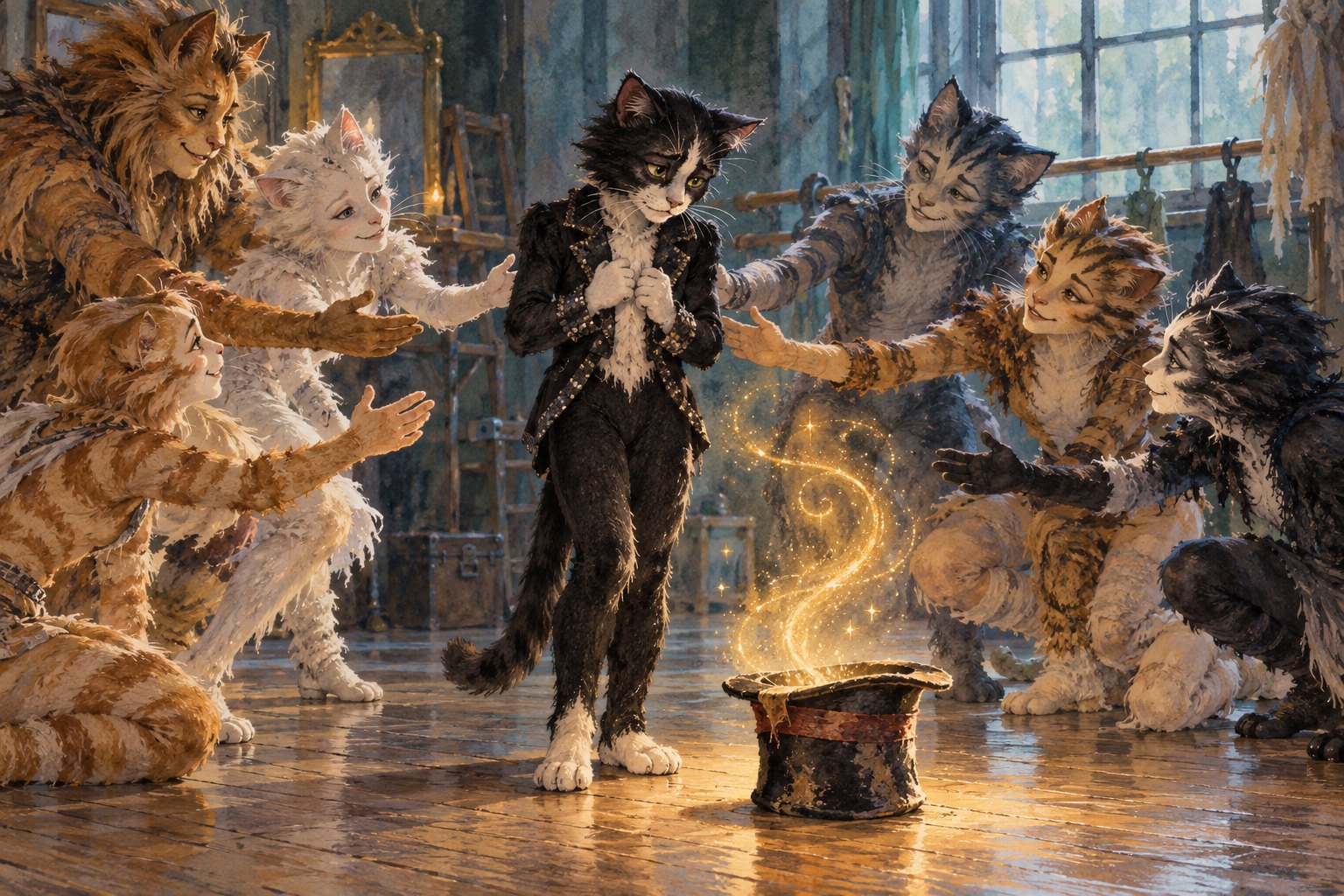
The rescue gives communal singing a practical dramatic purpose. The group helps a hesitant member sustain an effort whose outcome matters to everyone. Their attention becomes a resource instead of a verdict. For a film packed with individual showcases, this is a welcome change in the relationship between performer and audience.
The sequence can feel prolonged, and its emotional destination is easy to anticipate. Even so, the underlying construction works: uncertainty, encouragement, renewed effort, success. Talent becomes useful through trust. That is a stronger dramatic argument than simply introducing another spectacular cat.
The film struggles to give each kind of performance its own space
Seen through these characters, the movie contains several distinct experiences of performing: intimidation, remembrance, self-promotion, and stage fright. Those differences should generate changes in rhythm and attention. An anxious magician needs room for hesitation; an aging actor needs a listener; a manipulator needs us to register the people being manipulated.
My frustration with Cats is that its restless spectacle often competes with those needs. The elaborate environments and digitally transformed bodies keep offering fresh surfaces to inspect. The viewer’s attention can drift toward how a figure occupies the frame just when the scene needs us to understand what that figure wants.
Our earlier analysis of Victoria, Grizabella, and Old Deuteronomy considers the film’s emotional relationships more directly. The supporting performers reveal a related structural problem: a collection of distinctive acts does not automatically become a satisfying account of how a community values its members.
The ending quietly overturns the competition
Grizabella’s selection finally suggests that renewal answers vulnerability rather than dominance. Macavity cannot compel it. Professional distinction does not guarantee it. The result asks us to reconsider the apparent contest as an opportunity for the community to recognize someone it has pushed away.
The deeper implication, in my reading, is that worth becomes visible when the group changes how it watches. Gus needs attention that respects experience. Mistoffelees needs attention that supports effort. Grizabella needs attention that permits her return. Each requires something more generous than assessment.
That is why Dench’s reported regret provides a meaningful starting point for criticism without settling the verdict by itself. Cats contains recognizable ability and moments of tenderness, yet repeatedly struggles to organize them into a persuasive whole. Its most revealing achievement is the contrast it creates almost despite that struggle: winning demands a single chosen performer, while making something worthwhile requires the others to participate.
Original content by this site's editorial team. Published: October 20, 2026 at 07:54:29 PDT (Los Angeles time)