
Johnny Depp’s Ebenezer has entered the first-reactions conversation, with The Hollywood Reporter publishing coverage under that heading. For readers looking for an immediate verdict, however, the existence of that coverage does not establish a critical consensus. Without verified individual assessments and their context, calling the film a triumph, a disappointment, or a crowd-pleaser would go beyond what can responsibly be concluded here.
The more interesting question is what a persuasive response to this particular story should examine. An arresting Scrooge can make an entrance. A memorable Scrooge must make an audience believe that someone who has spent years refusing other people can finally learn to notice them.
This is character-focused commentary, not a review based on a screening. Spoilers follow for Charles Dickens’ original A Christmas Carol. References to its events and quotations describe the novella, not verified scenes or dialogue in Ebenezer. The accompanying images are conceptual illustrations.
What first reactions can tell a prospective viewer
A short reaction can capture something valuable: a performance that lingers, a surprising emotional response, or a striking visual impression. It rarely explains how consistently a movie sustains those qualities. The distinction matters especially with a familiar story, where recognizing a beloved moment can produce pleasure before a viewer has considered whether this version earns it.
For Ebenezer, a useful assessment would explain how the central performance develops. Does the character listen differently as the story progresses? Do his encounters alter his behavior, or does the film simply announce that he has changed? Those questions provide more guidance than an enthusiastic adjective standing alone.
There is also a difference between enjoying an actor’s presence and believing the character’s experience. Our discussion of what recognizable casting can promise a film makes a related distinction: familiarity creates expectations, while the finished relationships must justify them.
Scrooge’s defining habit is refusing to see
In Dickens’ novella, Scrooge makes his life manageable by narrowing its obligations. His nephew’s invitation is an inconvenience. Requests for charitable help are somebody else’s responsibility. Bob Cratchit’s needs belong beneath the demands of business. Scrooge does not merely dislike Christmas; he has organized his thinking to keep other people’s claims at a distance.
His famous dismissal, “Bah! Humbug!” is therefore more than a comic catchphrase. In the original text, it serves as a verbal door slammed shut. Dismissing an expression of warmth as nonsense saves him from having to respond to it sincerely.
My critical preference would be for a performance that allows this defensiveness to remain uncomfortable. If Scrooge becomes irresistibly lovable too quickly, the story loses the force of his cruelty. If he remains an abstract monster, his eventual awakening becomes difficult to believe. The dramatic challenge lies in showing a human being whose habits have hardened into harm.
That is the standard against which Depp’s characterization deserves to be considered. A distinctive voice, silhouette, or mannerism might establish the role, but the decisive work would happen when those defenses begin to fail.
The past offers an explanation without an excuse
The novella’s journey into Scrooge’s past complicates his present behavior. Memories of loneliness and lost affection reveal that his emotional isolation has a history. His relationship with Belle also exposes the growing authority of money in his life: security becomes something he pursues at the expense of intimacy.
These passages matter because they restore alternatives. Scrooge was not always exactly the person he has become. Other experiences and other choices were possible. Memory confronts him with a life that cannot be reduced to the identity he now performs.
An adaptation can mishandle that material by treating sadness as automatic absolution. Understanding why someone became cruel does not make the cruelty harmless. The strongest interpretation would let sympathy and accountability occupy the same scene.
For a viewer assessing Ebenezer, this provides a concrete question to carry into a fuller review: does the account describe a meaningful confrontation with past choices, or merely an affecting backstory? Emotional intensity and character development are related, but they are not interchangeable.
Bob Cratchit’s household is more than a lesson for its visitor
Scrooge dominates the narrative, yet Dickens gives his transformation significance through people whose lives continue beyond his attention. The Cratchits have their own attachments, worries, rituals, and pleasures. Their household matters before he recognizes its value.
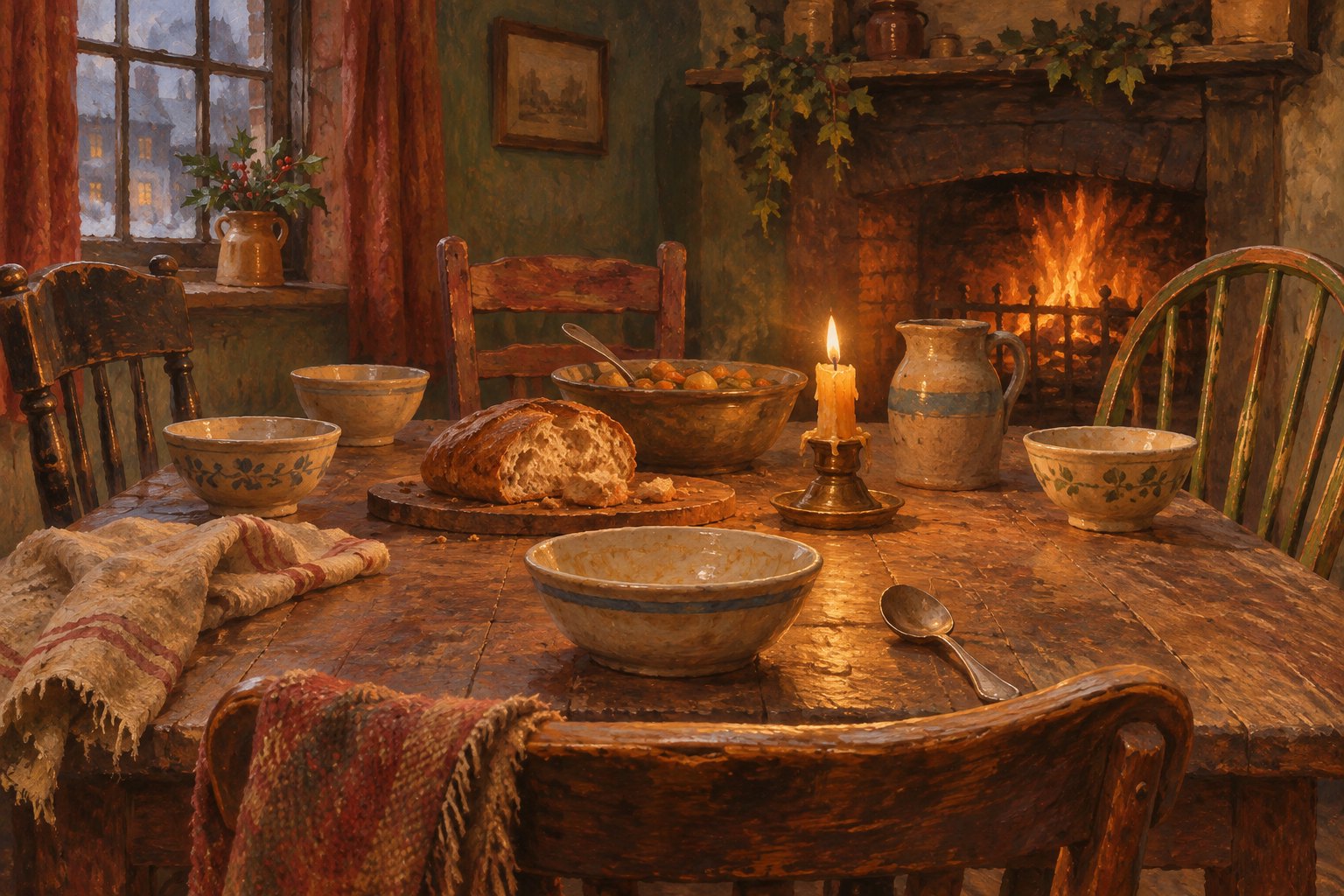
This is where a character-centered adaptation faces a particularly important test. Bob cannot function only as proof that his employer is unpleasant. Tiny Tim cannot exist solely to trigger the central character’s tears. Their vulnerability has emotional weight because they belong to a family with an existence of its own.
In the novella, Tim’s “God bless Us, Every One!” expresses an inclusive generosity that contrasts with Scrooge’s exclusion of others. The line’s familiarity can obscure its challenge: Tim extends goodwill beyond the boundaries that Scrooge treats as essential.
A production’s warmth would feel meaningful to me if it emerged from relationships and ordinary behavior. Attractive candlelight alone cannot supply that intimacy. It is the same concern behind our examination of giving vulnerable characters room to live beyond their condition: people become dramatically convincing when they are allowed more than one purpose.
Fear matters when it leads to responsibility
The supernatural structure of Dickens’ story makes avoidance progressively harder. The past exposes what Scrooge has lost. The present reveals what he refuses to acknowledge. The possible future forces him to confront consequences he cannot dismiss with another impatient remark.
That structure leaves considerable room for frightening imagery, but its deepest threat is relational. What does a life amount to when it has produced little affection, generosity, or grief at its passing? Scrooge encounters the possibility that his carefully protected existence has become terribly small.
His declaration in the novella, “I will honour Christmas in my heart,” matters because it promises continuity beyond a single overwhelming night. The ending gives that promise practical expression through generosity and changed conduct.
For any screen interpretation, the crucial distinction is between escaping punishment and accepting responsibility. A frightened man may want his future changed. A transformed man begins changing what other people can expect from him.
The verdict Ebenezer ultimately needs to earn
The first-reactions headline establishes a moment of attention around Ebenezer; it does not settle the quality of its storytelling. A meaningful recommendation will require evidence about the film’s actual choices, including its supporting characters, emotional pacing, and treatment of the ending. No performance rating or claim about specific Easter eggs is justified here.
My interpretive benchmark is straightforward: Scrooge’s redemption becomes moving when attention turns into action. Dickens’ enduring insight is that a person can know the language of business, duty, and self-preservation while remaining profoundly ignorant of the lives around him. The change is not simply that he feels more. It is that other people finally have reason to experience him differently.
That is what would make a new Ebenezer worth remembering after the first reactions fade: a convincing movement from shutting people out to making room for them.
Original content by this site's editorial team. Published: November 9, 2026 at 23:06:41 PST (Los Angeles time)