Godzilla rankings ultimately come down to what stays frightening after the buildings fall. My benchmark is still Godzilla (1954), with Godzilla Minus One its strongest companion for viewers who want human drama inside the destruction. Both make the monster matter through people whose decisions cannot be reduced to running, screaming, or explaining the next attack.
The arrival of Godzilla Minus Zero renews the worst-to-best debate, but a new title does not automatically earn a position through association. This is a character-focused argument about what should determine those positions, rather than an exhaustive franchise countdown or a scored review of Minus Zero.
Spoiler warning: Major plot developments and endings from Godzilla (1954) and Godzilla Minus One follow. Discussion of Minus Zero stays with its announced premise.
What should separate the best Godzilla movies from the rest?
A useful ranking needs room for different pleasures. Monster wrestling, disaster horror, political satire, and family adventure do not succeed by following identical rules. A playful installment should not lose points simply because it lacks the original's solemnity. The fair question is whether its characters, pacing, effects, and tone support the experience it promises.
My strongest preference is for films in which the human story changes the meaning of the spectacle. Destruction should reveal something: a scientist's compromised responsibility, a survivor's self-hatred, a community's ability to organize. If the people could disappear without changing the emotional shape of the climax, something essential is missing.
That is also why commercial success cannot settle artistic placement. Our discussion of what box-office milestones can and cannot tell us about a film makes a related distinction. Audience turnout establishes an event's scale; criticism still has to explain the experience.
Godzilla (1954): Serizawa makes victory morally frightening
Ishiro Honda's original remains my first choice because its solution is almost as disturbing as its monster. Dr. Daisuke Serizawa possesses the Oxygen Destroyer, a discovery capable of stopping Godzilla. Using it, however, risks introducing another means of mass killing into a world already shaped by catastrophic weapons.
From Serizawa's perspective, the dilemma is not whether he has enough courage to fight. It is whether saving people now can justify exposing people later to a new danger. His hesitation gives the film an ethical pressure that no increase in monster size could provide.
Emiko's position matters just as much. Keeping his confidence and protecting the public become incompatible obligations. The film places personal loyalty inside a disaster rather than suspending private relationships until the action is over. Knowledge becomes a burden shared between people who cannot preserve every promise.
Serizawa ultimately destroys his research and dies while deploying his invention. The ending defeats Godzilla without presenting technological ingenuity as an uncomplicated blessing. A rescue has occurred, but the person capable of repeating it has removed himself from the future.
That conclusion is emotionally devastating, although its logic deserves scrutiny. The film makes an individual's death carry the weight of controlling dangerous knowledge. It offers no comfortable institutional answer. For me, that unresolved anxiety is precisely why the original survives repeated viewing: the monster's disappearance does not make the world trustworthy.
Godzilla Minus One: Shikishima mistakes survival for failure
Takashi Yamazaki's Godzilla Minus One approaches responsibility through a man who believes he has already failed it. Koichi Shikishima survives both his abandoned kamikaze mission and Godzilla's attack on Odo Island. Mechanic Sosaku Tachibana's accusation helps turn that survival into a continuing sentence.
The crucial distinction is between what Shikishima did and what he believes he deserves. His fear during the attack becomes, in his own mind, evidence that he has forfeited the right to a future. Godzilla therefore threatens him twice: physically in the present and psychologically as the returning embodiment of a moment he cannot undo.
Life with Noriko and the orphaned Akiko challenges that belief. Their household creates obligations that cannot be discharged through one dramatic act. Being present tomorrow is harder for him to accept than imagining a death that might explain yesterday.
This is why the domestic scenes are central to the film's suspense. A repaired home or a shared routine gives destruction a specific emotional cost. We are watching someone acquire reasons to live while remaining suspicious of his entitlement to them.
Noriko gives the film its future—and exposes its limitation
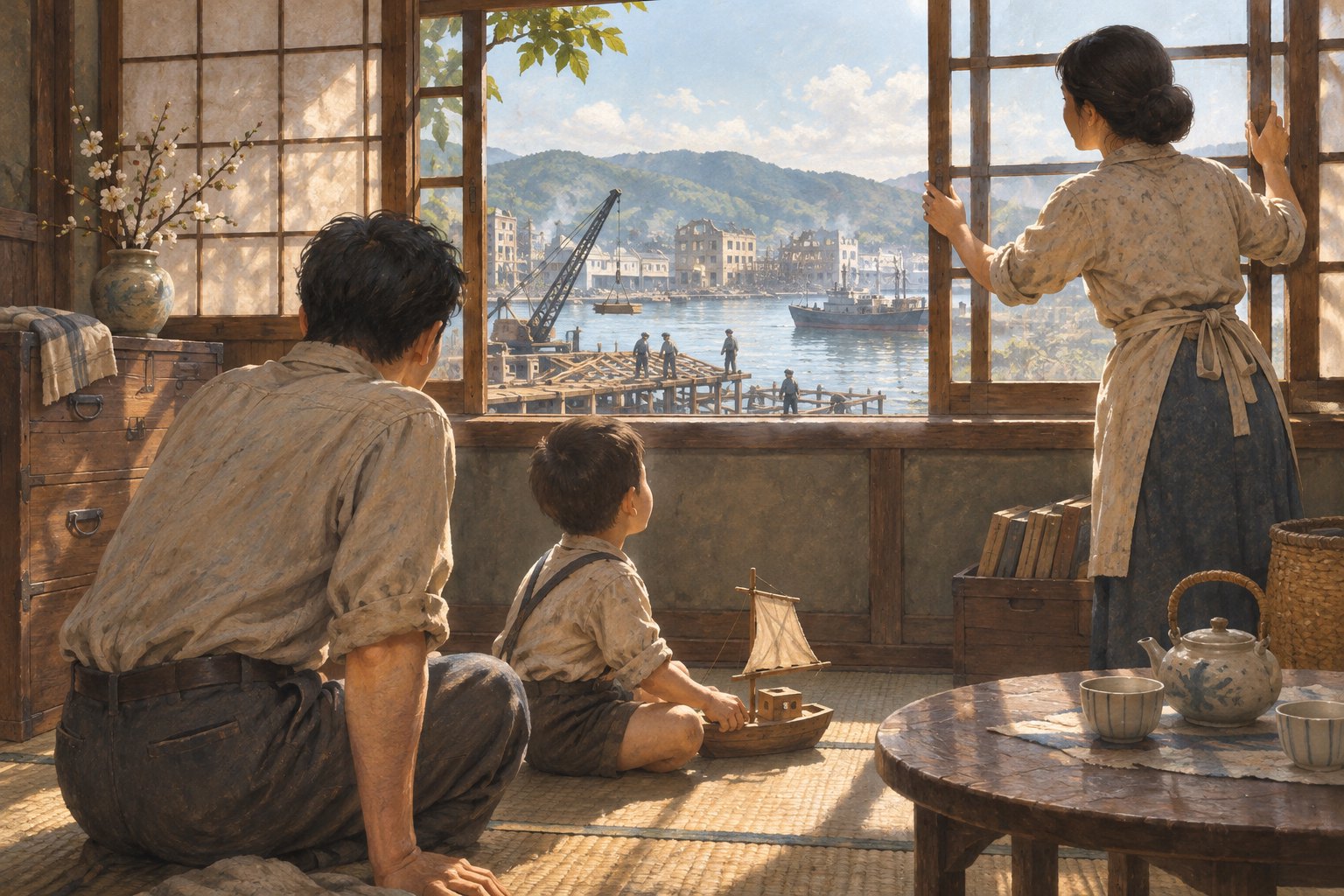
Noriko's practical commitment to building a life pushes against Shikishima's fixation on the dead. She is not merely asking him to feel better. Her presence makes an argument that caring for someone creates responsibilities beyond punishing yourself.
Yet the film gives his anguish greater dramatic space than hers. When Godzilla's Ginza attack apparently takes her from him, her absence intensifies his trajectory. The sequence is powerful, but it also reveals an imbalance: her suffering becomes most narratively important through its effect on him.
That reservation keeps my admiration from becoming unqualified. The emotional design is strong enough that I want more access to Noriko's interior life, not simply more reassurance about her fate.
Tachibana's most important repair is the possibility of return
Tachibana's instruction to Shikishima, rendered in English as “Live,” is the film's decisive reversal. The man associated with his guilt becomes someone who insists that guilt must not determine the ending. The aircraft's ejection seat turns that insistence into a practical possibility.
The climax consequently asks us to distinguish sacrifice from self-erasure. Shikishima can risk himself for others without treating his own death as the necessary proof of courage. That distinction also informs our analysis of character and responsibility in The Suicide Squad: action gains force when the people performing it have reasons to believe their lives matter.
Noriko's closing question, “Is your war finally over?”, brings the spectacle back to the person. Defeating Godzilla and escaping an internal war are related achievements, but they are not automatically the same one.
Where Minus Zero belongs in the conversation
TOHO's announced premise places Godzilla Minus Zero in 1949, two years after the preceding film's events, and continues the Shikishima family's story. That establishes a meaningful connection; it does not establish the sequel's quality or justify borrowing its predecessor's position.
The critical question is whether continuing this family deepens the idea of survival. Once a character has accepted that he should live, another disaster needs to test more than his willingness to repeat the same lesson. Relationships should develop, decisions should carry accumulated consequences, and familiar pain should reveal something new.
I would leave Minus Zero unranked here rather than turn that premise into a verdict. A defensible placement requires examining how the finished film handles those questions.
The deeper divide: dying responsibly or learning to live
The most revealing comparison between the original and Minus One is their opposite treatment of survival. Serizawa protects the future by making himself absent from it. Shikishima finally serves the future by allowing himself to belong to it.
Neither ending is reducible to a monster being defeated. Each asks what a damaged society expects from the people left standing. That is why the 1954 film remains my benchmark and Minus One its essential counterargument. The best Godzilla movies make us feel the scale of the creature, then leave us thinking about the value of one human life.
Original content by this site's editorial team. Published: November 9, 2026 at 22:33:27 PST (Los Angeles time)