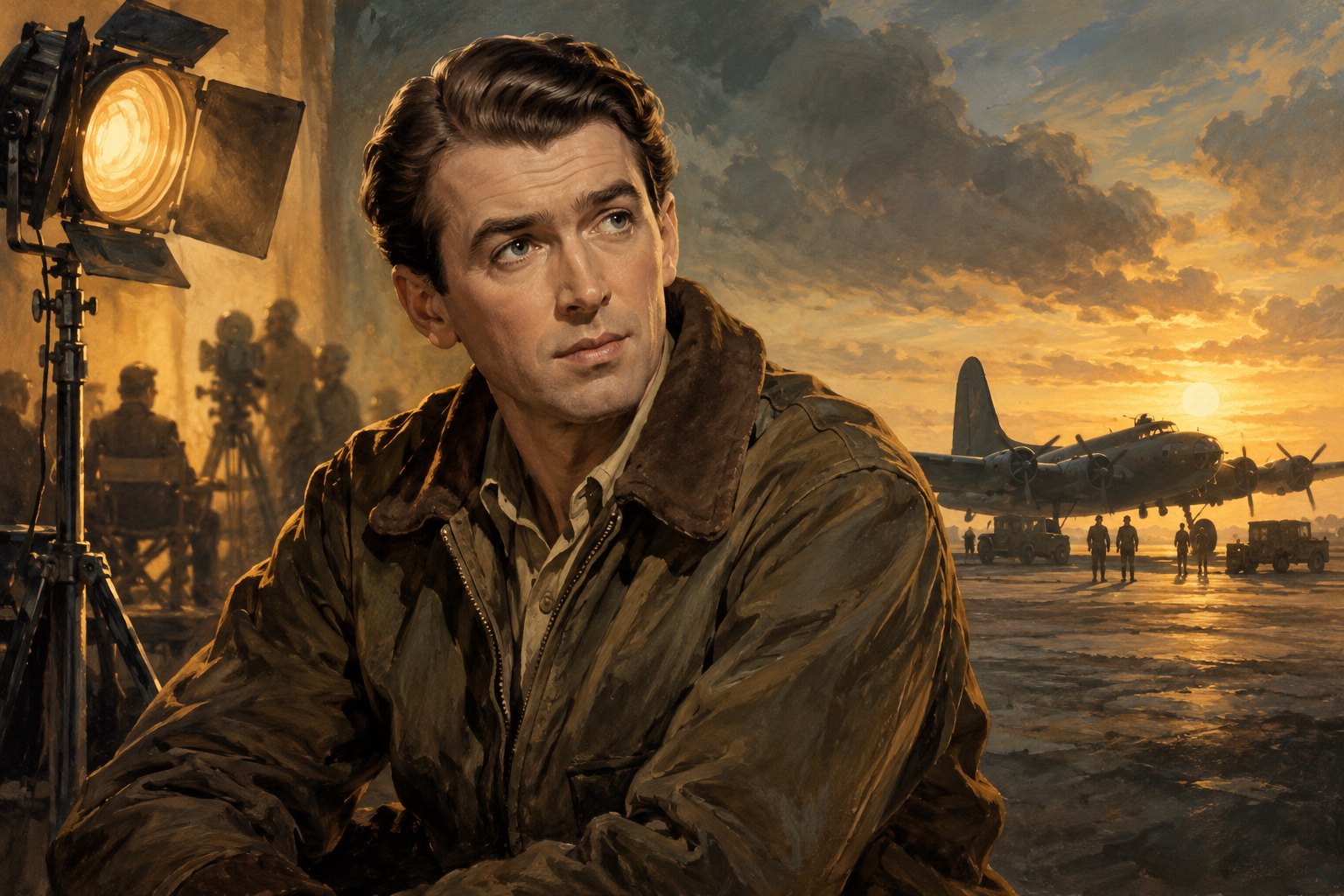
James Stewart’s journey from movie star to wartime pilot gives Jimmy a compelling question: what happens when someone celebrated for playing decent men must carry real responsibility for other people’s lives? His military service supplies the extraordinary history. His return to acting gives that history its most intimate dramatic possibilities.
Directed by Aaron Burns and written by Justin Strawhand, the film stars KJ Apa as Stewart and Max Casella as Frank Capra. Its announced story follows Stewart from his Oscar for The Philadelphia Story through combat service and toward It’s a Wonderful Life. Fathom Entertainment has announced a nationwide theatrical opening on November 6, 2026.
Review scope and spoilers: This is a critical preview grounded in the film’s confirmed premise and documented history, rather than a verdict based on a complete screening. The discussion includes the ending of It’s a Wonderful Life. Quotations from that classic are identified separately; they are not presented as verified dialogue from Jimmy.
The star who already knew how to fly
The first useful correction to the movie-star-goes-to-war shorthand is that Stewart brought relevant experience with him. According to the National Museum of the United States Air Force, he had accumulated more than 400 civilian flying hours before his military flight training. He entered the armed forces in March 1941, received his commission the following January, and worked as an instructor before going to England in 1943.
That background changes how we should understand the central character. This was not simply a celebrity seeking an unfamiliar adventure. Stewart possessed a practical skill that could become useful in a national emergency. The dramatic tension lies in the distance between being famous for something and wanting to be trusted with something else.
From Stewart’s perspective, recognition could therefore become an obstacle. A public figure arrives with an identity already attached: the familiar voice, the reassuring presence, the audience’s affection. Military competence has to be established through different evidence. The interesting character question is how a man accustomed to being recognized becomes willing to be evaluated.
That is also why the Oscar matters as more than glamorous scenery. It establishes the professional security Stewart was interrupting. A convincing treatment of this decision needs to make the abandoned career feel substantial; otherwise, sacrifice becomes an easy gesture without anything tangible behind it.
Command changes the meaning of courage
The Air Force museum records that Stewart commanded the B-24-equipped 703rd Bomb Squadron and later became operations officer of the 453rd Bomb Group. It credits him with 20 combat missions. These details establish that his service extended well beyond a symbolic appearance in uniform.
For a character-driven war drama, command creates a different kind of pressure from individual survival. A pilot must act under danger; a commander must also make decisions that affect people who depend on his judgment. The title “hero” describes how others may remember that service. It does not explain how responsibility feels to the person carrying it.
My strongest interest in Jimmy is consequently the relationship between competence and vulnerability. They can coexist. Knowing what to do does not remove uncertainty, and doing one’s duty does not guarantee an emotionally uncomplicated aftermath. A film that allows both conditions to remain visible can make courage more understandable without making it smaller.
This is a useful companion to the questions raised in our look at athletic identity and military responsibility in The Mosquito Bowl. In both stories, an established public identity meets circumstances that demand a different measure of character.
KJ Apa’s challenge goes beyond a familiar voice
Playing Stewart presents an unusual acting problem because recognition can arrive almost immediately. Viewers may listen for a cadence or watch for a particular posture before they engage with the person in the scene. An impression can establish resemblance quickly; sustaining a character requires more.
For Apa, the meaningful distinction will be whether Stewart’s recognizable manner changes with circumstance. Confidence in familiar surroundings, concentration at work, and discomfort after returning home should not become interchangeable expressions of the same celebrity impersonation. This is a standard for evaluating the performance, not a claim about scenes or acting choices that have not been independently assessed here.
Casella’s Capra introduces another productive relationship. A director knows an actor through collaboration, including abilities that the actor may temporarily doubt. That gives the return to filmmaking a potentially concrete emotional foundation: someone who remembers what Stewart can do offers him work that asks him to try again.
The challenge resembles the distinction explored in our discussion of Bruce Dern’s working life beyond his screen legend. An actor’s legacy becomes more interesting when attention shifts from a recognizable personality to the labor and choices behind it.
Why George Bailey belongs at the center of the homecoming

It’s a Wonderful Life was Stewart’s first movie after the war. Its significance to this story reaches beyond the pleasure of recognizing a beloved title. George Bailey is a man whose responsibilities repeatedly redirect his ambitions, until a financial crisis threatens his understanding of what his life has meant.
George is not Stewart, and the character should not be treated as a disguised military memoir. The connection is interpretive: both stories invite us to consider a person whose usefulness to others becomes difficult for him to see. The public may recognize value where the individual feels exhaustion or failure.
George’s plea, “I want to live again,” carries such force because it asks for an ordinary life back. He is not demanding that every frustration disappear. He wants to return to the relationships and imperfect circumstances he had come close to abandoning. Read alongside Stewart’s homecoming, the line suggests why returning to familiar work might hold deeper significance than restarting a career.
The ending offers another essential thought through Clarence’s written message: “No man is a failure who has friends.” Its power lies in shifting the measure of a life away from individual achievement. George’s worth becomes visible through other people’s actions, including their willingness to help him.
For Jimmy, that connection offers an emotionally persuasive destination. It also requires care. A meaningful acting role can provide purpose and expression without proving that suffering has been neatly resolved. Treating artistic work as an opportunity to reconnect is more convincing than treating one performance as a complete explanation of recovery.
The deeper story is learning to receive help
The most rewarding way to approach Jimmy is to follow the changing direction of responsibility. The celebrated actor has an audience. The military officer has people depending on him. The returning performer may need to depend on collaborators himself. Each position asks something different of the same person.
That progression gives the subject depth beyond the revelation that a Hollywood favorite served with distinction. It allows heroism to include the difficult business of returning: accepting uncertainty, finding useful work, and allowing other people to participate in one’s life.
The film’s premise deserves attention because it brings these identities into the same frame. Its ultimate achievement will depend on how fully it makes them human. Stewart’s medals explain why his service is remembered. The more searching question is how a man carrying that experience could stand before a camera again and make another person’s fragile hope feel believable.
Original content by this site's editorial team. Published: November 1, 2026 at 11:29:36 PST (Los Angeles time)