
I Play Rocky puts Anthony Ippolito in a particularly demanding position: playing Sylvester Stallone before the world had agreed that Sylvester Stallone could be a star. The appeal goes beyond resemblance. This is a story about someone whose writing earns attention while his ambition to perform it remains negotiable. That division gives the film its most interesting question: who gets to decide whether an artist belongs inside his own creation?
Movies We Texted About’s review singles out Ippolito’s transformation as a major strength. That is an encouraging assessment, but it remains another critic’s judgment. The discussion below offers a character-focused reading of the reported story and performance, rather than a firsthand screening verdict.
Spoiler note: This analysis discusses the central casting dispute and supporting characters’ roles. The accompanying artwork is conceptual illustration, not imagery from the film.
The role inside the role
Peter Farrelly’s film follows a young Stallone attempting to get Rocky made while insisting that he play its lead. Anthony Ippolito therefore has two identities to hold together: the recognizable future celebrity and the unproven actor experiencing events without knowing how they will end.
Those identities create different demands. Recognition encourages an audience to look for familiar speech and physical mannerisms. Character asks us to consider what the person wants, what he fears, and what he might lose. An impression can succeed almost immediately. A dramatic performance has to keep developing after that first flash of recognition.
For this particular role, the crucial distinction is between confidence and security. Stallone can be certain that he should play Rocky while having little reason to feel secure about his prospects. Those states are compatible. Someone may defend a decision fiercely precisely because everything surrounding it feels precarious.
That is the productive way to understand the praise for Ippolito: as a claim that the performance gives a famous identity an uncertain present. It is also the standard by which viewers can assess it. Does a moment reveal what this young man needs, or does it merely remind us whom the actor resembles?
“I play Rocky” makes authorship personal
The review describes negotiations in which Stallone refuses to surrender the lead despite increasingly attractive offers for his screenplay. The short declaration “I play Rocky” gives that conflict its clearest expression. The sentence connects a piece of work to the person who believes he must embody it.
From a buyer’s perspective, a script and its writer’s acting ambitions can be separate propositions. Admiring one does not automatically mean trusting the other. From Stallone’s perspective, that separation threatens the purpose of the opportunity itself. Selling the screenplay could solve an immediate problem while preserving the larger frustration: being allowed to contribute without being allowed to lead.
My reading is that this makes the dispute more revealing than a straightforward argument about money. Payment would acknowledge the value of his work. Casting would acknowledge a different claim about his possibilities. Neither form of recognition substitutes neatly for the other.
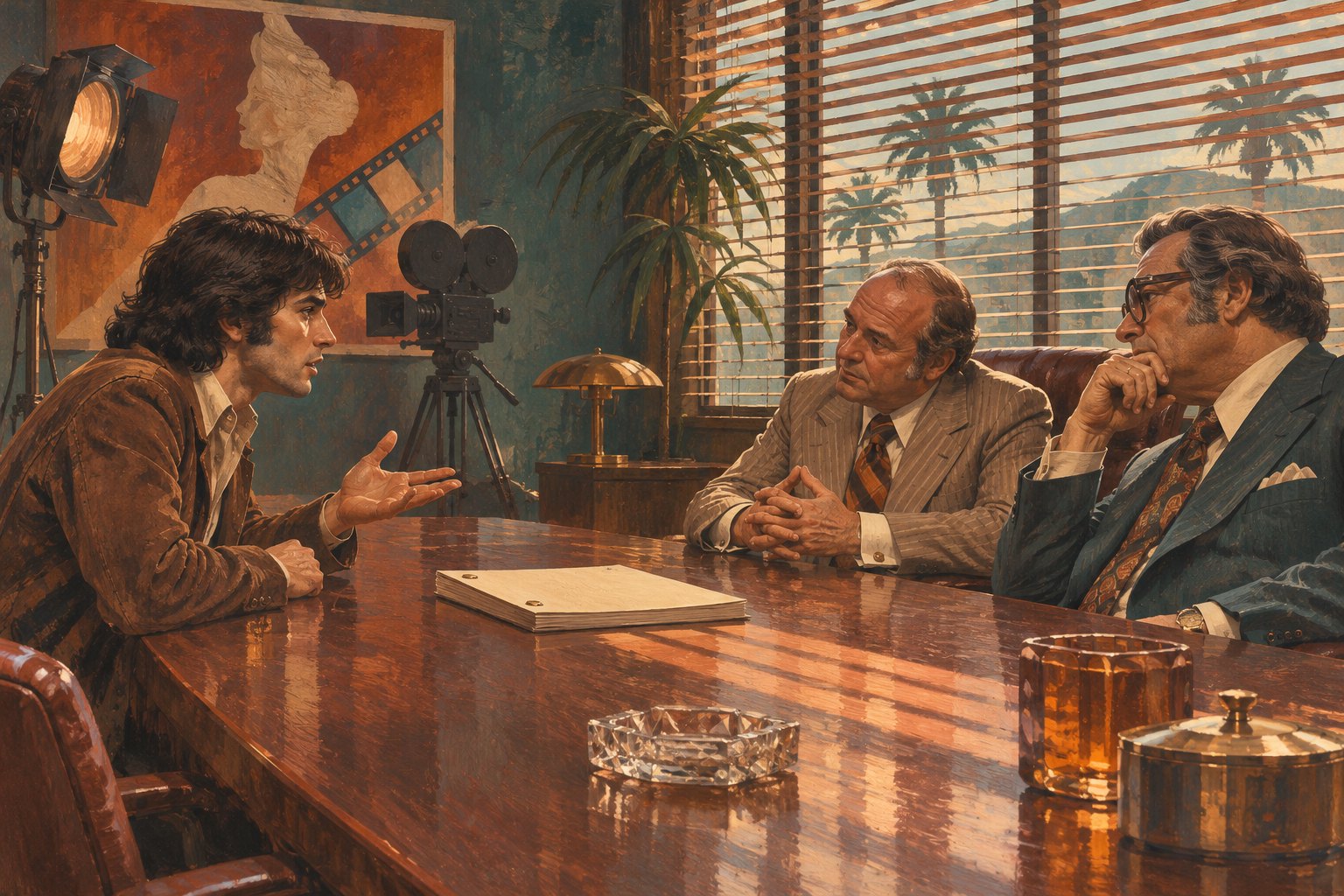
The title’s wording is useful here. “I play Rocky” is direct, almost grammatically stubborn. It leaves little room for compromise. Yet its emotional meaning depends on whether we hear a professional demand, a personal necessity, or both. A rich character reading allows those possibilities to remain in tension instead of deciding that every refusal must automatically be heroic.
Sasha’s perspective changes the price of conviction
AnnaSophia Robb plays Sasha Czack. The published review describes her encouraging Stallone’s writing and helping turn handwritten work into typed scripts. These details establish participation in the work, giving her a practical relationship to the ambition at the center of the story.
That matters because encouragement is often treated as an inexhaustible resource in films about exceptional people. The protagonist dreams; someone nearby supplies confidence. Looking from Sasha’s position changes the equation. Supporting an uncertain career involves time, effort, and decisions about what can reasonably be postponed.
A partner can believe in someone’s talent without endorsing every choice that talent inspires. Concern need not indicate a failure of imagination. It can represent a clearer view of consequences. Likewise, accepting help does not diminish an artist’s achievement; it makes the achievement more accurately understood.
This is where the film invites a useful question for viewers: when Stallone protects his future, whose present is being spent? That question does not cancel the appeal of persistence. It gives persistence an ethical dimension. Our discussion of why a biopic’s point of view matters considers the related importance of examining whose experience organizes a life story.
The people who must say yes
The reported story also gives producers Irwin Winkler and Robert Chartoff, played by P.J. Byrne and Toby Kebbell, a place between Stallone’s demands and the business of getting a film made. Their presence introduces another perspective on belief: the responsibility of committing resources to someone else’s certainty.
For an aspiring star, rejection can feel like a verdict on personal worth. For a producer, a casting decision creates obligations beyond the person asking for the part. Reading both positions together makes the central dispute more substantial. Talent needs recognition, but recognition becomes consequential when somebody must act on it.
The interesting dramatic territory is the movement from listening to commitment. Agreement is easy when nothing depends on it. Supporting a production means allowing a judgment to become vulnerable to an outcome. That is why collaborators deserve attention as characters with their own exposure to failure.
It is also a useful extension of the case for supporting characters with independent stakes. A central performance gains depth when the people around it have reasons to hesitate, disagree, and eventually commit.
The deeper meaning: being seen before becoming famous
The premise of I Play Rocky contains an unavoidable imbalance: audiences recognize a name that the characters must evaluate without our hindsight. Knowing Stallone’s eventual significance makes his insistence easier to applaud. It can also make uncertainty harder to appreciate.
A more demanding interpretation temporarily sets that knowledge aside. Would the decision still look reasonable before success supplied its justification? What distinguishes conviction from a gamble that happens to work? Those questions make the story worth discussing even when its broad destination is familiar.
Ippolito’s role sits directly inside that uncertainty. The transformation that matters most is the possibility of seeing a recognizable star as someone who still needs permission to begin. For viewers drawn to performance and character, that is the strongest reason to be interested in this film. Its central declaration becomes an argument about recognition: a person asking others to see a capacity that has not yet been publicly proved.
Original content by this site's editorial team. Published: November 18, 2026 at 16:26:30 PST (Los Angeles time)