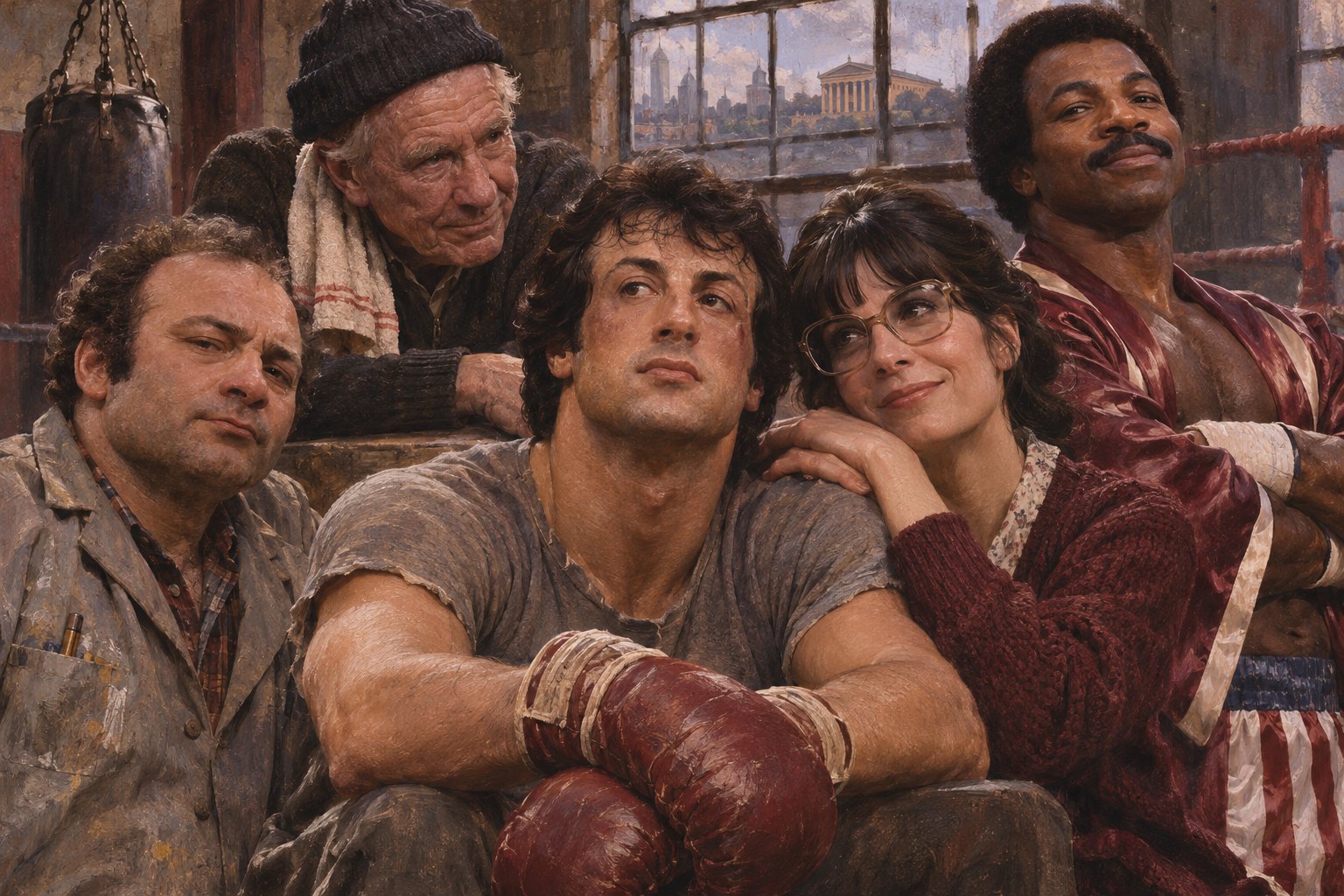
I Play Rocky and Mike Sielski’s Going the Distance: Stallone, Philly, and the Story of Rocky approach the same creation story with different responsibilities. The immediate answer to readers comparing them is straightforward: Sielski identifies differences in Stallone’s temperament, the identity of a studio executive, and the familiar story about his dog, Butkus. He also makes an essential distinction: the movie was developed independently of his book.
Those differences invite a more interesting discussion than whether Hollywood changed a few details. Each affects whom we sympathize with, whose resistance seems reasonable, and how easily creative ambition becomes a reassuring legend.
Spoiler note: This commentary discusses reported characterizations and story elements from I Play Rocky. It analyzes Sielski’s comparison and documented scenes; it does not present a firsthand screening review.
The central conflict: who gets to play the person on the page?
Directed by Peter Farrelly from Peter Gamble’s screenplay, I Play Rocky stars Anthony Ippolito as the young Sylvester Stallone. The official premise centers on his determination to both write Rocky and play its lead. That gives the film a conflict audiences can understand immediately: an aspiring actor sees an opportunity that depends on other people accepting his assessment of himself.
The line “That’s me on the page,” quoted in the Associated Press review, crystallizes that emotional position. For the screen character, selling a screenplay and surrendering its central role are not equivalent forms of success. One gets his work made; the other lets him embody it.
My reading is that this identification supplies both the story’s appeal and its critical vulnerability. A character can feel completely certain that a role belongs to him. A film still has to make that certainty compelling to viewers who know confidence alone cannot establish talent. The interesting dramatic question is what his conviction costs, and how he behaves when someone else has an equally firm opinion.
Stallone’s temperament changes the meaning of persistence
Sielski argues that Ippolito’s portrayal softens Stallone, whose behavior during the original production was more assertive and confrontational. His objection concerns the tendency to merge the actor with Rocky Balboa.
That distinction matters because gentleness and determination produce one kind of protagonist, while determination mixed with combativeness produces another. A gentle outsider asks for recognition. A forceful collaborator also asks for control. Both can be sympathetic, but they create different obligations for everyone around them.
For me, a biography becomes richer when it allows admirable qualities to become difficult in practice. Persistence may keep a project alive while exhausting a colleague. Protectiveness toward a screenplay may preserve its personality while making a useful suggestion feel like an attack. These are possibilities inherent in creative collaboration, not additional claims about particular incidents.
From the protagonist’s perspective, resistance can feel like proof that nobody understands him. From a collaborator’s perspective, the same exchange may involve someone refusing to listen. A strong character study makes space for both experiences. Otherwise, every disagreement arrives with its verdict already attached.
Readers interested in the distinction between performers and their fictional identities can explore how the original Rocky cast’s characters developed across the franchise. Here, the important boundary is between creating a beloved character and possessing that character’s personality.
Sandy Maddox makes institutional resistance personal
Another difference is concrete: Sielski identifies Sandy Maddox, played by Tracy Letts, as a composite of United Artists executives. Viewers should therefore avoid treating him as a single historical participant.
Combining people can make a complicated production story legible. An audience can follow a negotiation more readily when one recognizable face expresses the opposing position. The tradeoff is that institutional decisions acquire an individual temperament: caution can look like hostility, and a commercial calculation can resemble a personal insult.
Seen from Stallone’s side, a studio executive controls access to the future. Seen from the executive’s side, an unknown performer represents uncertainty. That imbalance is dramatically useful, but uncertainty itself is not evidence of bad faith.
My standard for a composite character is whether the simplification preserves meaningful disagreement. Does the opposing position have a logic viewers can understand? Can the protagonist’s eventual success coexist with the possibility that the initial concern was reasonable? Those questions reveal more about a biopic’s fairness than counting how many historical names appear.

Butkus raises a different question: who pays for a moving anecdote?
Sielski also disputes the film’s use of the familiar account in which financial hardship forces Stallone to sell Butkus and later pay heavily to recover him. His column calls that account inaccurate but leaves the fuller explanation to his book. The comparison alone does not establish the complete alternative sequence.
That limit matters. Replacing a questionable anecdote with an imagined correction would simply create another unreliable story.
A beloved animal gives hardship an immediate emotional scale. Money stops being an abstract measure of success when its absence threatens a relationship. For a character-centered movie, that is powerful material: viewers understand affection before they understand contracts.
But the other person in such an anecdote also receives a role. The more cruel or opportunistic that person appears, the more satisfying the protagonist’s eventual recovery becomes. Emotional clarity can therefore carry a reputational cost beyond the central character.
My judgment is that this deserves greater scrutiny than ordinary narrative compression. Combining several meetings might change pacing. Assigning blame changes how an audience understands another person. The two choices should not receive an automatic, identical exemption because the larger story is inspirational.
How to compare the film and book usefully
The best comparison starts by separating three questions:
- What does the film portray? Describe the action or characterization without immediately treating it as historical evidence.
- What does the reporting establish? Identify the supporting account and distinguish a documented correction from an unresolved dispute.
- What does the difference accomplish? Consider whether it changes sympathy, responsibility, or the apparent reason something happened.
This approach also leaves room for enjoyment. A scene can communicate longing effectively while requiring qualification as history. Recognizing that tension makes criticism more precise.
It also helps restore attention to collaboration. Our discussion of how actors, directors, and less visible collaborators share creative credit considers a related problem: cinema encourages us to remember a face even when an achievement depends on many people.
The deeper issue is what an underdog victory proves
The most compelling interpretation of this comparison is that success can reshape our understanding of everything preceding it. Once we know an artist’s work endured, stubbornness becomes vision, uncertainty becomes blindness, and compromise can start to sound like betrayal.
That is a satisfying narrative pattern. It is also worth resisting as a complete explanation of how art gets made. A successful film does not retroactively make every demand wise or every objection foolish.
I Play Rocky invites attachment to the person fighting for his chance. Sielski’s comparison asks viewers to examine the personality, institutions, and anecdotes supporting that attachment. Taken together, they offer a productive way to appreciate the legend: care about the ambition, stay curious about the collaborators, and let the human being remain more complicated than the hero he created.
Original content by this site's editorial team. Published: November 8, 2026 at 04:02:07 PST (Los Angeles time)