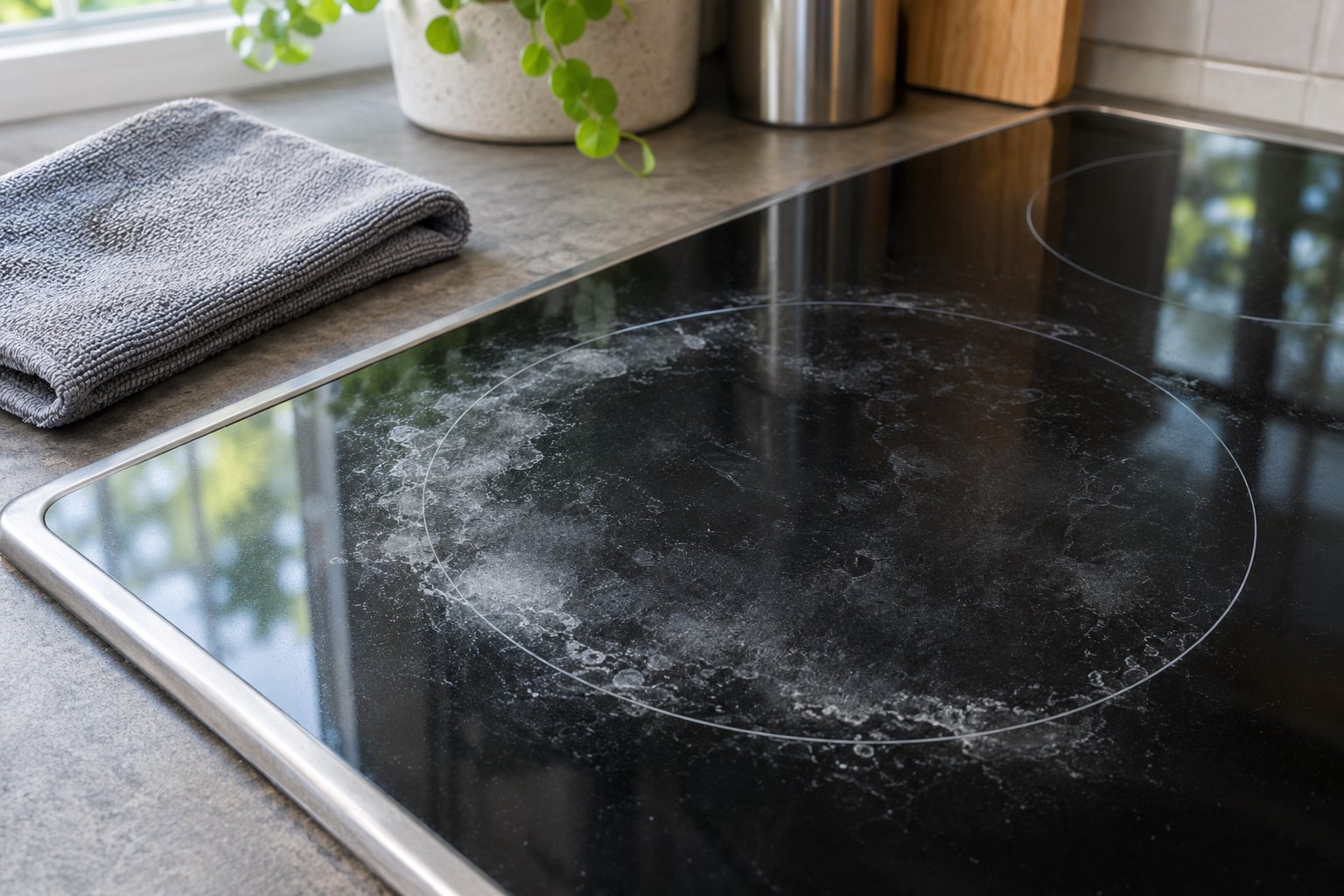
White film on a glass-top stove calls for a gentle first step: switch off the appliance, let the surface cool, and check its cleaning instructions before choosing a product or tool. Start with a clean, lightly dampened cloth, then dry the area and inspect it. If the haze remains, use the treatment approved for your particular cooktop rather than increasing pressure.
The frustrating part is that a pale mark does not tell you what caused it. Before treating the entire stove, work on one small area. That gives you a useful answer: is the cleaning method actually removing something, or are you repeatedly rubbing an unchanged surface?
Look at the mark before choosing a cleaner
Take a moment to recall when the cloudiness appeared. Was there a recent boil-over? Did it become noticeable immediately after cleaning? Does it follow the path of a pan? These observations help you describe the problem accurately, although none establishes a diagnosis on its own.
Wolf identifies evaporated water and food as possible sources of mineral deposits on its glass cooktops. It also distinguishes metal marks associated with moving cookware across the surface. Its care guidance recommends vinegar for hard-water spill-over stains and acknowledges that some marks can be permanent. These details explain why every white patch should not receive the same treatment. [Wolf’s glass-cooktop care guidance](https://www.subzero-wolf.com/assistance/answers/wolf/common/cleanelectric-and-inductionglass-cooktops)
Look at the dry surface under steady light. Photograph the affected area if that helps you compare it later. Avoid judging the result while the glass is wet: your useful comparison is the appearance before cleaning and after the surface has dried again.
Check the finish, not just the appliance category
The phrase glass-top stove is not a complete cleaning specification. Find your model’s care instructions and look for information about coatings, approved cleaners, permitted tools, and spill treatment. Keep those instructions nearby while you work.
This matters particularly with scrapers. Whirlpool warns that scrapers may damage the coating on its WipeClean cooktops and advises against their use. Its instructions prioritize water soaking, soft cleaning materials, and limited use of a suitable nonabrasive cooktop cleaner for persistent soil. [Whirlpool’s WipeClean cleaning instructions](https://producthelp.whirlpool.com/Cooking/Cooktops/Electric_Cooktop/Cleaning_and_Maintenance/WipeClean_Glass_Cooktop_Cleaning)
A technique demonstrated on somebody else’s stove is therefore only a starting point for research. Before copying it, establish that your appliance permits the same treatment. If you cannot identify the finish, postpone scraping and contact the manufacturer with the model number.
A controlled cleaning sequence
1. Prepare a small test area
For ordinary cleaning of an existing white film, begin with the controls off and the cooktop cool. Remove cookware and set out separate clean cloths for wiping and drying. Read both the appliance instructions and the cleaner label before opening a product.
Choose a manageable section of the affected area. You do not need to cover the whole stove to learn whether a method helps. Keeping the first attempt small also makes it easier to remove the product thoroughly and inspect the result.
2. Try the approved basic cleaning method
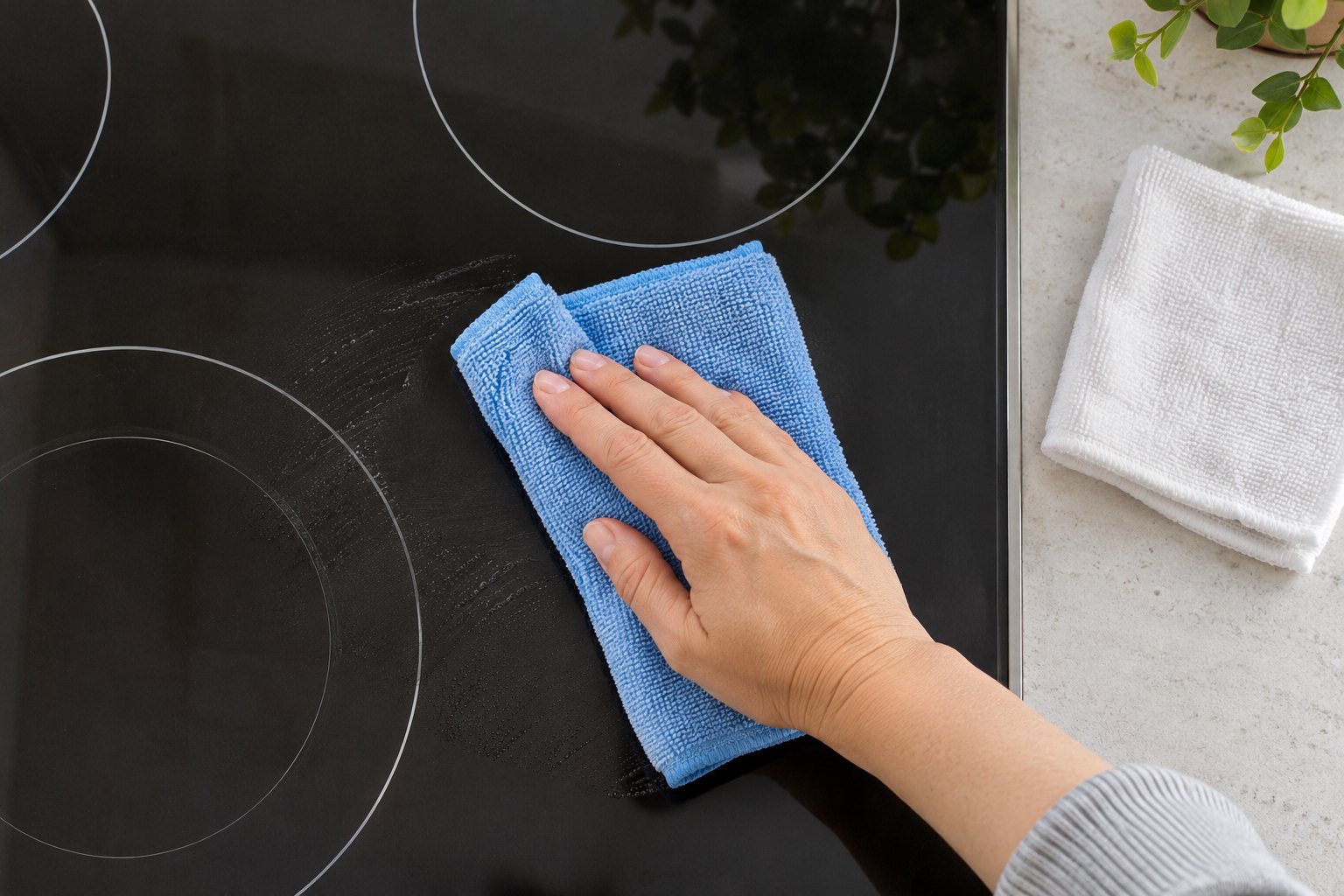
Use the simplest cleaning method listed in the manual. Wolf’s standard sequence includes an appropriate cooktop cleaning cream, a lightly dampened cleaning cloth, another wipe to remove residue, and a dry finish. WipeClean instructions instead begin with a water soak and gentle removal of loosened soil. Follow the sequence for your own surface.
Be deliberate about the final wipe. Use a fresh part of the cloth rather than continuing with the same soiled section. Finish the small area completely before deciding whether it needs another treatment.
3. Match any further treatment to the suspected residue
If a chalky spill mark remains, check whether your manufacturer authorizes a mineral-deposit treatment. Vinegar is an option in Wolf’s guidance, but that is not permission to apply it indiscriminately to every glass surface, surrounding trim, or specialized coating.
If the manual specifies a cooktop cleaner, choose the stated product type and follow its directions for quantity, application, and removal. Do not substitute a similarly named powder or assume that a product suitable for another kitchen surface is appropriate here.
4. Dry, compare, and decide
After the permitted cleaning cycle, compare the dry test area with the untreated portion. Look for an actual reduction in the mark’s size or opacity. A clearer section supports continuing that same approved method across the remaining residue.
If nothing changes, pause. Repeating a process without visible progress is a poor reason to press harder or add another product. Write down what you used and how the surface responded; that information is more useful for troubleshooting than an escalating list of experiments.
Why a scraper should not be your automatic next step
Some conventional ceramic-glass cooktop instructions include a dedicated scraper for particular deposits. Whirlpool’s conventional induction-cooktop guidance, for example, describes scraper use followed by cooktop cleaner and polishing. That permission is specific to the applicable surface and procedure. [Whirlpool’s ceramic-glass induction-cooktop instructions](https://producthelp.whirlpool.com/Cooking/Cooktops/Induction_Cooktops/Cleaning_and_Maintenance/Ceramic_Glass_Cooktop_-_Induction_Cooktop)
For a thin, unidentified haze, first establish what you are trying to remove. If your manual permits scraping, use the specified tool and technique. If it prohibits scraping, a stubborn mark does not create an exception.
Fresh sugary spills can have special removal instructions. Treat those as a separate situation and consult the appliance guidance promptly; a routine for old white film should not replace the manufacturer’s spill procedure.
Know when cleaning has reached its limit
Stop experimenting when an approved treatment produces no improvement, when you suspect damage, or when you cannot establish which tools are permitted. Ask the manufacturer whether the appearance suggests residue, a cookware mark, or a change to the finish. Include the model number, clear photographs, and the products already used.
A useful stopping point protects both the appliance and your time. The goal is a clean, serviceable cooking surface. A promise that every cloudy patch can be polished away should make you skeptical, especially when it comes without any reference to the appliance’s finish.
Make the next cleanup easier
Keep a short routine based on the manual: use approved materials, complete the residue-removal step, and inspect the dry surface before putting everything away. Store the care instructions where you can find them. The next time a mark appears, you will have a known process instead of starting with a different household remedy.
Once the kitchen is ready for movie night, our Home Alone retrospective on Kevin’s independence and family connections offers a seasonal change of pace. For a darker viewing discussion, explore our analysis of the characters behind Longlegs’ horror.
Original content by this site's editorial team. Published: November 21, 2026 at 22:25:13 PST (Los Angeles time)