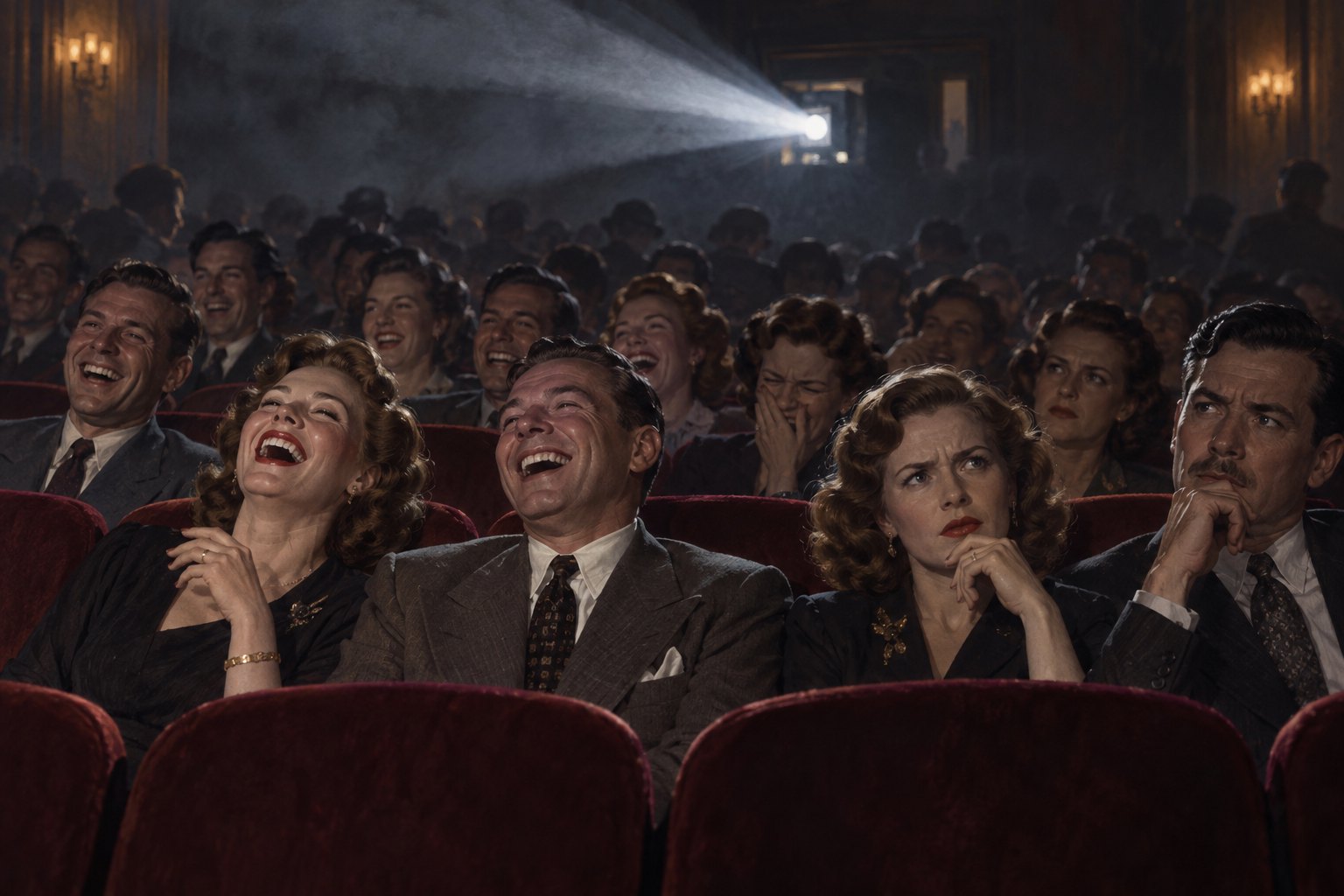
An Evanston audience helped change Sunset Boulevard by laughing at its original opening. Billy Wilder’s film initially introduced the dead Joe Gillis in a morgue, where corpses conversed. The reaction exposed a problem: viewers were taking the premise as an invitation to broad comedy. The finished film instead places Joe’s body in a swimming pool, preserving his narration from beyond the grave while giving his story a more ominous entrance. Film historian Steven M. Scene’s account is unnecessary to the point; author Steven Bingen and other historians have discussed the production, but the specific Evanston reaction is recounted by film historian Sam Staggs and, more recently, author Steven Cohan’s fellow scholar David M. Lubin in a [published interview about the film’s history](https://www.fathomentertainment.com/news/new-book-celebrates-sunset-boulevards-75th-anniversary-with-behind-the-scenes-secrets-exclusive-2/).
The significance becomes clearest when watching the movie through its characters. Joe thinks intelligence will protect him. Norma Desmond believes attention will restore her. Max von Mayerling believes devotion can keep reality outside. My reading is that the revised opening strengthens the tragedy by showing the cost of those beliefs before anyone has explained them.
Spoilers follow for the entire 1950 film, including its ending.
What the Evanston reaction actually changed
The essential distinction is between removing an idea and changing its presentation. Wilder retained the audacious device of a murdered man narrating his own downfall. What disappeared was the morgue conversation that had encouraged audiences to treat death as a comic routine. Turner Classic Movies’ [production history](https://www.tcm.com/articles/373027/behind-the-camera-sunset-blvd) documents the discarded scene and the replacement opening.
Calling this a moment that changed movie history is defensible in a specific sense: audience response helped reshape the opening of an enduring Hollywood film. It does not establish that one screening invented a storytelling technique or single-handedly determined the movie’s reputation.
The finished sequence establishes a crime scene before introducing the flashback. Joe’s wit survives, but it now accompanies visible consequences. We can enjoy his delivery while recognizing that his ability to make a situation sound ridiculous never gave him control over it.
That is also why first encounters matter. As our discussion of how premiere expectations shape a film’s reception considers, the circumstances of a screening influence how viewers approach a story. Here, the opening itself supplied the misleading expectation.
Joe Gillis: the narrator who cannot outsmart his own story
William Holden’s Joe is a struggling screenwriter who enters Norma’s property while evading men seeking to repossess his car. He accepts work on her proposed screen vehicle and becomes financially dependent on her. Those basic circumstances, documented in [TCM’s film overview](https://www.tcm.com/articles/373025/the-essentials-sunset-blvd), give his compromises an ordinary starting point: he needs money.
Holden makes that need persuasive without turning Joe into an innocent. His conversational ease suggests someone accustomed to explaining away a bad decision. Each concession can be treated as temporary. A comfortable arrangement becomes harder to leave precisely because he keeps insisting that he understands it.
The pool opening punctures that confidence. A conventional escape story might ask whether Joe will recognize danger soon enough. Here, recognition is insufficient. He can describe the trap beautifully and still remain inside it.
This is the film’s sharpest treatment of cynicism. Joe’s jokes create intimacy with us, but intimacy should not be mistaken for moral authority. Listening closely means noticing how often his amused superiority protects him from examining his own conduct.
Norma Desmond: a performance that needs witnesses
Gloria Swanson gives Norma a grandeur that is funny, commanding, and painful. When she declares, “I am big. It’s the pictures that got small,” the line is both a magnificent defense and a refusal to reconsider herself. The exchange appears in the film’s opening encounters, transcribed in [Filmsite’s scene account](https://www.filmsite.org/suns.html).
Swanson’s emphatic gestures are central to the characterization. Norma behaves as though a close-up might arrive at any moment. Her body preserves the habits of public display even in private conversation. Joe’s comparatively casual manner makes their scenes feel like competing understandings of what being seen requires.
In my view, reducing this performance to excess misses its precision. Norma does not merely remember fame fondly. She needs other people to confirm a version of existence in which her importance remains unquestionable. An ordinary disagreement can therefore feel like an attempt to erase her.

The private screenings concentrate that problem into one image: the present arranged around an endlessly recoverable past. The old performances can be projected again. The original relationship between star and audience cannot be summoned so easily.
Beginning with death makes it harder to dismiss Norma as an entertaining eccentric. Her theatricality remains enjoyable, but the film has already attached a terrible consequence to the household’s refusal to face change.
Max and Betty offer opposite kinds of attention
Max, played by Erich von Stroheim, sustains Norma’s belief in her continuing popularity by writing her fan letters. He is also her former director and first husband. Betty Schaefer, played by Nancy Olson, collaborates with Joe on a screenplay and becomes romantically involved with him. These relationships are detailed in the [American Film Institute’s synopsis](https://catalog.afi.com/Film/26513).
Max’s quietness makes him easy to underestimate. He supplies the evidence Norma wants, then treats preserving her belief as an obligation. His devotion is moving because it entails sacrifice; it is disturbing because it makes deception a daily service.
Betty offers Joe a different experience of being taken seriously. Collaboration requires work that another person can question and improve. Approval has to be earned through a shared process. Norma’s household instead rewards participation in an established fantasy.
This difference gives the relationships dramatic weight beyond a romantic triangle. As in our character-centered assessment of the Harry Potter films, the revealing question is what each relationship allows a person to become. Joe has an alternative, which makes his evasions more consequential.
The final close-up turns attention into a terrible reward
After Norma shoots Joe, the cameras gathered at her home become, in her perception, the machinery of her return. Max helps stage her descent down the staircase. Her final declaration—“All right, Mr. DeMille, I’m ready for my close-up”—completes the confusion between a criminal investigation and a film production. The ending and dialogue are documented in [Filmsite’s concluding scene analysis](https://www.filmsite.org/suns3.html).
My strongest response to the ending is discomfort at how closely visibility resembles victory. Norma has regained attention, but attention cannot supply the recognition she wants. The camera records her while she misunderstands why it is there.
Evanston’s laughter therefore matters beyond a production anecdote. The revision helps establish the emotional distance the ending needs: enough room to appreciate the film’s wit, but insufficient room to escape its suffering through laughter alone.
Hollywood references that deepen the tragedy
The film’s references to actual Hollywood history give its invented household additional resonance. Norma’s bridge companions include Buster Keaton, Anna Q. Nilsson, and H. B. Warner; Cecil B. DeMille also appears as himself. These appearances are identified in [TCM’s cast listing](https://www.tcm.com/articles/373025/the-essentials-sunset-blvd).
They do more than reward recognition. Real figures from the industry stand inside a fictional account of its memory and neglect. Norma’s past acquires substance without making her interpretation of the present reliable.
That tension is what makes Sunset Boulevard so powerful. Its characters confuse being watched with being valued, being needed with being loved, and understanding a compromise with escaping it. The revised opening gives us the consequence first. The rest of the film shows how people can keep performing long after the performance has stopped protecting them.
Original content by this site's editorial team. Published: September 27, 2026 at 19:05:47 PDT (Los Angeles time)