Henry Winkler says his name was kept off the original Scream poster because his association with the Fonz threatened the impression its advertising wanted to create. According to Variety’s reporting, the explanation he remembers included “you were the Fonz” and concern that his presence would “knock the balance of horror off.” That is Winkler’s account of the decision, rather than an independently established measure of how audiences would have responded. [Variety’s report](https://malaysia.news.yahoo.com/henry-winkler-says-name-cut-203834315.html)
The distinction matters because the film itself suggests a compelling alternative reading. Familiarity can make horror more effective. Winkler’s Principal Himbry brings a recognizable adult presence into a story where recognition repeatedly becomes a dangerous shortcut. Looking again at his small role reveals how carefully Scream separates feeling reassured from actually being safe.
Major spoilers follow for Scream (1996), including Himbry’s death and the killers’ identities.
What a familiar name promises before the movie begins
The marketing concern Winkler describes is understandable as a question of expectation. A performer associated with a beloved television character can suggest a tone before viewers know anything about the new role. Someone encountering Winkler’s name might anticipate warmth, humor, or the pleasure of recognition.
But that expectation is also material a director can use. Wes Craven’s film, written by Kevin Williamson, repeatedly invites viewers to make assumptions and then tests their reliability. A school principal should represent order. A boyfriend should offer intimacy and support. Knowing the conventions of horror should provide an advantage. Each proposition becomes unstable.
My reading is that Winkler’s familiarity strengthens this design. His presence gives the adult world an immediately legible face. When that world proves vulnerable, the loss registers quickly. The casting supplies an emotional association that the story can disturb, whether or not the advertising foregrounds it.
Himbry’s authority has a strict limit
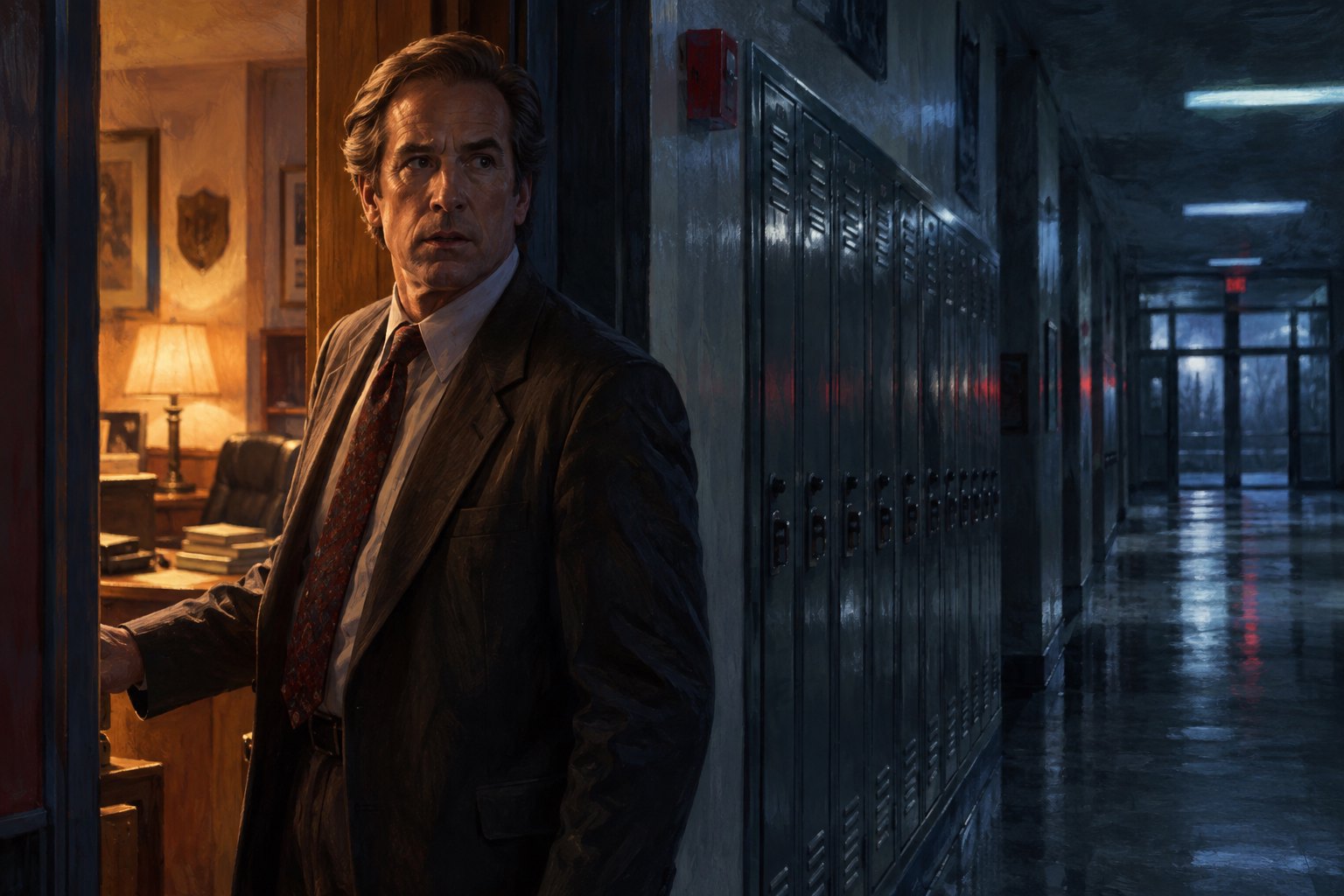
Himbry understands the murders as a crisis demanding adult control. His confrontation with students wearing the killer’s costume makes that responsibility concrete: young people are turning other people’s terror into a prank. His anger carries a legitimate moral objection, even as his manner makes the encounter uncomfortable and darkly funny.
Winkler’s performance works through that friction. Himbry can command attention, reprimand students, and insist on consequences. Those are meaningful powers within a school. The problem is that the danger has escaped the institution’s familiar categories. A disciplinary response cannot make a masked murderer behave like a student who fears expulsion.
After the school empties, Himbry is killed in his office. Later, news of his death draws partygoers away from Stu’s house, reducing the crowd around Sidney. His death therefore changes both the emotional atmosphere and the practical arrangement of the climax. The plot synopsis on Craven’s official site confirms that connection. [Official Scream synopsis](https://www.wescraven.com/film/scream/)
There is a harsh secondary implication. Himbry objects to students treating violence as entertainment; the news of his own murder becomes something people leave a party to investigate. In this reading, his death exposes the same appetite his disciplinary authority could only temporarily suppress.
Sidney has to judge people without reliable protection
Himbry’s vulnerability belongs to the larger predicament facing Sidney Prescott. Played by Neve Campbell, Sidney must navigate danger while also carrying grief over her mother’s murder. Other people keep interpreting her experience for her, whether through suspicion, gossip, romantic pressure, or media attention.
Campbell gives the film its emotional center by making guardedness feel active. Sidney observes, hesitates, gets angry, and revises her judgments. She is not simply waiting for the screenplay to identify the killer. She is attempting to decide what closeness means when someone familiar may be using that closeness against her.
Billy’s position as her boyfriend makes the eventual revelation particularly cruel. Trust has practical consequences: whom she approaches, whose explanation she accepts, where she feels able to lower her defenses. His apparent vulnerability can become another performance she is expected to believe.
That character perspective is what makes the mystery matter beyond guessing names. It also connects with the question running through our discussion of why a horror protagonist’s emotional journey matters: suspense gains force when decisions express a person’s needs, rather than merely move that person toward the next attack.
Knowing the movies does not settle the danger
“What’s your favorite scary movie?” sounds like an invitation to share a taste. In Scream, the question becomes a means of intrusion. The opening conversation with Casey takes a familiar social exchange and makes the person answering increasingly vulnerable. Williamson’s screenplay establishes that movement from apparent flirtation to threat. [Kevin Williamson’s screenplay](https://cemp.ac.uk/scriptzone/script.php?id=524&type=download)
Randy approaches the same genre knowledge from another direction. His survival rules turn frightening uncertainty into a system that can be explained to a room. The attraction is obvious: rules promise that good interpretation will lead to good outcomes.
The film’s strongest joke is that recognition and perception are different abilities. You can identify a convention while missing what is happening nearby. You can explain a fictional victim’s mistake without understanding the pressures that produced it. The viewer is implicated in that overconfidence, too.
This is also why the humor generally sharpens the suspense. Laughter changes our attention. A character becomes entertaining, a reference becomes recognizable, and the surrounding space briefly feels easier to read. Then the film makes that confidence expensive. Our review of how horror turns familiar spaces into unsafe territory explores a related source of tension.
Where the balance of humor and horror feels cruel
My reservation about Himbry’s treatment is that his usefulness to the plot exceeds the film’s interest in his inner life. He supplies authority, comic discomfort, and a consequential death, but receives little of the emotional space granted to Sidney. Viewers who find his scenes more functional than moving have a reasonable case.
Yet that imbalance also creates an unsettling effect. Woodsboro’s social machinery keeps moving. People gossip, joke, gather, and chase the latest development. A death can become a logistical event before anyone has fully considered the person who died.
Winkler makes that compressed role memorable because he gives it a recognizable human rhythm. Himbry’s forcefulness belongs to someone accustomed to being obeyed. Fear becomes more pronounced when that habitual confidence stops helping him.
The school’s Easter egg and the film’s deeper argument
Himbry’s school sequence also contains a deliberate moment of recognition: Craven appears as a janitor named Fred, wearing a hat and striped sweater that evoke Freddy Krueger. Fandango’s account of the cameo identifies the connection to Craven’s earlier horror creation. [Craven’s Scream cameo](https://www.fandango.com/movie-news/the-last-horror-blog-classic-director-cameos-in-movies-742788)
The joke fits the film’s method. A familiar image rewards the audience, but recognizing it offers no protection to the characters. Enjoyment and danger occupy the same space.
Sidney’s final “Not in my movie” gives that relationship a more forceful conclusion. After so many people have tried to define her story, the line sounds like a claim to authorship. Survival requires her to act on the situation in front of her, including the betrayal of familiar people. [Discussion of Sidney’s final confrontation](https://tigermedianet.com/?p=56314)
Winkler’s poster recollection brings us back to the expectations a face can carry. Whatever the commercial reasoning behind the decision he describes, Himbry demonstrates the dramatic value of those expectations. In my judgment, Scream is strongest when reassurance remains believable long enough to be broken. A familiar presence gives the fear something personal to take away.
Original content by this site's editorial team. Published: September 20, 2026 at 05:22:21 PDT (Los Angeles time)