
Heart of the Beast gives Brad Pitt a survival partner whose importance goes far beyond being an appealing animal in danger. James Belmont and his combat dog, Odin, make an emotionally charged pair because each has something the other needs. The prospect of losing that relationship gives the wilderness adventure its strongest dramatic question: what does strength mean when you cannot protect someone without accepting help yourself?
The promise of a movie that will make men cry is an attention-grabbing invitation, but tears are a personal response, not a reliable measure of quality. The more interesting discussion concerns the kind of affection this story makes visible—and whether its survival machinery gives that affection room to breathe.
Spoiler note: This analysis discusses the setup, injuries, and supporting-character encounters described in published accounts. It does not disclose the final outcome and is based on documented story details rather than a firsthand screening.
James and Odin have already survived something together
Directed by David Ayer, the film follows James and Odin after a plane crash strands them in Alaska. Paramount’s synopsis identifies Pitt’s character as a Special Forces officer and presents the pair’s relationship as central to their survival. That established partnership distinguishes the premise from a story about a stranger reluctantly learning to love an animal. [Paramount’s official trailer synopsis](https://www.youtube.com/watch?v=bfCgu83suHs)
For James, Odin represents continuity. A familiar companion carries familiar expectations: how to communicate, when to pay attention, what another being needs. In an environment where almost everything becomes uncertain, that knowledge has practical value as well as emotional weight.
Reading the story through James’s priorities also changes the meaning of escape. Reaching safety alone would answer the geographical problem while leaving the personal one unresolved. The relationship makes survival more demanding because there are two lives to consider. It also makes survival worth pursuing.
A capable man whose body cannot obey him
The Associated Press’s account identifies a heart attack during James’s flight as the event that precipitates the crash. It also describes Odin’s prosthetic leg and the pair’s combat nightmares. Both characters carry vulnerabilities into the wilderness; neither arrives as an untouched emblem of physical power. [The Associated Press’s review](https://apnews.com/article/caf6540596bba681b35319e10765ee69)
That setup allows a useful distinction between competence and control. Training can teach someone how to respond to danger. It cannot guarantee that the body will cooperate. From James’s perspective, the frightening loss is therefore larger than transportation or equipment: his own reliability has become uncertain.
My reading is that this uncertainty supplies the story’s most compelling route into male vulnerability. James does not need to become incompetent to become emotionally accessible. His knowledge and limitations can exist together. Caring about him requires recognizing both.
That tension also connects with our discussion of survival and responsibility in Resident Evil: danger becomes more revealing when a character must consider another life alongside his own.
Odin deserves to be understood as a partner
Odin’s role invites viewers to think beyond the familiar arrangement of a commanding human and an obedient pet. A shared history of service makes the relationship reciprocal, even though their abilities and forms of communication differ. James may make plans, but the emotional stakes depend on acknowledging that he also receives support.
There is a critical distinction here between interpreting an animal’s behavior and pretending to know its thoughts. A dog looking toward a person can convey attention or attachment without requiring an elaborate human monologue behind the eyes. The viewer supplies some meaning; the relationship supplies the context.
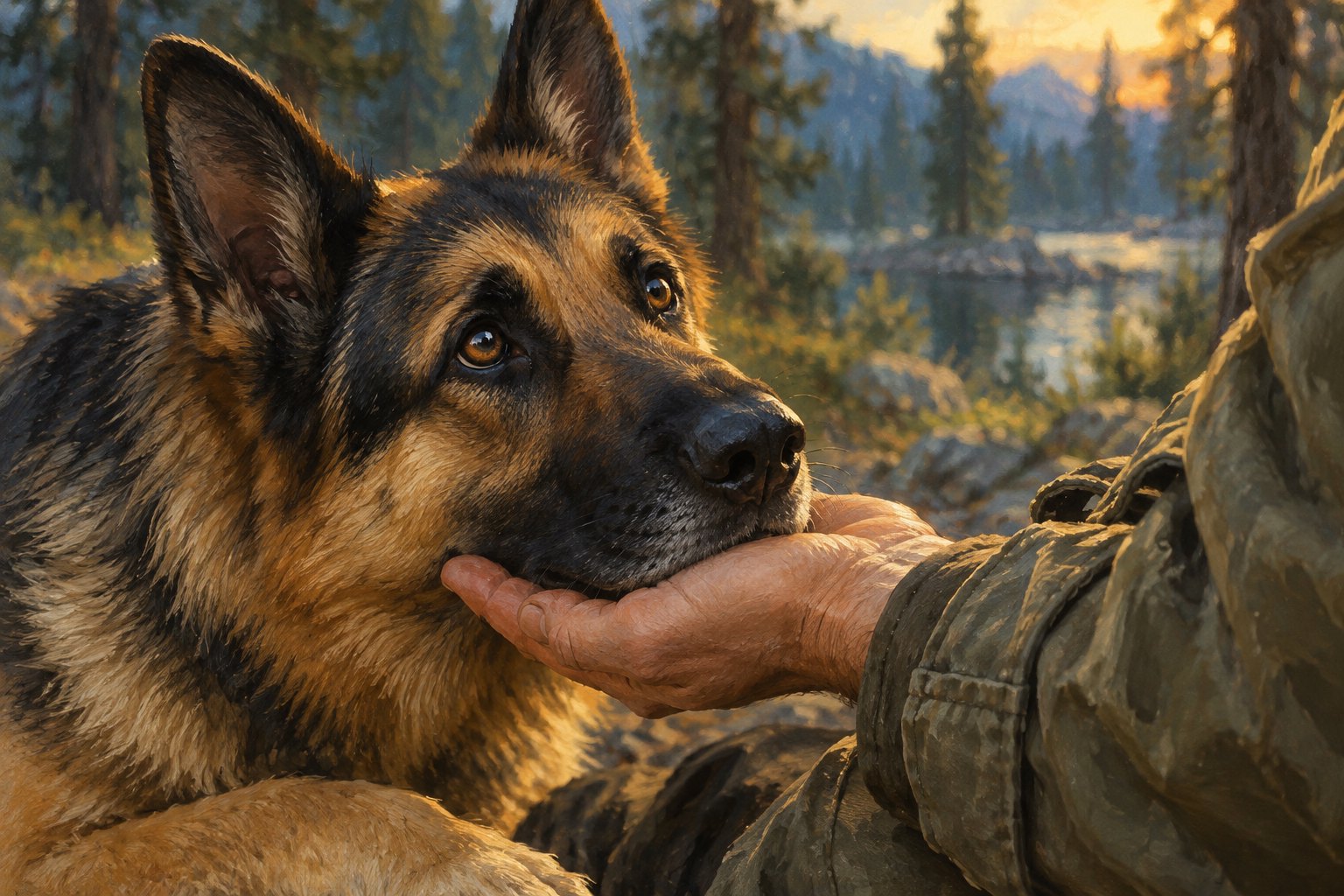
For this reason, ordinary contact matters to the interpretation as much as danger. Trust is not created only when one companion performs a spectacular rescue. It also consists of accepting proximity, recognizing a need, and allowing oneself to be cared for. Those are small actions with unusually high stakes for a character invested in self-sufficiency.
Watkins puts James’s guardedness into words
J.K. Simmons plays Watkins, a solitary former gold miner whose encounter with James introduces another human perspective. Sight and Sound records his observation, “You got that quiet, stern demeanour about you,” and describes James answering with a mocking echo. [Sight and Sound’s account](https://www.bfi.org.uk/sight-and-sound/reviews/heart-beast-bracingly-executed-man-dog-survival-story)
The exchange matters because it gives James some distance from the image he projects. Someone else sees a recognizable military bearing; James can respond to that assessment rather than simply embody it. Humor, however brief, suggests a person who exceeds the outline of the wounded loner.
Watkins also provides a useful contrast with Odin. A human visitor asks James to navigate conversation and social expectations. His dog offers a relationship already established. Neither form of companionship invalidates the other, but their difference helps explain why familiarity can feel like shelter.
Does sacrifice explain love—or narrow it?
One of the film’s central lines, attributed to Watkins in a published account, makes its emotional ambition explicit: “It’s not who you live for…It’s who you’d die for.” [Writer of Pop’s review](https://writerofpop.com/2026/09/25/thrilling-heart-of-the-beast-is-excellent-but-its-not-for-everybody/)
As a statement about extreme loyalty, the line is clear. As a complete definition of love, it deserves resistance. Willingness to die for someone can be meaningful, but so can the less dramatic work of staying alive, accepting assistance, and continuing to care when pride makes that difficult.
That is where the film’s premise becomes richer than its most quotable sentiment. A survival story necessarily values persistence. Every effort to continue creates another opportunity for companionship. The question is not only what James might sacrifice for Odin, but what their relationship enables him to keep doing.
Readers interested in that distinction may also appreciate our analysis of protection and another person’s needs in Angh. Care becomes complicated when protecting someone and deciding for them begin to overlap.
The deeper meaning of needing someone
The most persuasive interpretation of Heart of the Beast is that dependence can belong inside courage. James’s attachment to Odin makes him vulnerable because it gives him something to lose. It also gives his decisions direction. Those consequences cannot be neatly separated.
This is why the emphasis on men crying feels too narrow. The relationship offers a broader point of recognition: many people find it easier to provide care than to receive it. Watching a capable character need another being can expose that imbalance without making it shameful.
The meaningful emotional test is therefore not how many viewers leave in tears. It is whether James and Odin remain recognizable as companions beneath the danger and sacrifice. Their bond is most interesting as a reason to continue living—and as a reminder that being needed does not eliminate the need for someone else.
Original content by this site's editorial team. Published: September 26, 2026 at 17:25:26 PDT (Los Angeles time)