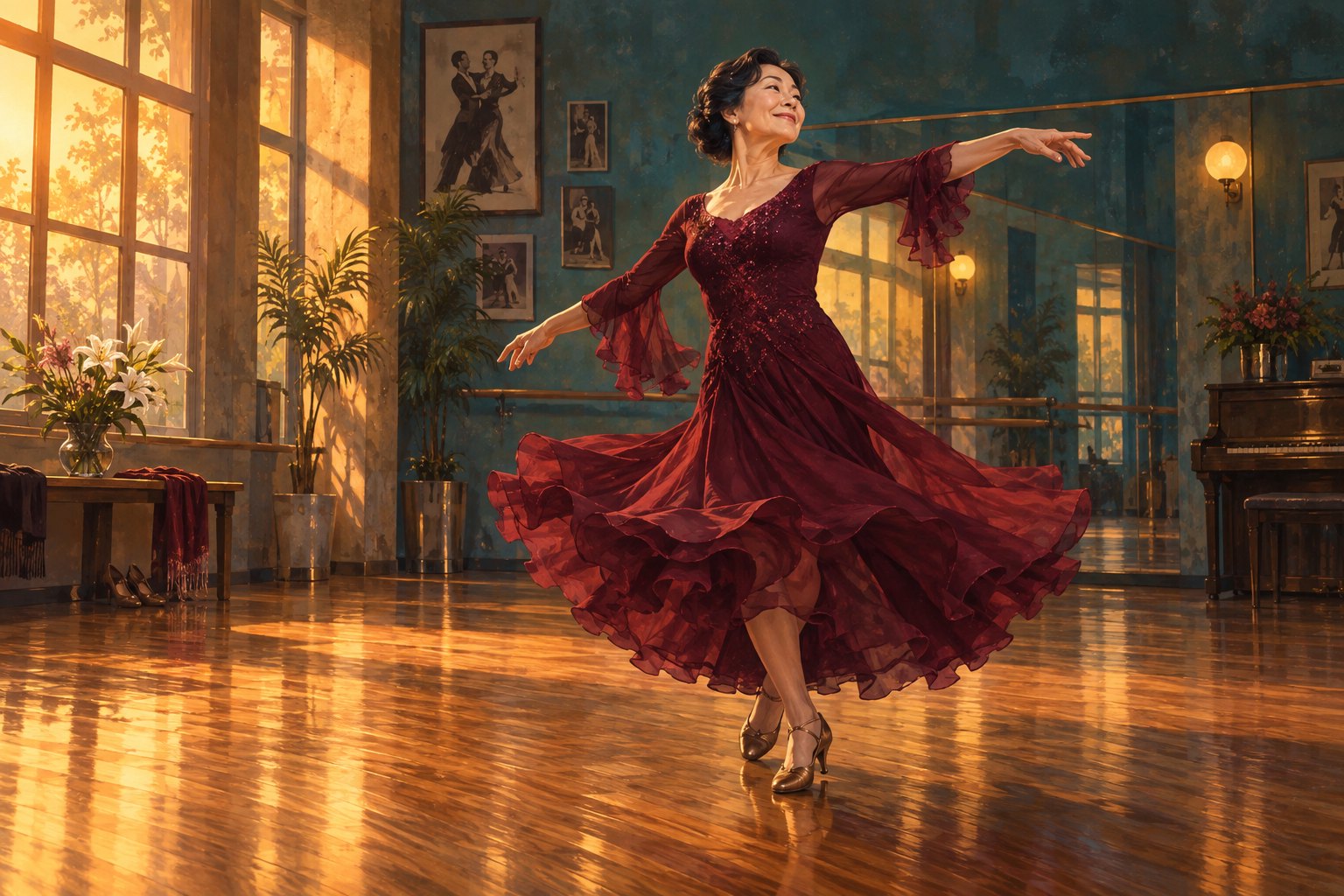
Josef Kubota Wladyka’s Ha-Chan, Shake Your Booty! honors his mother through something more revealing than a fictionalized family history: her commitment to dancing through difficult times. Its heroine, Haru, must find her way back toward movement after losing the person who shared her life and the dance floor. The connection between filmmaker and mother gives that premise personal weight, but Haru’s conflicting needs give it dramatic substance.
Rinko Kikuchi plays Haru in the film, directed by Wladyka and written by Wladyka and Nicholas Huynh. The official synopsis establishes its central progression: Haru and Luis compete in Tokyo’s ballroom scene; tragedy leads her into isolation; returning to the studio introduces an unexpected infatuation. [Sony Pictures Classics’ film synopsis](https://www.sonyclassics.com/film/hachanshakeyourbooty/)
Spoiler note: This analysis discusses the central bereavement, Haru’s attraction to her instructor, and the film’s supernatural imagery. It does not reveal the ending. The discussion draws on documented story details and filmmaker interviews rather than presenting a firsthand assessment of every scene.
A Mother’s Influence Without a Mother’s Biography
Wladyka has described his mother’s ballroom dancing as a sustaining passion through hardship. In his Sundance interview, he also recalled her taking her children to arthouse movies. Those two enthusiasms meet here: dance supplies the subject, while cinema provides a way to make its emotional significance visible. He identified A Man and a Woman, Shall We Dance?, and Dirty Dancing as important influences. [Wladyka’s Sundance interview](https://www.sundance.org/blogs/give-me-the-backstory-get-to-know-josef-kubota-wladyka-the-director-behind-ha-chan-shake-your-booty/)
That background invites a useful distinction. A tribute can preserve someone’s attitude toward life without transferring her experiences directly to a character. Reading Haru as a literal portrait would reduce both women: the fictional heroine would become an illustration of someone else’s history, and the filmmaker’s mother would become a collection of plot points.
My reading is that the tribute works most meaningfully as a principle of characterization. Haru deserves passions that survive a devastating change in circumstances. Her grief matters, but so does the person who existed before it. Honoring that continuity is a more demanding task than simply making a grieving character admirable.
Haru and Luis: Losing a Partner Changes Ordinary Life
In Scott Simon’s NPR interview with Wladyka, the opening is described through Haru and Luis’s domestic intimacy: cooking, multilingual conversation, and watching their dancing. When Luis collapses, Haru calls, “Luis, can you hear me?” and “Luis, look at me.” These brief fragments of verified film dialogue carry an immediate shift from companionship to alarm. [NPR’s interview and film excerpt](https://www.wlrn.org/2026-09-26/josef-kubota-wladyka-discusses-his-new-film-ha-chan-shake-your-booty)
The emotional significance lies in how ordinary the shared activities are. A marriage occupies time through repeated gestures: preparing food, remembering jokes, watching something together. The loss of a spouse therefore changes more than a person’s future plans. It changes the meaning of familiar hours.
Ballroom partnership adds another dimension. A dancer learns to anticipate another body’s movement, to respond to pressure and timing without needing an explanation. From Haru’s perspective, returning to dance can mean encountering a practiced language whose familiar conversational partner is gone.
That makes withdrawal understandable without making it a satisfying destination. The studio holds reminders of Luis, but it also holds a part of Haru that belongs to her. Her dilemma is not simply whether she can tolerate memories. It is whether avoiding pain will gradually require avoiding her own interests.
Why Attraction Makes Recovery More Complicated
The new instructor introduces desire into a story already shaped by attachment. That is a productive complication because wanting someone does not automatically settle what a previous relationship means. Attraction can arrive before a person has developed a comfortable explanation for it.
For Haru, the studio potentially brings several experiences together: the pleasure of dancing, the reassurance of company, the excitement of being noticed, and the discomfort of discovering that excitement. Separating those feelings too neatly would make her easier to describe and less interesting to understand.
My strongest reservation about a simple “dance heals grief” reading is that it risks turning every new feeling into evidence of improvement. Desire can be confusing, impractical, or embarrassing. A character does not have to make flawless choices to be moving toward a fuller life.
Viewers should therefore pay attention to what Haru wants beyond the instructor himself. Does a moment concern romance, physical confidence, companionship, or permission to enjoy something? Those possibilities can overlap. The distinction helps keep her at the center of the story instead of treating a new partner as its automatic solution.
There is a related question beneath the musical pleasures of our character-focused reading of Damn Yankees: what happens when an exciting alternative encounters the emotional claims of an established relationship?
The Crow Gives Absence a Presence
The film also gives Haru’s mourning an unusual visual companion. Wladyka told NPR that the large bird associated with Luis combines a crow’s connection to death with the softer appeal of Japanese mascot culture. His explanation frames the creature as a manifestation of Luis’s lingering presence in their shared home.
As an interpretive device, that combination is more interesting than a straightforward symbol of darkness. Grief can be frightening because someone is absent and comforting because memories make that person feel close. An image capable of holding both responses gives Haru’s attachment room to remain contradictory.

The useful question is less whether the bird has a single literal explanation than what its presence allows Haru to express. Missing someone can involve continuing a conversation with them internally. Giving that experience a visible form lets a movie explore attachment without forcing the character to explain herself in polished speeches.
Dance References Are an Emotional Vocabulary
The films Wladyka names as influences offer a viewing context, but influence should not be confused with a catalog of hidden Easter eggs. Without an identifiable, verified visual quotation, declaring a costume or gesture a secret reference would tell readers more than the evidence supports.
A more useful approach is to watch how dance changes the relationship between private feeling and public behavior. Someone may struggle to describe an emotion yet reveal it through hesitation, distance, or a willingness to approach another person. Choreography can make those decisions legible.
That attention to embodied experience also connects with our analysis of loneliness and self-expression in Marie Antoinette. In both discussions, the critical task is to look beyond attractive surfaces and ask whose feelings those surfaces help us understand.
The Deeper Tribute: Keeping a Life Open
The most compelling interpretation of Wladyka’s homage is that persistence can include pleasure. Continuing after loss need not mean becoming solemnly exemplary. It can involve curiosity, awkwardness, renewed appetite, and the willingness to appear foolish in front of other people.
Haru’s story makes that idea concrete because dancing belongs to both her marriage and her individual identity. Returning to it raises a difficult possibility: the same activity can preserve an attachment and acquire a different meaning. Remembering Luis and discovering what she wants next do not have to be mutually exclusive projects.
That is where a film inspired by a mother’s spirit can reach beyond private dedication. Its richest question concerns how people carry love forward while allowing their lives to change. For Haru, the next step matters because she must choose to take it.
Original content by this site's editorial team. Published: September 28, 2026 at 02:29:28 PDT (Los Angeles time)