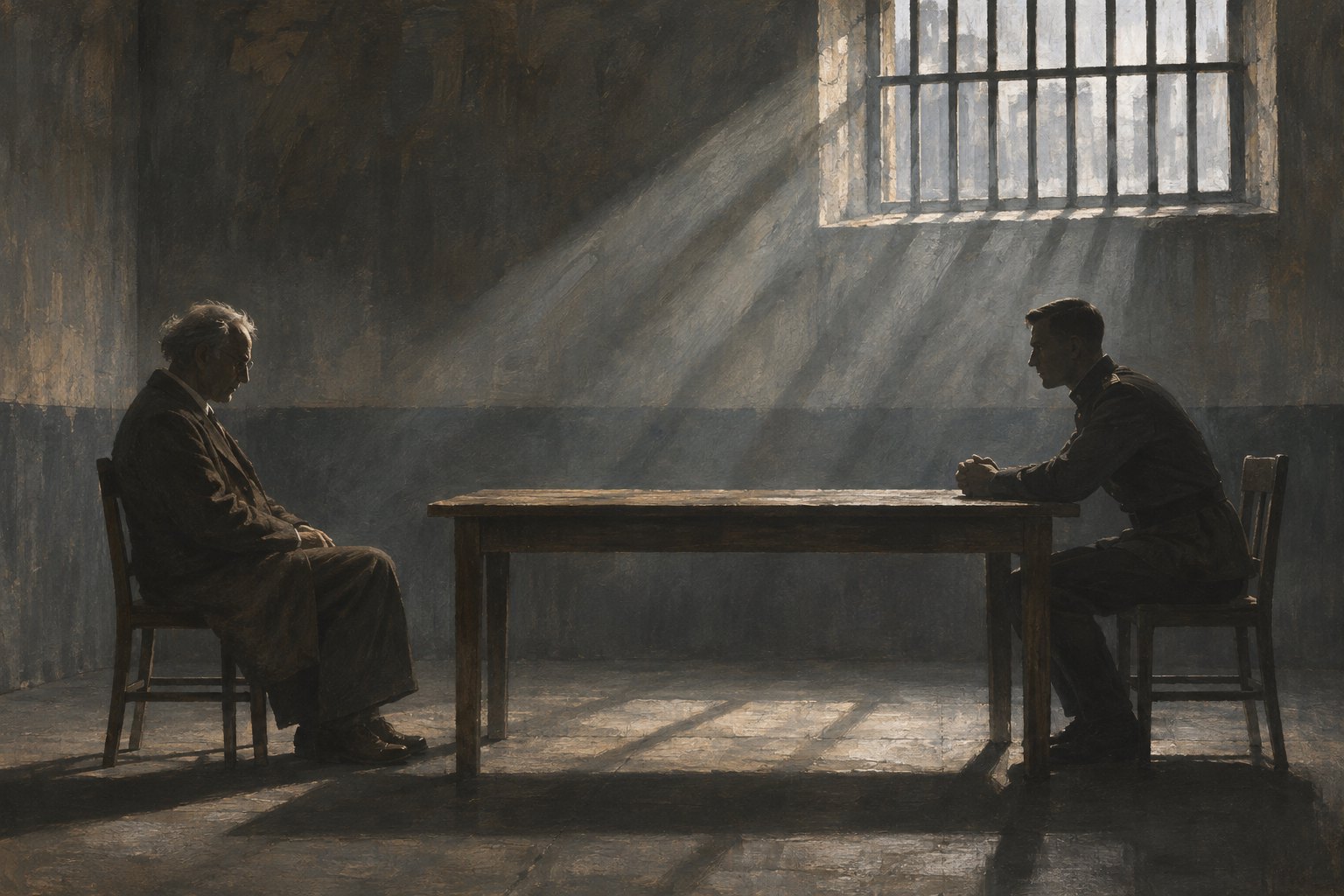
Confession has a strong dramatic premise: a former teacher must answer to a student who now possesses the power to destroy him. Rob Lowe plays the imprisoned professor; James Franco plays his interrogator. Variety’s characterization of the film as sluggish raises the central question surrounding this confrontation: why might a relationship loaded with danger fail to generate sustained tension?
The most useful answer begins with the characters. An interrogation becomes compelling when each exchange changes what someone wants, fears, or believes they can survive. A serious subject and forceful arguments cannot supply that movement by themselves.
Scope and spoilers: This is a critical analysis of the film’s documented premise, publicly quoted trailer dialogue, and reported reception, rather than a firsthand screening review. It discusses character relationships and thematic developments without reconstructing the ending.
A classroom relationship becomes an instrument of intimidation
Directed by Václav Marhoul and written by Ben Shapiro, Confession takes place in Moscow in 1938. Lowe’s Alexei, a disillusioned former literature professor, is imprisoned at Lubyanka. Franco’s Vladimir, once his student, conducts the interrogation. The distributor’s account establishes the conflict between Alexei’s convictions and the demands of a regime suppressing dissent. [The Daily Wire’s official film introduction](https://www.dailywire.com/news/official-trailer-offers-chilling-look-at-the-daily-wires-confession).
The reversal gives their encounters an intimacy that a confrontation between strangers would lack. Vladimir knows Alexei as someone who once possessed intellectual authority. Alexei must confront the fact that education has not prevented his former pupil from becoming an instrument of cruelty. Their shared history makes the imbalance personal before either man delivers an argument.
That does not establish that Alexei caused Vladimir’s brutality. It creates a more interesting interpretive possibility: the professor may recognize the limits of what he once believed teaching could accomplish. Knowledge, verbal sophistication, and moral judgment do not necessarily develop together.
From Vladimir’s side, the relationship offers an opportunity to reverse an old hierarchy. That is a reading of the setup, rather than a verified account of his private motives. Still, it explains why this particular pairing promises more than a generic contest between a prisoner and an official.
What a single word can do for Franco’s character
The publicly quoted teaser dialogue includes Vladimir addressing Alexei as “Professor” and warning, “You will remember your duty.” Those brief lines establish recognition and command without requiring an extended statement of ideology. The same teaser includes a prisoner asking Alexei whether he has witnessed a child starving. [ComingSoon’s account of the teaser dialogue](https://www.comingsoon.net/movies/trailers/2206537-james-franco-rob-lowe-jennifer-jason-leigh-daily-wire-confession-trailer/xwp_curated_content).
“Professor” is particularly useful language for this relationship. It preserves Alexei’s former standing while exposing how little protection that standing offers. An honorific can become a reminder of humiliation when the speaker controls the conditions under which it is spoken.
The warning about duty introduces another conflict: who gets to define an obligation? For the interrogator, duty can mean submission to institutional authority. For the prisoner, it may mean refusing to cooperate. The same word can demand incompatible actions from two people sitting in the same room.
This is where dialogue can produce drama economically. A short statement can change a relationship more effectively than a long explanation. As our discussion of why memorable movie dialogue depends on its dramatic context argues, a line lasts because of what speaking it costs someone.
Alexei’s personal failures complicate his moral resistance
The professor’s imprisonment does not erase his earlier relationships. Jon Jones’s review describes Alexei’s ex-wife, Anya, played by Jennifer Jason Leigh, and his son, Sasha, played by Kodi Smit-McPhee, confronting him with grievances. Jones finds the father-son encounter more compelling than the central interrogation and criticizes the film’s extended dialogue and uneven momentum. These are that reviewer’s observations, not an independent assessment of the performances here. [The Peach Review’s assessment](https://thepeachreview.com/2026/11/10/heavy-dialogue-and-a-slugs-pace-make-confession-pretty-bleak/).
Those reported family tensions suggest a valuable complication. A person can resist an unjust institution while remaining accountable for the damage he has done at home. Moral courage in one situation does not automatically settle every other obligation.
For Sasha, the relevant question may be whether his father’s changed convictions can mean anything to someone who experienced his earlier failures. For Alexei, repentance becomes more demanding when the person he hurt does not immediately accept it. Neither position requires the family’s pain to become a convenient lesson.
This distinction matters to Lowe’s character. If Alexei becomes only a representative of righteousness, the audience has little left to discover about him. If his resistance coexists with shame, defensiveness, or incomplete understanding, the character retains the capacity to surprise us.
Why a confined drama can feel slow
Slowness is not inherently a weakness. A pause can make an audience notice a threatened person calculating an answer. Repetition can reveal exhaustion. An extended exchange can show how difficult it is to maintain a conviction under pressure.
The crucial issue is whether the dramatic situation changes. Does an answer expose a vulnerability? Does a threat force a new decision? Does someone abandon a tactic because it has failed? These are useful questions for evaluating Confession without confusing deliberate pacing with dramatic inactivity.
The reported dissatisfaction with the Alexei-Vladimir exchanges points toward a specific risk: once their opposing positions are understood, further statements of those positions may add duration without adding uncertainty. That is an inference from the criticism, not a verified description of every scene.
The teacher-student history makes this risk especially frustrating in principle. Their relationship contains opportunities for embarrassment, remembered affection, disappointment, and rivalry. If ideological exposition occupies too much space, those less predictable emotions have less room to develop. Our earlier examination of the moral stakes of a forced admission in Confession explores the ethical problem; the question here is how that problem becomes changing behavior on screen.

The deeper conflict is over what words are allowed to mean
The most productive interpretation of Confession begins with Alexei’s profession. A literature professor works with language that can hold uncertainty, contradiction, and competing perspectives. An interrogator seeking a predetermined admission demands language that performs a specific institutional task.
Read through that contrast, the title describes a struggle over authorship. Who determines the account of a person’s life: the person himself, the people he has harmed, or the authority holding him captive? A truthful acknowledgment of personal wrongdoing and a statement extracted through coercion can both be called confessions, although they involve profoundly different relationships to responsibility.
That distinction gives the film’s premise lasting interest. Alexei’s meaningful freedom would involve more than maintaining an argument. It would involve accepting responsibility where it belongs while resisting responsibility imposed through force. The reported pacing concerns matter because such a struggle needs discovery, hesitation, and change. The richest version of this drama lives in the distance between knowing what is right and becoming capable of doing it.
Original content by this site's editorial team. Published: November 12, 2026 at 06:12:21 PST (Los Angeles time)