
Sterling K. Brown is in talks to star in a new Longlegs movie with Nicolas Cage, according to Variety. The essential distinction is that negotiations are not a completed casting agreement. The report also does not, by itself, establish whom Brown would play or how his character would relate to Cage’s.
Still, the potential pairing raises an interesting dramatic question: whose fear will organize the next story? Cage gives the original its most conspicuous nightmare, but Lee Harker gives that nightmare somewhere to land. A new leading performance needs an equally compelling reason for viewers to remain with the person looking into the darkness.
Major spoilers follow for the original Longlegs, including its ending. Discussion of Brown’s possible contribution is critical speculation, not a description of the new movie’s plot.
Lee Harker makes the original more than a killer showcase
In Osgood Perkins’ original film, Maika Monroe plays FBI agent Lee Harker, whose investigation into a series of family murders gradually exposes a connection to her own childhood. Nicolas Cage’s Longlegs leaves coded messages, but the mystery ultimately reaches beyond identifying the person responsible. Lee must confront the possibility that her understanding of her life has been deliberately shaped by other people.
Monroe’s restraint is crucial. Her stillness makes ordinary conversation feel effortful, while her watchfulness encourages us to inspect rooms alongside her. She rarely provides the reassuring emotional cues that tell an audience exactly how frightened to feel. Instead, the performance creates an uncomfortable distance: we can recognize her distress without feeling that we fully know her.
The early reference to the “almost birthday girl” turns a familiar childhood milestone into something invasive. A birthday normally confirms that a child is growing into a separate person. Here, it becomes an occasion on which someone else claims knowledge and control. Perkins discussed that opening encounter and Lee’s recovered connection to Longlegs in his [Inverse interview](https://www.inverse.com/entertainment/longlegs-ending-explained-oz-perkins-interview-dolls).
My reading is that Lee’s apparent emotional remoteness becomes more affecting as the investigation proceeds. What initially resembles a detective’s professional reserve begins to feel like a life lived without access to its own foundations. Solving the case promises knowledge, but knowledge may destroy the relationships that have sustained her.
Cage’s performance works through imbalance
Cage makes Longlegs difficult to classify. His strained voice, exaggerated presentation, and abrupt changes in intensity create an unstable mixture of ridiculousness and menace. The performance risks making the villain seem absurd. For me, that risk is part of its effectiveness: embarrassment and fear can occupy the same moment.
Monroe and Cage establish radically different rhythms. Lee appears to be conserving every reaction; Longlegs seems determined to force a reaction out of the world. Their encounter concentrates a tension that has already been operating across the film. One person is struggling to understand what is happening, while the other treats understanding as something he can withhold.
His death during interrogation also denies the familiar satisfaction of a captured villain being made to explain himself. The investigation continues after the most recognizable face of the threat is gone. That structural choice matters when considering a new film with Cage: the original already demonstrates that the character’s physical presence and the reach of the horror are different things.
Ruth turns protection into the film’s ugliest bargain
Alicia Witt’s Ruth Harker supplies the story’s most painful reversal. She cooperated with Longlegs to spare Lee, delivering his dolls to other households while disguised as a nun. Her maternal protection depends on exposing other families to devastation. Perkins discussed Ruth’s bargain and the film’s unresolved final threat in his [Variety interview about the ending](https://au.variety.com/2024/film/features/longlegs-ending-deaths-explained-16019/).
Ruth is disturbing because her motive is comprehensible without being defensible. Wanting a child to survive is easy to understand. Converting that desire into permission to sacrifice other children is the moral catastrophe. The film does not need to make her emotionally empty to make her actions horrifying.
From Lee’s perspective, the revelation corrupts the meaning of being loved. Her survival carries a history she never agreed to participate in. Gratitude, dependence, and revulsion become almost impossible to separate. That conflict gives the supernatural machinery a human consequence beyond its immediate shock value.
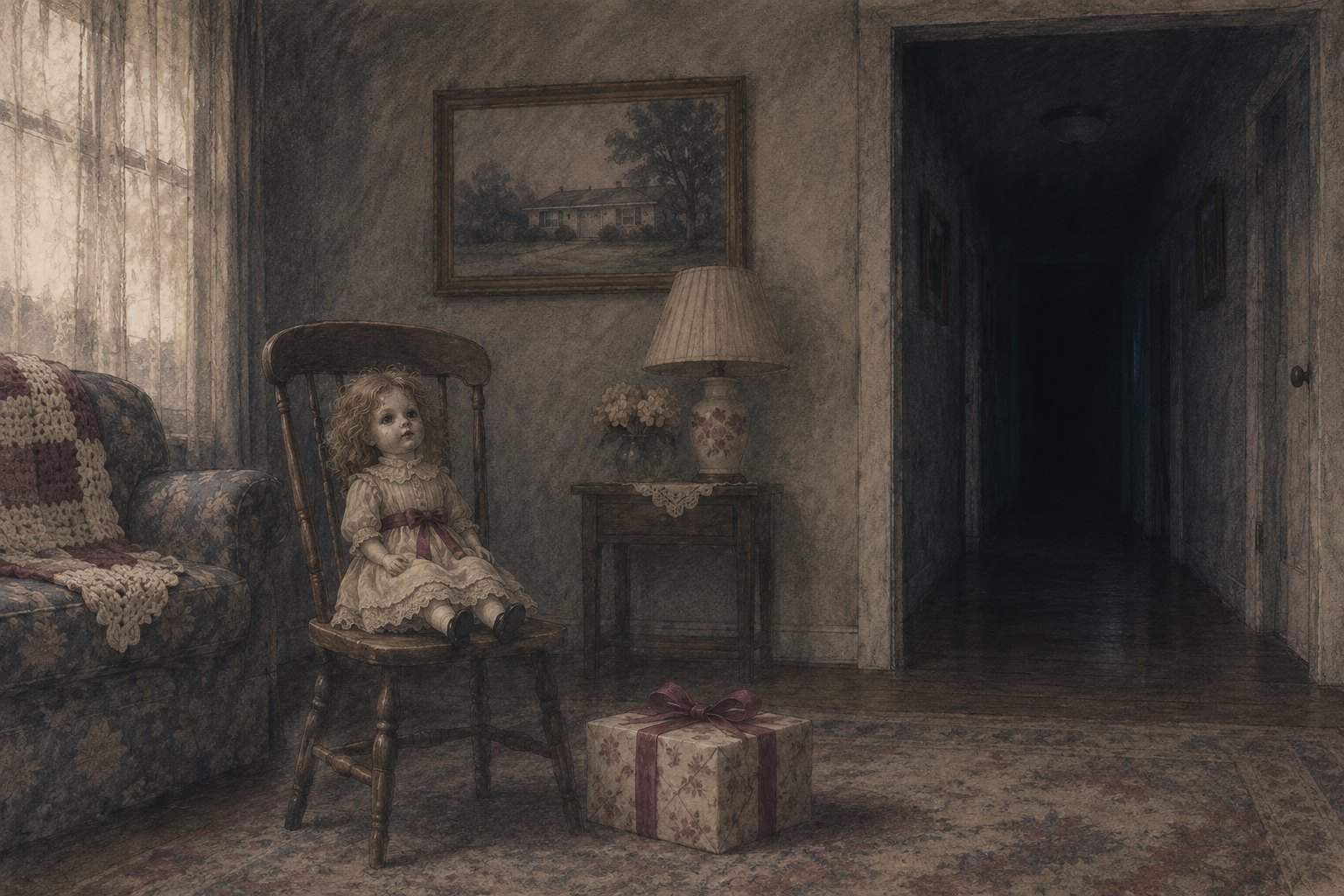
This symbolic illustration reflects the film’s corruption of domestic comfort. A doll and a gift ordinarily express care; the story turns that expectation into vulnerability. The disturbing question is how readily a reassuring presentation can make people accept something dangerous.
It is a darker variation on the problem explored in our commentary on family protection and control: loving intentions do not automatically preserve another person’s freedom. Ruth’s version of protection leaves Lee alive while keeping essential truths beyond her reach.
The ending is powerful, but its mechanics invite frustration
The final confrontation leaves Lee facing a surviving doll she cannot destroy. The closing “Hail Satan!” refuses the emotional release that normally follows a decisive act of resistance. Evil retains the last word, and survival remains an uncertain achievement.
As horror, I find that refusal effective. As a detective story, the resolution is less satisfying. The film encourages attention to evidence and patterns, then places enormous explanatory weight on supernatural influence. Viewers who expect every clue to participate in a fully testable solution may reasonably feel that the rules have shifted.
The ambiguity works best at the level of consequence. We do not need an exhaustive technical account of the dolls to understand Lee’s predicament. She has discovered why her life took its shape, but discovery has not restored what was taken from her. The weaker moments come when explanation temporarily makes the nightmare feel tidier than the experience of watching it.
What Brown’s possible role needs to accomplish
Without a verified character description, assigning Brown a badge, a family connection, or a place in the mythology would be premature. The useful question is what dramatic function any new lead must fulfill.
First, that person needs a recognizable life beyond encountering Longlegs. Lee’s story hurts because the investigation rearranges her understanding of home and motherhood. Another central character needs something comparably specific at risk, even if the circumstances are entirely different.
Second, the character should have a distinct relationship to uncertainty. Repeating Lee’s withdrawn manner would risk reproducing the original’s surface. Someone who seeks reassurance, relies on other people, or insists on explanations could produce a different kind of tension. These are possibilities for performance, not predictions about Brown’s role.
Finally, the film needs consequences that remain meaningful after the frightening images fade. As our analysis of character stakes in continuing franchises argues, recognizable elements endure when they remain attached to intimate motivations.
The deeper horror is inheriting someone else’s bargain
The original Longlegs is most unsettling when viewed as a story about a child growing into the consequences of an adult’s decision. Lee did not choose the arrangement that preserved her life. Yet she must absorb its truth and act within the damage it created.
That is the standard Brown’s potential involvement brings into focus. The next film can offer another unforgettable encounter with Cage, but its lasting power will depend on the person whose world that encounter changes. A compelling new lead would give the terror a different emotional meaning—and make returning to Longlegs feel necessary.
Original content by this site's editorial team. Published: November 23, 2026 at 21:36:36 PST (Los Angeles time)