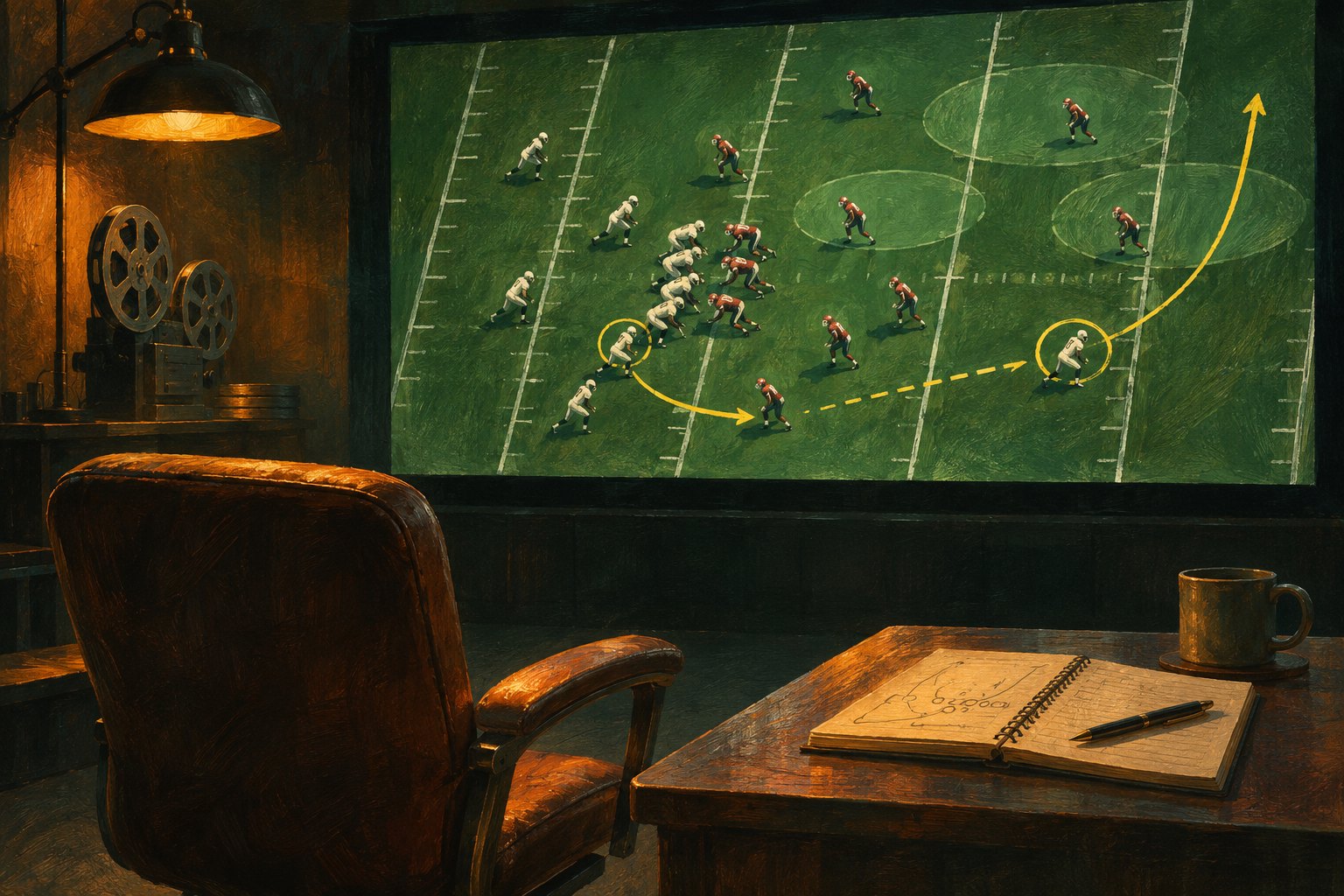
Greg Cosell’s Film Study WK 11, published by the Cleveland Browns, concerns football analysis rather than a narrative movie. For readers looking for the segment, that distinction matters immediately: the attraction is the explanation of a team sport, with real players whose work can be difficult to follow when attention stays on the ball.
The episode’s title and publisher establish its subject, but they do not establish its individual arguments. Without a verified recording or transcript, specific plays, player evaluations, and quotations cannot responsibly become the basis of a review. This companion instead considers a focused question prompted by Cosell’s Week 11 film study: what should an explanation reveal about the people working around the most visible action?
The central challenge: giving attention to an ensemble
Football presents an unusual storytelling problem. A viewer can follow the ball and understand the immediate outcome while missing much of the cooperation that produced it. The player completing the visible action becomes the natural center of attention; everyone else risks turning into moving scenery.
For me, the most valuable purpose of a film-study segment is to redistribute that attention. An explanation earns its place when it helps a viewer understand how one player’s movement changes another player’s possibilities. That is a more demanding task than identifying who ended up with possession.
The useful connection to movie criticism is ensemble staging. In a crowded dramatic scene, a supporting performer may change its emotional direction without speaking. In football analysis, an off-ball action may deserve attention because of the space, time, or restriction it creates. These are different activities, but both reward an observer who can explain relationships rather than merely name the central figure.
Read the player’s role before assigning a personality
A character-centered approach needs limits when the subjects are real athletes. A fictional character can be interpreted through dialogue, recurring behavior, and a completed dramatic arc. A football player’s movement does not give viewers equivalent access to private thoughts or intentions.
That makes role a better starting point than personality. What area is the player occupying? Who is nearby? What changes when that player moves? Those questions produce an account of the action without immediately turning someone into the brave hero, hesitant newcomer, or careless villain.
Consider a hypothetical receiver moving across the field while a teammate gets the pass. The receiver’s contribution might involve affecting a defender’s position, but establishing that requires more than noticing the movement. An explanation should show the defender’s response and clarify the connection. It should also leave room for uncertainty about the assignment.
This is where a film-study discussion can become particularly satisfying: the apparent supporting player acquires a meaningful role. The pleasure comes from understanding an interaction that was previously hard to see, rather than discovering a convenient personality trait.

Technical language should explain a relationship
Specialist vocabulary can make commentary efficient, but efficiency for an expert is not necessarily clarity for a general viewer. A term becomes useful when the audience can connect it to something observable and understand why that detail matters.
A strong explanation therefore has three parts: identify the action, translate its purpose into ordinary language, and demonstrate its consequence. Naming a coverage or protection without completing the other steps can leave a newcomer with more terminology and little additional understanding.
For a Week 11 film-study audience, a practical listening question is whether the explanation remains understandable after the technical label is removed. Can you describe which player influenced another, and how? If so, the terminology has helped organize an idea. If not, the label may be doing too much of the work.
This differs from the emphasis in our guide to decisions in Coach Harbaugh’s Colts breakdown. Here, the concern is the commentator’s teaching: whether the explanation gives a viewer language they can use independently.
The narrator should leave the viewer somewhere to look
A useful commentator directs attention with enough precision that the viewer can follow. Mentioning several players, a formation, and a defensive adjustment in quick succession may communicate expertise, yet still leave the audience unsure which relationship deserves attention first.
My preference is for explanations that introduce one problem at a time. Establish the relevant players. Describe their initial relationship. Then explain the change. Complexity can accumulate once the audience has a stable starting point.
There is a corresponding responsibility for the viewer: distinguish what you understood from what merely sounded persuasive. After a passage of commentary, try describing its central point in a single sentence. Difficulty doing so does not automatically expose bad analysis; it identifies the part that needs another listen.
Our commentary on Lincoln Fa’alafi and the limits of footage considers what images can establish. The complementary question for Cosell’s film-study format is what an explanation enables its audience to understand.
Three questions to carry into the Week 11 segment
These questions provide a compact way to assess the discussion without presuming what Cosell says in this particular installment:
- Whose contribution becomes clearer? Look for an explanation that expands your understanding beyond the player who finishes the action.
- What relationship can you now describe? A useful takeaway connects players, spacing, or timing rather than simply adding a technical term to your vocabulary.
- Where does the explanation acknowledge uncertainty? Notice whether observed movement, inferred responsibility, and personal judgment remain distinguishable.
The point is not to grade every sentence. It is to identify whether the discussion leaves you with a more specific understanding of the sport and a fairer account of its participants.
A deeper reading: attention is a form of credit
The broader editorial promise of Greg Cosell’s Week 11 film study lies in the possibility of making shared work legible. A team sport offers more contributors than any single viewer can comfortably follow. Commentary decides which of those contributions receive explanation, and explanation influences where credit goes.
That is also why football analysis belongs in a conversation about screen storytelling without being treated as a fictional film. The narrator helps organize our attention, but the people being described remain real and their responsibilities may not be fully knowable from the available material.
My standard for the format is straightforward: a worthwhile breakdown should make the ensemble easier to understand. Whether this specific installment meets that standard requires direct examination of the episode. The most meaningful potential takeaway is nevertheless clear—a richer understanding of how people act together, including those whose work happens beyond the center of the screen.
Original content by this site's editorial team. Published: November 27, 2026 at 12:19:14 PST (Los Angeles time)