Godzilla Minus Zero has brought a provocative question out of its New York Film Festival world premiere: what should a Godzilla movie be willing to show? Variety reports that the sequel carries the franchise’s first R rating and that its director defended retaining the action, saying that “Censoring” it “Was Not an Option.” That makes the classification a creative talking point as well as an audience consideration.
The meaningful issue is what that freedom serves. More explicit destruction can make the human cost of a monster attack harder to ignore. It can also become another attraction, leaving the people beneath the spectacle less important than the spectacle itself. My view is that the strongest defense of the rating must ultimately come from the film’s attention to those people.
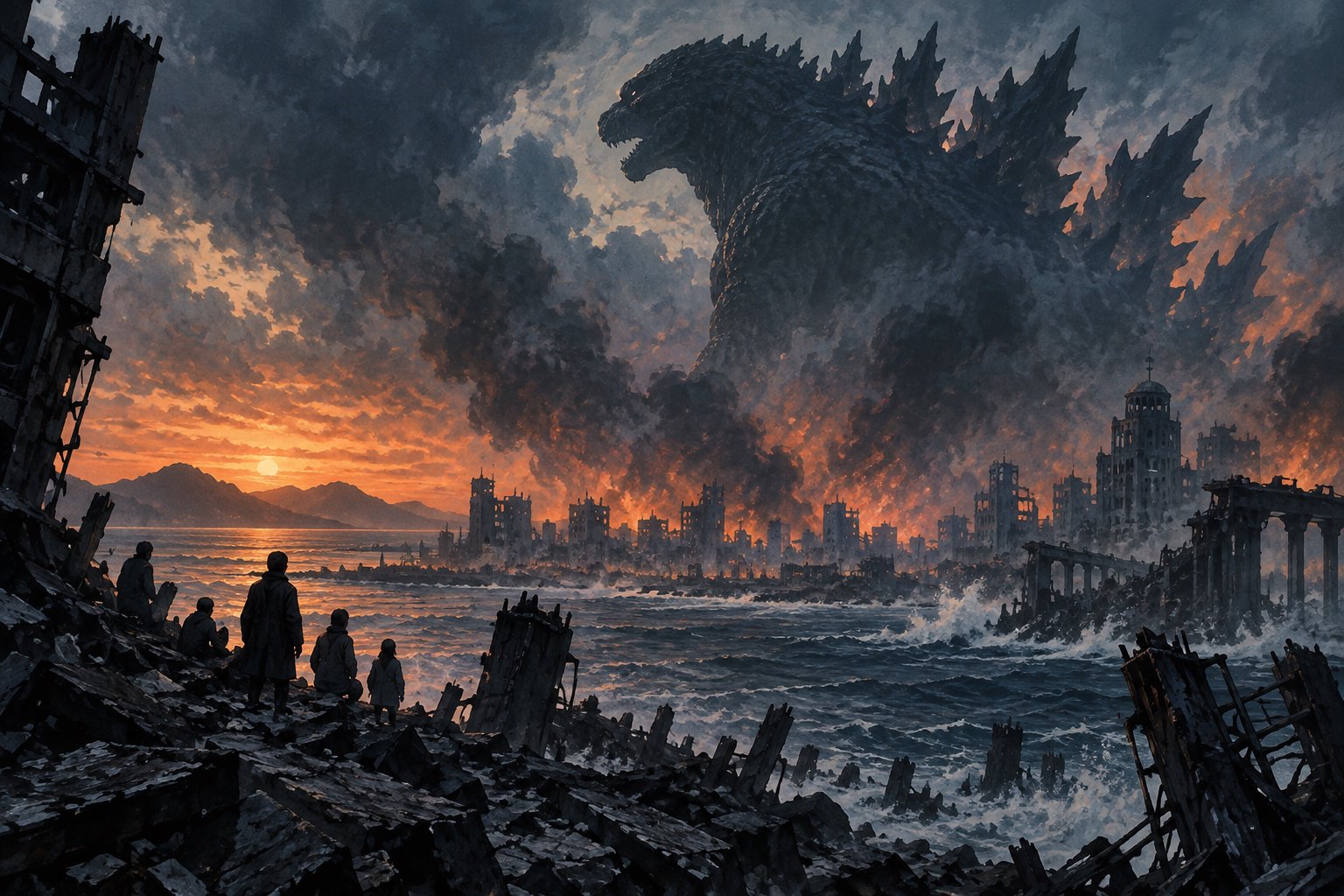
This is spoiler-free commentary on the reported premiere and rating decision, not a full-film review. It does not establish unverified character developments, reproduce unconfirmed dialogue, or assess the ending. The accompanying images are conceptual illustrations, not movie stills.
What the rating announcement actually tells us
The central news is straightforward: the sequel premiered at NYFF, and its director publicly defended action that the report connects with an R classification. Those facts establish an artistic position. They do not, by themselves, establish how disturbing the finished film is, how frequently it depicts violence, or whether its harshest passages are its best.
That distinction matters because a classification can quickly become a substitute for criticism. Viewers may interpret the letter as a promise of seriousness, brutality, or creative independence. None of those qualities automatically follows. A film earns its emotional force through choices about perspective, duration, performance, and consequence.
Nor does the reported franchise milestone prove that earlier approaches were inadequate. The useful question is specific to this sequel: does showing more make the experience more truthful to the people living through it? That is a stronger basis for judging the decision than treating a restrictive rating as an achievement in itself.
The director’s defense creates a demanding standard
Refusing to soften a sequence can be a defensible creative choice. Sometimes an image carries an argument that would disappear if the camera turned away. If a movie wants destruction to feel intolerable, making every impact comfortable to watch could undermine its purpose.
But the language of censorship needs care. A director’s description of a proposed change does not settle whether that change would damage the work. Editing is also how filmmakers create emphasis, preserve suspense, and prevent repetition. The relevant distinction is whether removing an image would remove meaning.
Here is a practical critical test: imagine the disputed moment shortened or moved offscreen. What would be lost? Perhaps the audience would no longer understand a survivor’s fear. Perhaps the distance between a spectacular attack and a vulnerable body would become too easy to overlook. Those would be substantial losses. If only the intensity decreased, the artistic argument would require more support.
Human perspective gives destruction its weight
A monster movie operates on two scales. From a distance, a collapsing neighborhood is an arrangement of movement, smoke, and light. From within it, destruction is a blocked exit, a missing person, or the sudden disappearance of somewhere familiar. Film form determines how often viewers move between those perspectives.
For Godzilla Minus Zero, that offers a useful standard without inventing its scenes. Does the camera grant people an experience of their own, or use their reactions mainly to certify the monster’s size? Does fear affect decisions? Does someone’s loss remain important after the action moves elsewhere?
A character needs more than screen time to become a person. A small decision can establish that someone has priorities beyond surviving the current shot: waiting, helping, refusing, changing course. When destruction interrupts a recognizable intention, the audience understands what has been taken away.
This is also why the emphasis on character as the foundation of franchise storytelling applies here. Familiar spectacle attracts attention; specific human wants give that attention somewhere to settle.

Aftermath can matter as much as impact
One limitation of escalating violence is that escalation eventually becomes predictable. Once viewers expect the next attack to be larger or harsher, surprise becomes harder to sustain. A quiet consequence can break that pattern more effectively than another increase in scale.
Aftermath changes the unit of attention. An attack is measured in seconds; repair takes time. Fear can survive the immediate danger. People may disagree about what safety requires, what they owe one another, or whether familiar routines are still possible. These are potential dramatic functions of aftermath, not claims about the sequel’s plot.
The distinction is especially useful when assessing a director’s insistence that difficult material is necessary. If the film asks viewers to witness suffering, it should also give that suffering dramatic persistence. Otherwise, the image risks becoming disposable even when it is difficult to watch.
Our discussion of vulnerability and dependence in survival storytelling approaches a related question: what happens when endurance alone cannot meet a person’s needs? In monster cinema, accepting help can reveal as much about courage as confronting danger.
Premiere excitement and lasting judgment are different things
The enthusiastic framing of the NYFF premiere makes the sequel an immediate conversation piece. A festival screening is also a particular encounter between a film and an audience. Its atmosphere can illuminate the power of a set piece without resolving how the whole work holds together.
A useful review should therefore distinguish the force of individual moments from the coherence of the experience. Does the action develop the emotional conflict? Do quieter passages acquire new meaning afterward? Does the film earn its changes in tone? These questions remain valuable whether the audience cheers, recoils, or does both.
The deeper issue is whose experience survives the spectacle
The most compelling interpretation of the rating debate concerns attention. A giant monster can make people physically insignificant within an image. A thoughtful film can insist that their lives remain significant within the story.
That is the standard I would bring to Godzilla Minus Zero. Its reported R rating gives the filmmakers room to depict harsher consequences. The director’s defense explains a commitment to keeping that material. Neither fact completes the critical argument.
The argument will be completed by what the violence lets us understand: whose fear becomes legible, whose choices remain consequential, and whose suffering the film remembers. If the sequel makes those lives harder to dismiss, its uncompromising action will have a purpose deeper than intensity.
Original content by this site's editorial team. Published: September 26, 2026 at 23:01:58 PDT (Los Angeles time)