Godzilla Minus Zero makes survival an unfinished business. Its central family has already endured a catastrophe, but enduring one disaster offers no protection from the next—and no agreement about what courage should require. The most compelling way to approach Takashi Yamazaki’s sequel is through that conflict: Kōichi and Noriko have a child to protect, while the world keeps finding reasons to demand their service.
Forbes critic Mark Hughes praises the film’s treatment of trauma and its continuity with Godzilla Minus One. The more interesting question beneath that enthusiasm is whether returning to wounded characters develops their lives or merely renews their suffering. My reading is that the sequel’s strongest ideas concern the responsibilities that come after heroism, particularly when a survivor becomes useful to people with power.
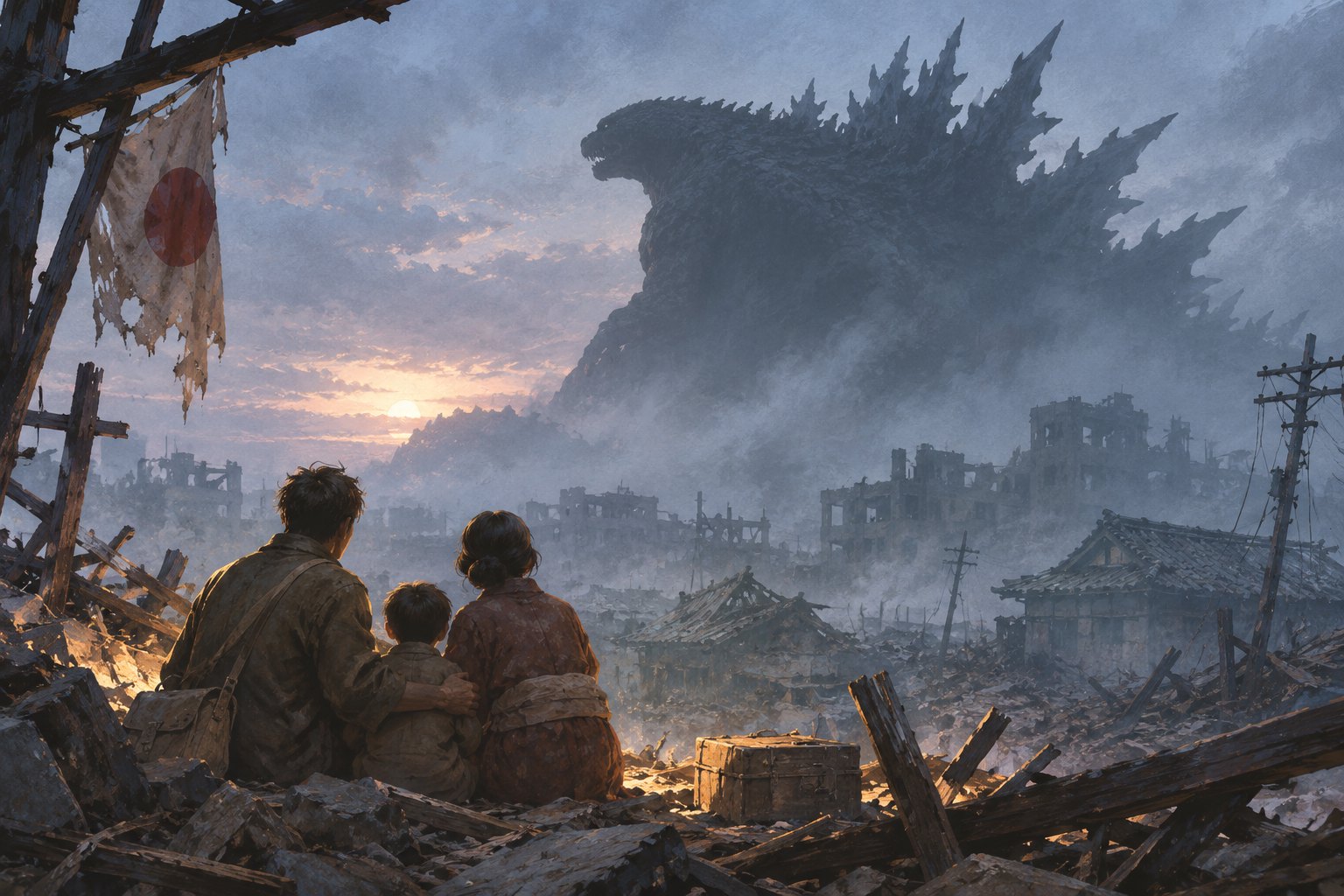
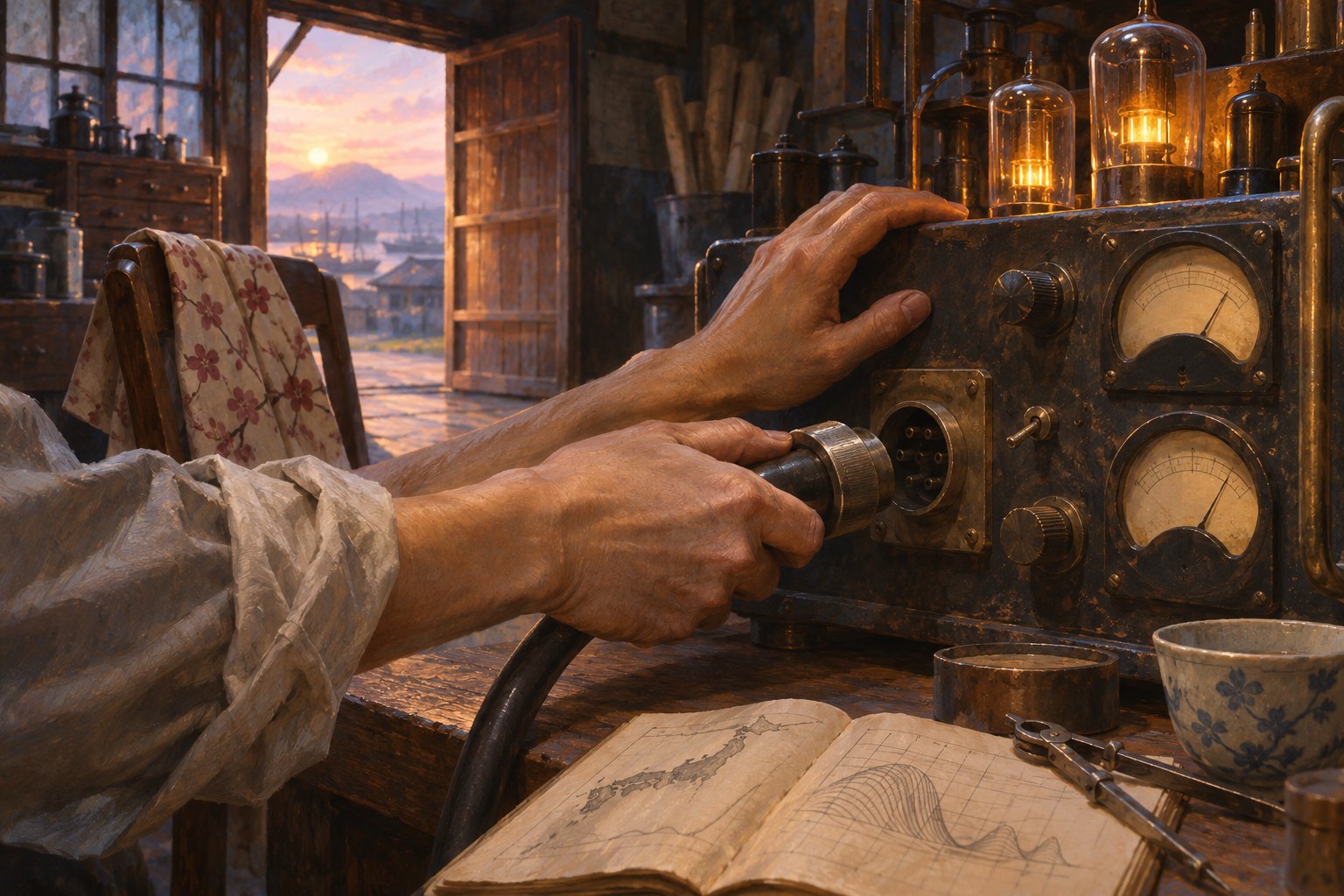
Spoiler warning: This analysis discusses published accounts of major character developments and the ending. The accompanying illustrations are conceptual artwork, not film stills.
Kōichi’s family changes the meaning of duty
The story resumes two years after the previous film. Kōichi Shikishima, played by Ryunosuke Kamiki, and Noriko, played by Minami Hamabe, are raising Akiko, played by Sae Nagatani. Their domestic life gives the returning pilot a reason to hesitate when another emergency calls him back.
That hesitation deserves attention. An action narrative can make reluctance look like an obstacle that a hero must overcome before the entertaining part begins. Here, reluctance contains a legitimate moral argument. Kōichi’s life belongs partly to people who depend on his return. Taking a dangerous assignment is therefore a decision about their future as well as his own conscience.
Akiko makes that argument concrete. Her line, “Something scary is coming again!” compresses the sequel’s premise into a child’s alarm. She cannot experience a new threat as an opportunity for redemption. She experiences the possibility of losing her parents.
This is where character continuity earns its place. A returning protagonist should bring changed obligations into a familiar situation. As our discussion of how franchises make returning characters matter explores, recognition becomes dramatically useful when audiences understand what a person stands to lose now.
Ghidorah introduces a different kind of helplessness
King Ghidorah takes a substantial role in the sequel’s early conflict while Godzilla remains dormant. The flying monster’s electrical attacks widen the practical problem facing the human characters. A previous victory cannot simply become a reusable instruction manual.
That change gives meteorologist Makoto Aoyama, played by Masami Nagasawa, a meaningful function. Weather knowledge becomes relevant to understanding the threat. Alongside naval engineer Kenji Noda, played by Hidetaka Yoshioka, she represents an approach to disaster built around observation, planning, and collaboration.
There is an appealing humility in this arrangement. Expertise does not make the characters masters of their world. It gives them something more limited: a way to act without understanding everything. For a monster story, that distinction preserves suspense. A plan can be intelligent and still fail because its designers are confronting something beyond their experience.
The potential weakness is structural. More specialists and more explanations can distribute attention away from the family. The useful critical test is whether a planning scene changes someone’s decision or simply postpones the next attack. Technical information earns its screen time when it exposes a disagreement about acceptable risk.
Noriko’s survival becomes a question of ownership
Noriko’s connection to Godzilla develops into a central mechanism of the plot. Godzilla’s DNA remains in her body, allowing a resonance device to attract the creature through her. Her survival has made her strategically valuable.
This is the film’s most disturbing ethical proposition. A person can survive an attack and then discover that the consequences give others a reason to claim authority over her body. Medical vulnerability and military usefulness become entangled.
The distinction between choosing to help and being treated as equipment matters enormously. Noriko’s family sees a person whose life has value beyond the operation. A strategic calculation can reduce that same person to access, capability, and potential advantage. The science-fiction premise makes that reduction unusually literal.
Murakami gives grief a dangerous destination
Kanji Murakami, played by Min Tanaka, carries the loss of his family in Hiroshima into the present crisis. His anger introduces a different response to catastrophe from the Shikishimas’ effort to preserve a home. Where their attention turns toward the people still beside them, his suffering creates an opening for revenge.
The contrast is morally useful because grief does not dictate a single outcome. Pain can intensify compassion, narrow it, or make another population’s suffering seem like an overdue correction. Understanding Murakami’s loss does not require accepting every action that grows from it.
His eventual participation in destroying the means of exploiting Noriko gives that conflict a consequential resolution. Knowledge acquires an ethical limit. The achievement is no longer simply discovering what can be done; it includes recognizing when a discovery should cease to be available.
The dialogue’s directness is both strength and risk
“Will we ever live in peace?” is a blunt question, quoted in Empire’s review. It expresses the film’s emotional situation without disguise. Such directness can suit melodrama, where characters speak feelings that quieter films leave unstated.
But explicit dialogue creates a demanding standard for the surrounding scenes. If fear has already been established through behavior, repeating it aloud needs to add something: a changed relationship, an accusation, a request that another person cannot answer. Otherwise, emotional emphasis can flatten distinct reactions into the same register of anguish.
For me, the underlying character dilemmas are more persuasive than the size of the declarations. A parent deciding whether to leave, or a scientist deciding whether to preserve dangerous research, contains an argument that tears alone cannot supply. This is also why small human moments deserve the big screen: scale can make a pause or refusal feel consequential, too.
The ending measures victory through a child
After the monster confrontation, Kōichi and Noriko consider leaving Akiko behind for her protection. They ultimately escape together as a family. That decision prevents the conclusion from treating physical survival as a complete answer.
My interpretation is that Godzilla Minus Zero locates its deepest conflict in the language of necessary sacrifice. Institutions can demand sacrifice for security; injured people can demand it for justice; parents can contemplate it out of love. Each motive needs scrutiny because good intentions do not erase the experience of the person being left behind.
The family’s choice offers no guarantee of safety. It acknowledges that protecting a child includes remaining answerable to her needs. That gives the sequel a meaningful destination beyond another defeated monster: survival becomes worthwhile through the relationships people refuse to surrender.
Original content by this site's editorial team. Published: November 7, 2026 at 14:04:22 PST (Los Angeles time)