Ghost Soldier builds its action premise around an immediately understandable grievance: people should not lose their homes because a powerful company wants their land. Its more difficult proposition is that the right man, sufficiently wronged and sufficiently armed, can deliver justice himself. That tension makes Henry “Fitz” Fitzgerald worth examining beyond his capacity to defeat whoever comes next.
Jim Caviezel plays Fitz in director William Eubank’s thriller, written by Chris Papasadero. The official synopsis identifies him as a former Special Forces soldier and weapons developer whose secluded life is disrupted by a corporation threatening his community. Those credentials establish the fantasy’s central advantage: the apparently vulnerable resident has extraordinary means of resistance. [Sony’s official synopsis](https://ghostsoldier.movie/)
Spoiler notice: The discussion below includes reported character relationships, violence, and the climax. It is an interpretation of documented story material, rather than a firsthand assessment of performances, editing, or cinematography.
Fitz’s strongest claim to heroism is his responsibility to others
A solitary action hero becomes more interesting when solitude stops being an adequate response to the world. Fitz could be understood simply as a homeowner resisting dispossession. His neighbors give that resistance a wider meaning: defending property becomes a question of whether someone with unusual power has obligations to people without it.
The film’s relationship between Fitz and young Jack Hernandez supplies a particularly useful perspective. Apple TV’s published plot description identifies Jack as the son of a soldier who died overseas and describes a hunting trip on which he and Fitz bond. It also describes Fitz intervening when corporate enforcers threaten the Hernandez home. [Apple TV’s plot description](https://tv.apple.com/us/movie/ghost-soldier/umc.cmc.668r531ryggqi89owj9a210ww)
Read through Jack’s position, protection has two dimensions. There is immediate safety, but there is also the example an adult sets. A capable protector can offer reassurance while teaching a child that every serious dispute ultimately belongs to whoever commands the greatest force. Those possibilities need not cancel each other out; their coexistence is precisely what makes the relationship worth considering.
My reading is that Fitz’s moral credibility depends more on this responsibility than on his military résumé. Training explains what he can do. It cannot, by itself, explain what he should do. The distinction matters whenever an action movie asks competence to carry the weight of character.
The river makes the conflict larger than one man’s land
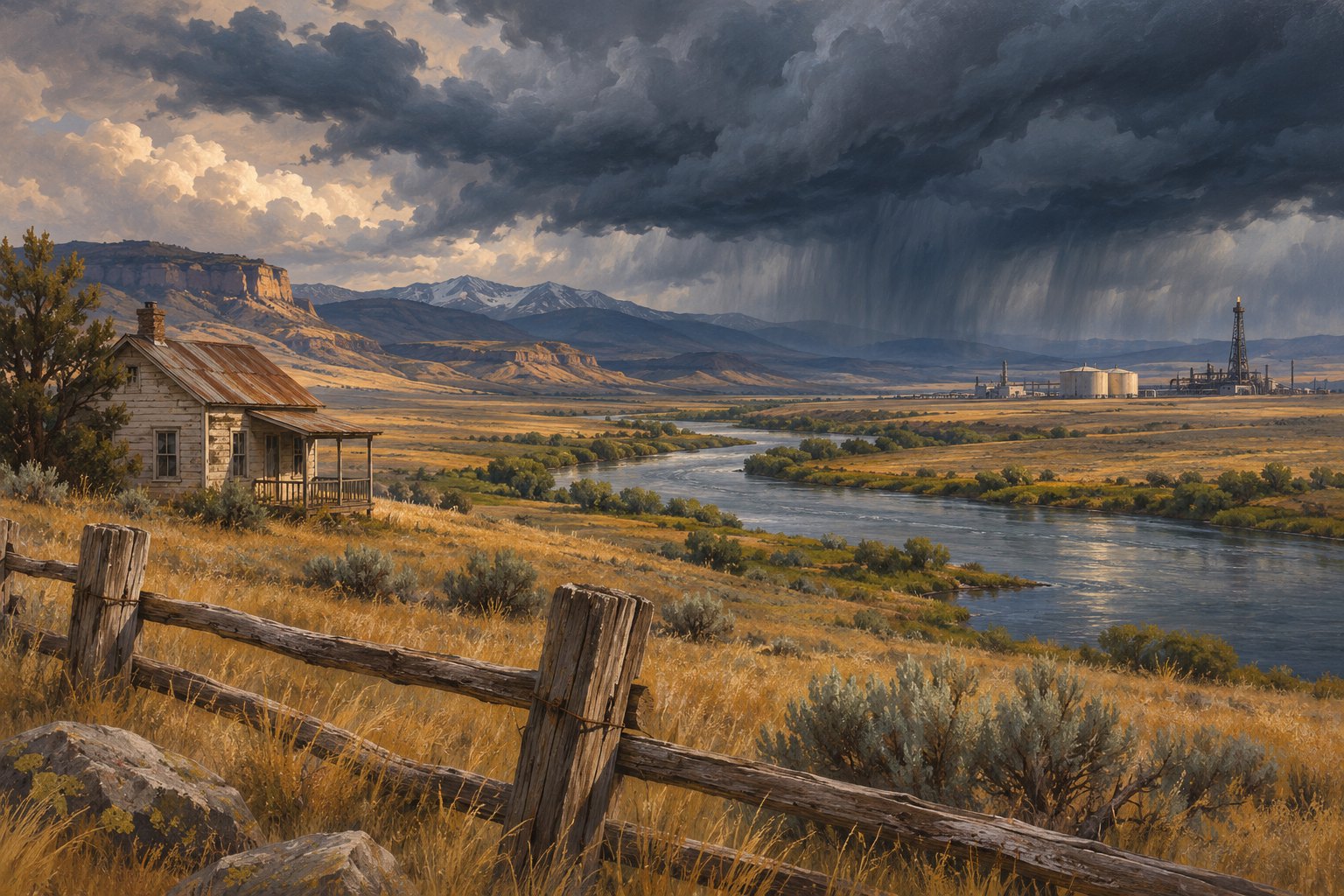
John Mulderig’s review for Catholic Review identifies Brownstone’s objective as control of a Wyoming river to supply water for data centers. It describes threatened evictions and escalating intimidation. This gives the confrontation a concrete resource at its center, rather than leaving corporate greed as an entirely abstract motive. [Catholic Review’s assessment](https://catholicreview.org/movie-review-ghost-soldier/)
A river means something different depending on where a character stands. For a resident, it belongs to the geography of daily life. For an acquiring company, it can become an asset whose value depends on securing control. The conflict therefore involves competing definitions of a place: home, community, infrastructure, and revenue source.
That distinction offers a stronger basis for criticism than merely dividing the characters into decent locals and sinister outsiders. Coercion is the meaningful offense. A corporation’s identity does not establish its wrongdoing; its treatment of people does. Keeping that emphasis makes Fitz’s resistance intelligible without treating every change to the landscape as an act of aggression.
Belonging can also become possessiveness, a distinction explored in our analysis of home, recognition, and control in Bird in Hand. Here, the related question is whether defending a community continues to honor its members’ interests once one defender takes charge of the conflict.
Sheriff Parker exposes the problem of authority
Olivia Thirlby’s Sheriff Heidi Parker offers Fitz assistance that Mulderig describes as sincere but ineffective. Brownstone’s security chief Graves, played by Garret Dillahunt, escalates matters by bringing in assassins led by Beau Knapp’s Mirko. These reported roles place Fitz between compromised public protection and increasingly organized private violence.
From Parker’s perspective, the central problem is not simply whether Fitz can stop dangerous people. It is what happens when lawful authority cannot protect residents and an individual starts performing its functions. Success on the battlefield does not automatically answer questions of accountability afterward.
This is where the lone-avenger structure becomes morally convenient. If institutions cannot act and enemies continually escalate, the protagonist’s options appear to narrow until violence looks inevitable. Yet inevitability is also a storytelling choice. Viewers can accept a dangerous situation while still examining how thoroughly the narrative has eliminated alternatives.
Parker consequently matters as more than potential backup. Her position invites a question Fitz’s arsenal cannot settle: who gets to decide when the emergency has ended?
Religious conviction does not settle the question of revenge
Two reported lines crystallize Fitz’s certainty: “Corporate tyranny is still tyranny” and “God will judge our enemies. I’ll just arrange the meeting.” [Dialogue quoted by Nick Schager](https://www.thedailybeast.com/obsessed/ghost-soldier-maga-actor-jim-caviezels-comeback-is-a-wild-right-wing-action-fantasy)
The first proposition identifies an abuse of power. The second assumes permission to administer an irreversible answer. The distance between those positions is the moral territory a revenge story needs to explore.
Mulderig specifically objects to Fitz invoking St. Michael while committing killings the reviewer characterizes as cold-blooded murder. That is the reviewer’s judgment, but it identifies a substantive tension between the protagonist’s religious language and his conduct.
Faith can supply a character with courage, restraint, humility, or certainty. These qualities do not always lead in the same direction. When religious conviction accompanies revenge, the useful critical question is whether belief imposes limits on the avenger or merely reinforces his confidence.
For me, the strongest interpretation here concerns self-authorization. A person can correctly recognize injustice and still overestimate his entitlement to punish it. Sympathy for the victim does not require surrendering judgment about the victim’s subsequent choices.
What Fitz’s victory can—and cannot—resolve
Mulderig reports a climax in which Fitz destroys Brownstone’s headquarters with rocket launchers. The image supplies a decisive physical answer to the corporation’s power. As a narrative endpoint, however, destroying the headquarters cannot itself demonstrate that the community has regained a durable, accountable way of protecting its interests.
That distinction shapes my assessment of the story’s central promise. Fitz offers the satisfaction of resistance made effective. The unresolved issue is whether effectiveness becomes the sole measure of righteousness.
Our discussion of taking time to reflect after a movie offers a useful habit here: separate the relief of seeing an aggressor defeated from agreement with every means used to defeat him.
Ghost Soldier invites a deeper reading as a fantasy about escaping powerlessness. Its hero possesses the skills ordinary people lack when intimidation overwhelms their choices. That desire is understandable. The difficult question is what becomes of a community when its freedom rests on one exceptionally powerful person’s judgment. Fitz’s cause can deserve sympathy while his claim to unrestricted moral authority remains open to challenge.
Original content by this site's editorial team. Published: November 20, 2026 at 08:35:53 PST (Los Angeles time)