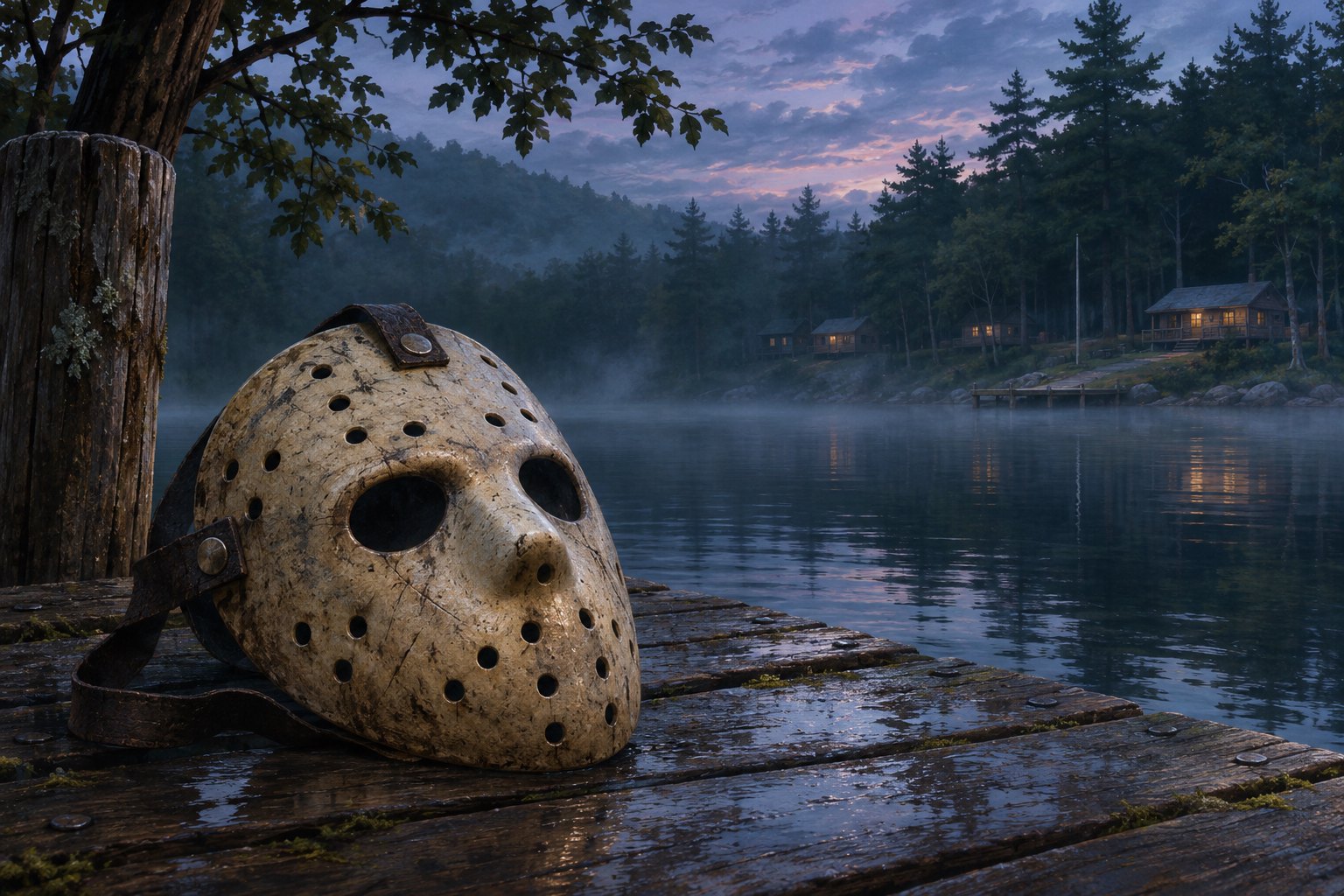
Friday the 13th is getting a new movie, according to Collider, which describes the return as the franchise’s first new film in 18 years. For viewers looking for confirmation of a comeback, that is the central news. It is also an announcement worth separating from any judgment about the finished movie: a return alone cannot tell us whether the scares, characters, or storytelling will work.
The most revealing place to consider that distinction is the original Friday the 13th. Beneath its familiar reputation lies a nasty little story about an adult who converts a child’s death into permission to destroy other people. Revisiting it through Pamela Voorhees and Alice gives the comeback a more interesting context than another inventory of weapons and masks.
Spoiler warning: The following retrospective discusses the killer’s identity and ending of the 1980 film. It does not review or describe the plot of the newly reported movie.
The original film’s strongest idea is its betrayal of trust
The original’s essential reversal is simple: the person who looks capable of providing comfort becomes the source of terror. Pamela arrives with the manner of an adult who understands the camp and can explain what has happened. Alice needs exactly that kind of reassurance.
From Alice’s perspective, accepting help is reasonable. She has neither the audience’s distance nor its freedom to turn every encounter into a guessing game. Her ordeal becomes especially cruel when the prospect of rescue transforms into another demand that she fight for her life.
My view is that this reversal gives the film more staying power than its mystery construction deserves. Pamela enters the action too late for her identity to function as a particularly satisfying puzzle solution. But as an emotional trap, her arrival works. The film exploits a familiar reflex: when something terrible happens, find someone who appears to know what to do.
Pamela mistakes suffering for moral authority
“You see, Jason was my son.” Pamela’s explanation makes the name personal before it becomes a franchise emblem. Her account of his drowning places failed supervision at the center of her grievance. She remembers a vulnerable child whom adults should have protected.
The disturbing turn is what she does with that memory. Pamela treats the people in front of her as substitutes for those she blames. Individual responsibility disappears. Working at the camp becomes sufficient evidence of guilt.
That distinction matters when interpreting the movie’s violence. We can understand the emotional source of her anger without accepting her explanation as a moral verdict. Alice is not responsible for repairing Pamela’s past, and the other young workers cannot be made answerable for a death they did not cause.
Pamela’s grief also becomes a closed conversation. When she voices “Kill her, Mommy,” she supplies both the instruction and the authority behind it. The son she claims to serve cannot contradict her. In my reading, the horror lies in this complete absence of resistance inside her own argument: every objection can be overwritten by the demand she attributes to Jason.
This makes Pamela more unsettling than a generic avenger. She speaks as though love has settled the question of right and wrong. Her actions demonstrate how thoroughly that certainty has destroyed her ability to recognize another person’s life as valuable.
Alice’s uncertainty gives the finale its weight
Alice begins as someone with reservations about staying at the camp. She has interests and unfinished concerns beyond it. Those small details matter because they suggest a life that the movie’s killing machinery threatens to erase.
She is not introduced as a specialist in survival. Her eventual resistance develops under pressure, through confusion, flight, and the need to respond to immediate danger. That makes her fear more persuasive than a succession of perfectly calculated decisions would be.
The film does sometimes stretch those responses into repetitive business. Its pauses can feel like suspense being prolonged because the next attack has not arrived yet. For me, the distinction is whether a delay keeps us inside Alice’s uncertainty or merely keeps the running time moving. The original achieves both effects, and its reputation should not exempt the weaker stretches from criticism.
Still, Alice’s confrontation with Pamela has a useful dramatic imbalance. Pamela believes she possesses the entire explanation. Alice needs enough understanding to survive. The killer demands recognition of an old wound while refusing to recognize the person standing before her.
Our character-focused review of Jason Lives considers a later version of survival within this series. Here, the tension is more intimate: Alice must stop treating apparent adult authority as a promise of safety.
The lake ending makes escape feel provisional

After Alice defeats Pamela, the canoe sequence offers a different rhythm. The lake seems to provide distance from the violence on shore. Its stillness invites the viewer to begin relaxing along with her.
The sudden appearance of the boy breaks that invitation. The subsequent hospital conversation leaves Alice’s experience unresolved rather than converting it into a clean explanation. Read within this film, the sequence works through uncertainty; later franchise developments need not settle every aspect of its original effect.
As a scare, it is aggressively manipulative. The film offers release and then snatches it away. As an ending to Alice’s experience, however, it has a more troubling implication: surviving an event does not guarantee that the world will feel safe afterward.
The water also changes meaning. It belongs to Pamela’s story of loss, becomes Alice’s temporary refuge, and then delivers the final disruption. A single location accommodates incompatible emotional realities. That is a stronger visual idea than simply leaving a threat available for another installment.
What this means for another Friday the 13th
The reported new movie does not need to reproduce Pamela’s reveal or Alice’s canoe escape. Repeating their surfaces would risk turning surprise into a recognition exercise. Their value lies in how they make ordinary expectations unreliable: an adult may not protect you, a familiar place may not welcome you, and daylight may not restore certainty.
For viewers assessing the eventual film, those are useful questions to carry forward. Does a scene give us a reason to trust someone before that trust is tested? Does the setting mean something to the characters? Do their reactions change what a frightening moment feels like?
Our broader discussion of what another Friday the 13th should remember approaches the franchise’s return from its enduring identity. The original suggests a particularly sharp criterion: recognizable imagery becomes more powerful when it carries a character’s mistaken belief or desperate hope.
The deeper horror is a past imposed on strangers
I find the original uneven as a mystery and more effective as a confrontation with displaced blame. Pamela cannot restore what she has lost, so she makes unrelated people inhabit her tragedy. Alice’s struggle is the refusal of that imposed role.
That interpretation gives the comeback its most productive connection to the first film. The series began with someone insisting that the past must continue to govern the present. Another worthwhile entry can explore the consequences of that insistence. The disturbing question is not simply whether violence returns to the lake, but whose future gets taken away when someone refuses to let the past end.
Original content by this site's editorial team. Published: November 13, 2026 at 20:34:43 PST (Los Angeles time)