A thirteenth Friday the 13th movie is reportedly on the way, with a franchise director returning, according to the Los Angeles Times. That prospect raises a question beyond how Jason Voorhees will look: who will make his return worth fearing?
For an illuminating answer, revisit Friday the 13th Part VI: Jason Lives (1986), written and directed by Tom McLoughlin. Its strongest asset is the friction among people who understand the danger differently. Tommy Jarvis wants certainty. Sheriff Garris wants control. Megan Garris wants someone to examine what is actually happening.
Full spoilers follow for Jason Lives. This is a retrospective review, not a review or plot preview of the forthcoming film. The earlier movie offers a useful standard for assessing a comeback without assuming anything about the new production’s story.
Tommy Jarvis brings the monster back by demanding closure
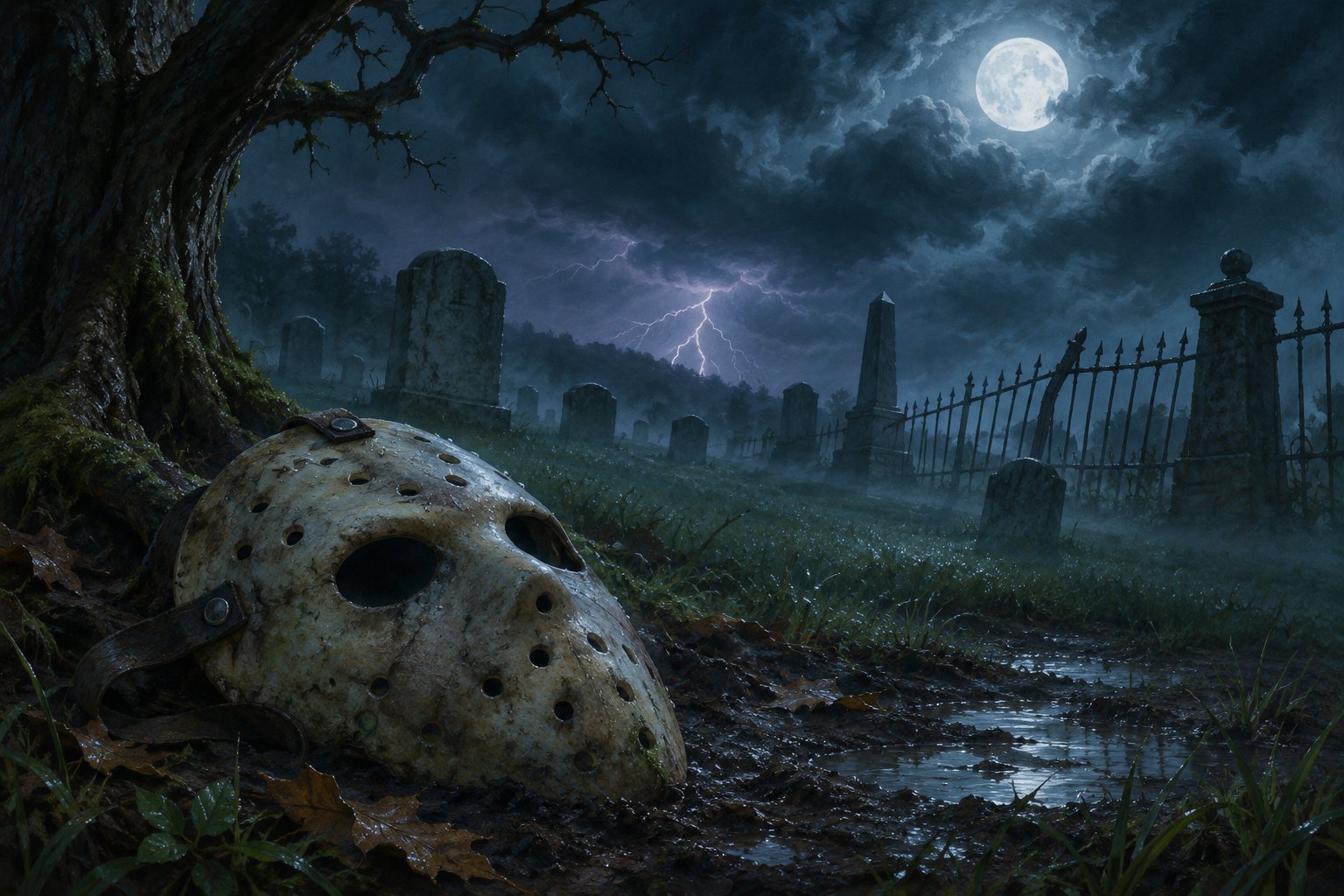
Tommy, played by Thom Mathews, visits Jason’s grave intending to destroy the body. His attack on the corpse leaves a metal fence post embedded in it; lightning supplies the catastrophic result. The person most desperate to prevent another killing spree has helped make one possible.
“This is between me and Jason,” Tommy insists early on. It is a revealing declaration because the film immediately demonstrates its limitations. Whatever Tommy believes he is settling, the consequences reach people who never agreed to participate.
That gives the opening more substance than a convenient resurrection mechanism. Tommy confuses having survived Jason with having sole responsibility for ending him. His determination is understandable, but his private mission cannot contain the public danger it creates.
Mathews makes that contradiction playable through urgency. Tommy rarely seems comfortable occupying an ordinary conversation. He needs other people to catch up with what he knows, and that impatience makes him easier to dismiss. The performance puts the viewer in an uncomfortable position: we know his warning is accurate, while also recognizing why his behavior alarms strangers.
My reading is that the film becomes more interesting when Tommy’s guilt matters as much as his courage. His eventual task is to protect people from the consequences of his mistake. Simply proving that he was right would be a much smaller victory.
Sheriff Garris mistakes a settled opinion for an investigation
David Kagen’s Sheriff Garris encounters Tommy through the filter of his psychiatric history. The community has also renamed Crystal Lake as Forest Green, hoping to leave its notorious association behind. Tommy’s warning threatens that comfortable distance.
Renaming gives the film a sharp little metaphor without requiring a speech. A community can change the words it uses more easily than it can address what happened. Garris treats the return of an unwelcome subject as though it were itself the emergency.
The conflict works because the audience possesses decisive information he lacks. We have seen the resurrection. Every refusal to investigate therefore consumes time we know the characters cannot afford.
Yet the screenplay presses this obstruction too far. Once Megan supplies information contradicting his suspicion of Tommy, Garris’s resistance becomes increasingly difficult to accept as sound judgment. At those moments, the machinery of prolonging the chase shows through the character.
His final effort to protect Megan restores some human weight. The man who misunderstands the crisis can still respond courageously when his daughter is threatened. That does not erase his failures; it prevents him from being merely a uniformed obstacle.
This concern with the gap between confidence and knowledge also connects with our analysis of evidence and judgment in Minority Report. Here, the stakes are delivered through brisk horror mechanics: accepting the wrong explanation leaves the real threat free to move.
Megan turns sympathy into useful action
Jennifer Cooke’s Megan initially approaches Tommy with flirtatious curiosity. That is a lightweight foundation for trust, and the film does not suddenly transform their relationship into a deeply developed romance. What makes her valuable is how she behaves when curiosity meets evidence.
She notices when her father’s explanation stops making sense. She helps Tommy escape confinement and participates in the effort to stop Jason. Her independence has practical consequences, rather than existing only as an appealing personality trait.
There is a worthwhile distinction between Tommy and Megan. He brings knowledge accumulated through suffering; she brings the willingness to act on information despite pressure to dismiss it. Neither contribution is sufficient alone.
For me, Megan is the film’s most welcome corrective to its hero’s solitary fixation. Tommy begins by defining the struggle as personal. The ending requires him to survive through another person’s intervention. A character introduced partly through attraction becomes indispensable through action.
The jokes work best when the danger stays real
Jason Lives enjoys the absurdity of its own premise. Cemetery caretaker Martin’s observation, “Some folks have a strange idea of entertainment,” gives the audience a knowing nudge. The movie recognizes that its viewers have arrived expecting another elaborate encounter with death.
That awareness gives the film personality, although the comic detours sometimes loosen its grip. The paintball sequence, in particular, devotes considerable attention to people whose personalities are built for quick comic recognition. Viewers looking for sustained dread may find the interruptions costly.
The camp’s children provide an effective counterweight. Their presence gives the counselors responsibilities beyond their own survival. An adult’s disappearance means someone vulnerable has one fewer person looking after them.
The distinction matters for any future installment. Humor can make characters enjoyable company before danger arrives. It becomes less effective when it encourages us to regard everyone as disposable. This film’s better passages preserve a reason to want someone rescued.
The lake ending makes survival a shared achievement
Tommy’s plan culminates in chaining Jason to a boulder beneath the lake. But completing the trap does not carry Tommy safely through the confrontation. Megan must enter the water, free him, and revive him. The resolution belongs to both characters.

The final underwater image leaves Jason alive and restrained. Read psychologically, that is a more persuasive conclusion to Tommy’s struggle than a declaration that his past has vanished. The danger has been contained; living beyond it remains possible.
Our retrospective on the original Friday the 13th considers Alice’s fragile safety and Pamela Voorhees’s destructive grief. Jason Lives offers a different emphasis: recovery requires moving beyond a private confrontation and allowing someone else to help.
A familiar opening joke, and a useful standard for the next film
One conspicuous visual reference arrives near the beginning: Jason’s James Bond-style opening gag borrows the recognizable gun-barrel setup and substitutes the slasher’s attack. It announces the film’s playful relationship with screen icons. Familiarity itself becomes part of the entertainment.
But the film earns more than recognition when its human characters make consequential choices. My verdict is that Jason Lives remains an engaging, unevenly frightening sequel whose emotional structure is stronger than its disposable supporting roles suggest.
A returning franchise director can make the reported thirteenth film an intriguing prospect. The harder achievement will be giving its characters competing beliefs, credible responsibilities, and reasons to save one another. Jason supplies the threat. The survivors determine whether his return means anything.
Original content by this site's editorial team. Published: November 13, 2026 at 18:42:06 PST (Los Angeles time)