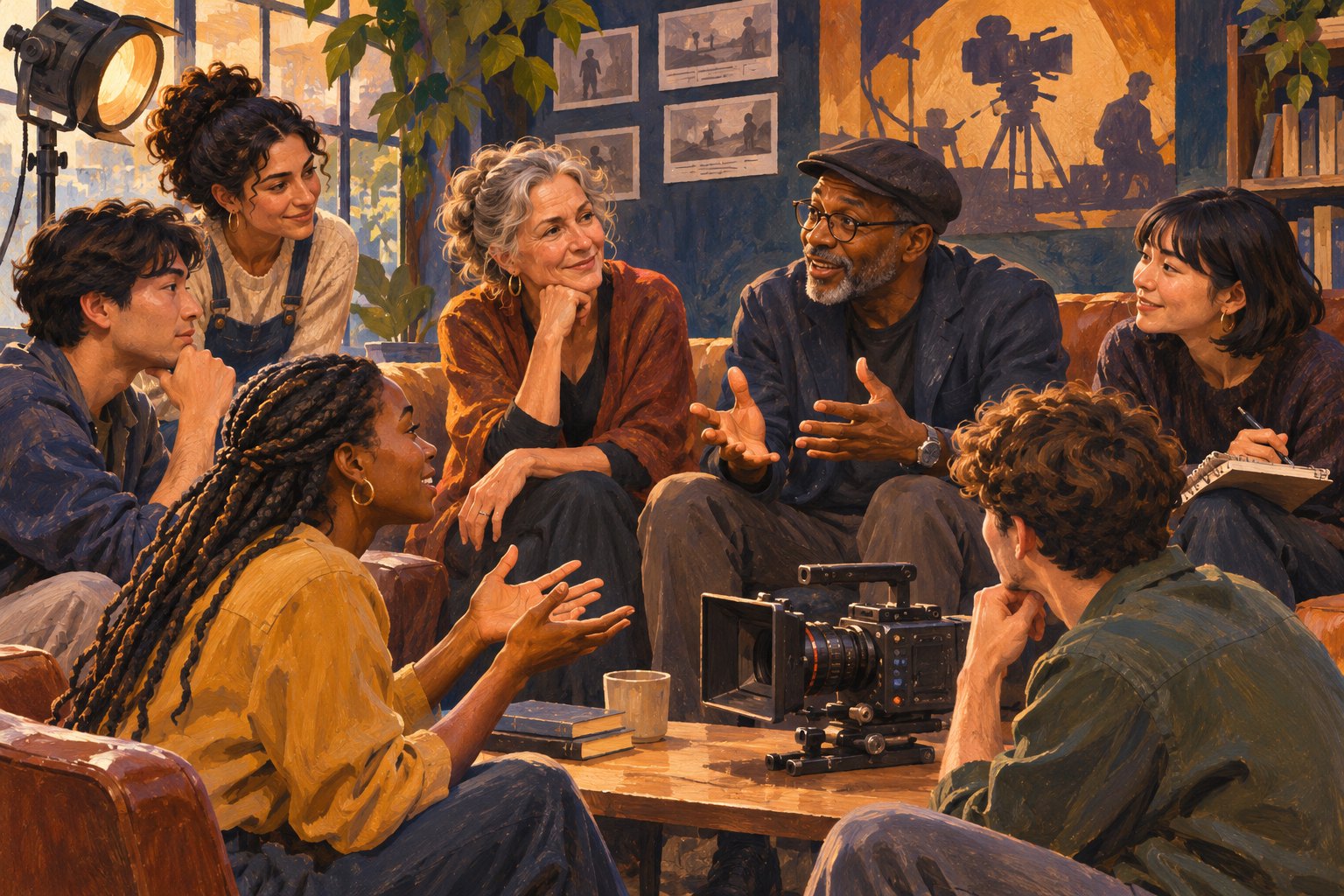
Film students meeting and networking with Oscar-winning industry professionals is an appealing story about access. The more revealing element in the University of Cincinnati coverage is confidence: its headline foregrounds the words “I've gained confidence.” That is a modest, personal measure of progress, and potentially a meaningful one for someone learning to bring creative ideas into a room.
The reported encounter connects students with accomplished film professionals. It does not, by itself, establish what projects might follow or how anyone’s career will develop. Its immediate interest lies in something less predictable than a job offer: the possibility that talking with experienced practitioners can help emerging filmmakers participate more fully in their own education.
Our view is that this is where the story deserves attention. An impressive introduction can become a useful learning experience when a student leaves better able to ask questions, explain a creative choice, or acknowledge a problem in unfinished work.
What confidence means when your work is unfinished
Filmmaking requires people to share ideas before those ideas can defend themselves on screen. A scene on the page may feel awkward. An early edit may lack the rhythm its director imagined. An actor may need a clearer explanation of what changes emotionally between the beginning and end of a take.
In those situations, confidence has a practical function. It allows a filmmaker to communicate an intention while remaining open to revision. Someone who can identify a problem precisely gives collaborators a better chance of helping solve it.
That distinction matters when interpreting the Cincinnati story. Feeling more confident after meeting professionals is a worthwhile personal response. Whether that feeling becomes artistic growth depends on what happens afterward. The useful test is whether a student becomes more willing to make decisions, seek specific feedback, and keep working when a first attempt disappoints.
Confidence can also make room for uncertainty. A student does not need a polished answer to every question to belong in a conversation about film. Recognizing what they have yet to learn can be the beginning of a more productive exchange.
What an Oscar-winning professional can bring to a conversation
An Academy Award gives an encounter an obvious sense of occasion. For students, the distinction may make a professional’s career feel especially distant from their own circumstances. A conversation creates an opportunity to move beyond that distance and discuss the decisions that filmmaking actually involves.
The most useful questions invite someone to explain their process. How did they recognize that a scene was failing? What information did a collaborator provide that changed their approach? Which limitation forced them to reconsider an otherwise attractive idea?
These are suggested questions, not a reconstruction of what anyone asked during the reported encounter. Their value is that they lead toward reasoning a student can examine. A success story becomes more instructive when it includes alternatives considered, compromises made, and choices abandoned.
There is also a limit to what any celebrated practitioner can offer. One person’s experience cannot provide a complete map of an industry or a guaranteed route into it. Students can respect expertise while asking how advice applies to their own interests, resources, and responsibilities.
Start with the character, then ask about the craft
For students interested in directing, writing, performance, or editing, character perspective offers a concrete way to begin a professional conversation. Instead of asking broadly how to make a scene emotional, consider what a character wants, what another person prevents them from getting, and what the audience needs to notice.
Imagine a practice scene in which someone conceals disappointment during a conversation. This is a hypothetical exercise, not a film shown at the event. The filmmaker could emphasize the speaker’s reassuring words, hold on the listener’s face, or allow a pause to complicate the exchange. Each choice changes whose experience organizes the scene.
A discussion with an experienced professional could explore how to choose among those possibilities. Does the audience need immediate access to the disappointment, or should it become apparent later? Is the performance already communicating enough? Would a close-up clarify the moment or make it too emphatic?
That kind of inquiry connects networking to film analysis. It treats a finished scene as the result of decisions rather than an effect produced by prestige. Our commentary on watching emerging filmmakers’ work at Mountain Frame approaches student filmmaking through a related question: what do the choices on screen allow us to understand?

Turn a brief introduction into useful learning
The Cincinnati coverage provides a starting point for students preparing for similar opportunities. A conversation need not produce an ongoing mentorship to be valuable. It can leave someone with one better question or a manageable experiment to try.
- Prepare a specific introduction. Explain what you are studying or making and identify the part of filmmaking that currently interests you. Specificity gives the other person something to respond to.
- Bring a problem with boundaries. A question about maintaining tension in a short dialogue scene is easier to explore than a request for the secret to becoming a successful director.
- Listen for the reasoning. Advice becomes more useful when you understand the circumstances behind it. Ask what made a particular approach appropriate for that project.
- Follow up proportionately. If further contact is invited, a concise thank-you and a reference to the discussion can be enough. An initial introduction does not imply a commitment to review a screenplay or arrange employment.
- Test an idea in your work. Try a different cut, simplify a scene, or reconsider a character’s objective. Evaluate whether the change improves what the audience understands.
This approach makes professional contact useful even without an immediate career outcome. It also gives students a way to assess advice through practice, preserving their responsibility for the final creative decision.
Why movie audiences have a stake in these encounters
For readers who primarily watch and review movies, student networking may seem far removed from the finished film. Yet the habits discussed here have recognizable consequences on screen: whether a performance has space to develop, whether an edit clarifies a relationship, and whether an impressive image serves the story.
Consider location. A filmmaker can treat a setting as attractive scenery or ask how it affects a character’s movements, privacy, and choices. Our discussion of what a Maine filming location can bring to a story explores that distinction. Professional conversations are most relevant to audiences when they help emerging filmmakers connect practical decisions with dramatic meaning.
It would be premature to claim that this encounter has already produced stronger films. The more defensible judgment is that access creates an opportunity for learning—and that students deserve to be understood as developing artists, with questions and intentions of their own.
The next creative decision is the meaningful test
The confidence emphasized in the University of Cincinnati headline is compelling because it describes a change in how someone approaches participation. For an emerging filmmaker, being able to enter a conversation can matter before there is a finished project, a professional credit, or an audience.
The lasting value of meeting Oscar-winning professionals will be personal and uneven. Some students may retain a practical suggestion; others may gain the courage to ask for criticism or explain an unfamiliar idea. The strongest interpretation of this story is that professional access can make creative participation feel possible. What gives that possibility substance is the work students choose to do next.
Original content by this site's editorial team. Published: November 24, 2026 at 17:11:27 PST (Los Angeles time)