Family holiday movie favorites need something beyond decorations and a happy ending: they need to give everyone on the couch a reason to return. Our strongest pick is The Muppet Christmas Carol. Its jokes welcome younger viewers, its ghost story supplies suspense, and its portrait of a man who has confused financial security with a meaningful life becomes more uncomfortable with age.
For households that prefer elaborate slapstick, Home Alone offers a different attraction: a child’s independence fantasy colliding with the desire to have his family back. But the Muppets make the more rewarding choice when the room wants comedy, music, and something worth discussing afterward. Their Christmas story understands that comfort becomes more valuable when a film acknowledges why people need it.
Spoiler notice: This review discusses the central relationships and ending of The Muppet Christmas Carol, including its treatment of death and bereavement.
Why this holiday favorite deserves a closer look
Directed by Brian Henson and released in 1992, the film places Michael Caine’s Ebenezer Scrooge among familiar Muppet performers. Kermit plays Bob Cratchit, Miss Piggy plays his wife, Emily, and Gonzo assumes the role of Charles Dickens, with Rizzo providing commentary from closer to street level.
The essential artistic decision is Caine’s seriousness. He treats a conversation with a frog as a consequential exchange between an employer and an employee. That conviction gives the other performers room to be ridiculous without making the story itself disposable.
My judgment is that this balance explains the film’s endurance better than nostalgia alone. A returning viewer can anticipate the punch lines while noticing something new in Scrooge’s discomfort. The performance gives the familiar plot an inner life.
Scrooge thinks isolation is a form of protection
Scrooge begins with a preference that sounds almost reasonable: “I wish to be left alone.” Caine makes it feel like a rule practiced for decades. Every request becomes an intrusion; every relationship threatens to cost him something.
From Scrooge’s perspective, money promises control. People are unpredictable. Affection creates obligations. A balance sheet offers the reassuring appearance of certainty. The film’s moral argument becomes interesting because this outlook has an emotional logic, even as its consequences are cruel.
His journey into the past exposes the weakness of that logic. In his relationship with Belle, postponement becomes a way of life. He keeps moving the point at which they will supposedly have enough to begin living together. Her disappointment reveals how easily preparation for happiness can become an excuse never to choose it.
What hurts is the older Scrooge’s awareness. Watching his younger self, he can recognize the loss without interrupting it. Caine’s stillness makes memory feel less like exposition than an experience he has spent years avoiding.
The sequence also gives adults a different film from the one children may be watching. A younger viewer sees a sad separation. Someone older may recognize the habit of treating love as something that can wait until work settles down.
The Cratchits challenge his view of other people
Kermit’s Bob brings a familiar gentleness to the story, but gentleness should not be mistaken for agreement with his circumstances. His politeness operates inside an unequal relationship. He has to negotiate with a man who controls his livelihood.
At home, Emily supplies the anger that Bob contains. Miss Piggy’s forcefulness is useful here: she prevents the household’s affection from making its financial situation look acceptable. Her resentment gives the family dignity beyond its ability to endure hardship pleasantly.
Scrooge’s visit to their home changes the scale of his attention. An employee becomes a father; a wage becomes the means of feeding a household. The film asks him to understand consequences that his business habits have allowed him to keep abstract.
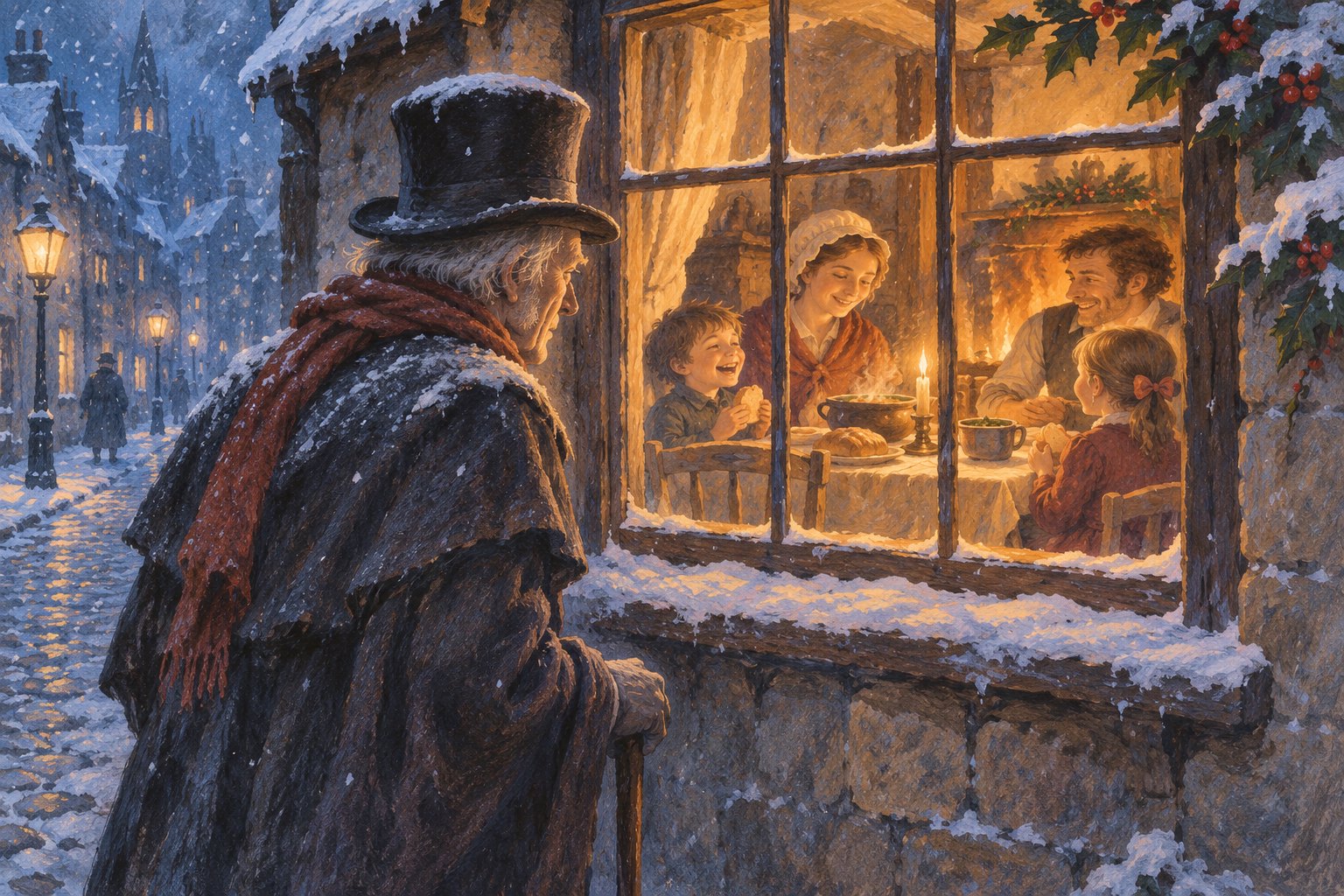
Tiny Tim’s “God bless us, every one!” can sound merely sweet in isolation. Within this family, it expresses an openness that Scrooge has deliberately narrowed out of his own life. The child makes room for others while the wealthy adult keeps calculating reasons to refuse them.
There is a limitation here: Tim functions more as the story’s emotional center than as a fully complicated character. Yet the family’s interactions give his vulnerability a setting. We care about the relationships surrounding him, not simply the lesson his presence teaches.
That concern with belonging also runs through our analysis of Fievel’s search for home in An American Tail. Both films make family warmth meaningful by letting separation and uncertainty remain frightening.
Gonzo and Rizzo make room for fear
Gonzo’s confidence as Dickens and Rizzo’s practical complaints create a second way into the movie. One wants to deliver literature; the other would appreciate food and fewer physical hazards. Their competing priorities resemble the mixed attention spans of a family audience.
“Light the lamp, not the rat!” captures their appeal. The gag interrupts solemnity without requiring us to stop caring about Scrooge. Rizzo’s immediate predicament and the larger moral story can occupy the same space.
Still, the comic interruptions occasionally release tension sooner than I would like. Viewers seeking an uninterrupted ghost story may find the rhythm too restless. The film earns its strongest emotional moments when it gives Caine time to react without immediately supplying a joke.
The movement toward the future is especially effective because the tone grows harsher. The prospect of death strips away Scrooge’s usual defenses. His wealth cannot guarantee affection, and control cannot protect him from the ending toward which his choices are leading.
Choosing it for your own family movie night
This is an excellent choice for a household that enjoys songs, theatrical storytelling, and comedy with a serious emotional destination. It deserves attentive viewing: Scrooge’s reactions often carry as much meaning as the dialogue.
- For children sensitive to frightening imagery: expect ghosts, darkness, and scenes involving graves. Familiar puppets do not make every sequence gentle.
- For viewers affected by loss: the story includes a possible future in which the Cratchits mourn Tiny Tim. Consider whether that is welcome material for the evening.
- For a mixed-age group: let different responses coexist. Someone laughing at Rizzo is still participating in the same film as someone absorbed by Scrooge’s regret.
A useful question afterward is what Scrooge must actually do to make his change believable. That leads beyond a general discussion of kindness toward responsibility. For another family-film conversation about learning to value a community, our review of Cars and the people of Radiator Springs explores how paying attention to others changes a protagonist’s priorities.
The ending makes generosity an everyday obligation
The film’s deepest idea is that Scrooge needs to change his conduct as well as his feelings. Regret matters because it produces action. A warmer personality alone would leave the people around him facing the same problems.
There is a fairy-tale simplicity to locating so much hope in one wealthy man’s transformation. The ending cannot resolve every injustice its world contains. But it does make a concrete demand of its central character: use what you have differently, and become accountable to people you previously dismissed.
That is why The Muppet Christmas Carol belongs among our family holiday favorites. Repeat viewing does not exhaust its meaning. As viewers grow older, they may move from enjoying the comic observers to understanding the anxious parent or recognizing the adult who keeps postponing connection. The reassuring ending stays familiar; the responsibility behind it becomes harder to ignore.
Original content by this site's editorial team. Published: November 28, 2026 at 16:05:30 PST (Los Angeles time)