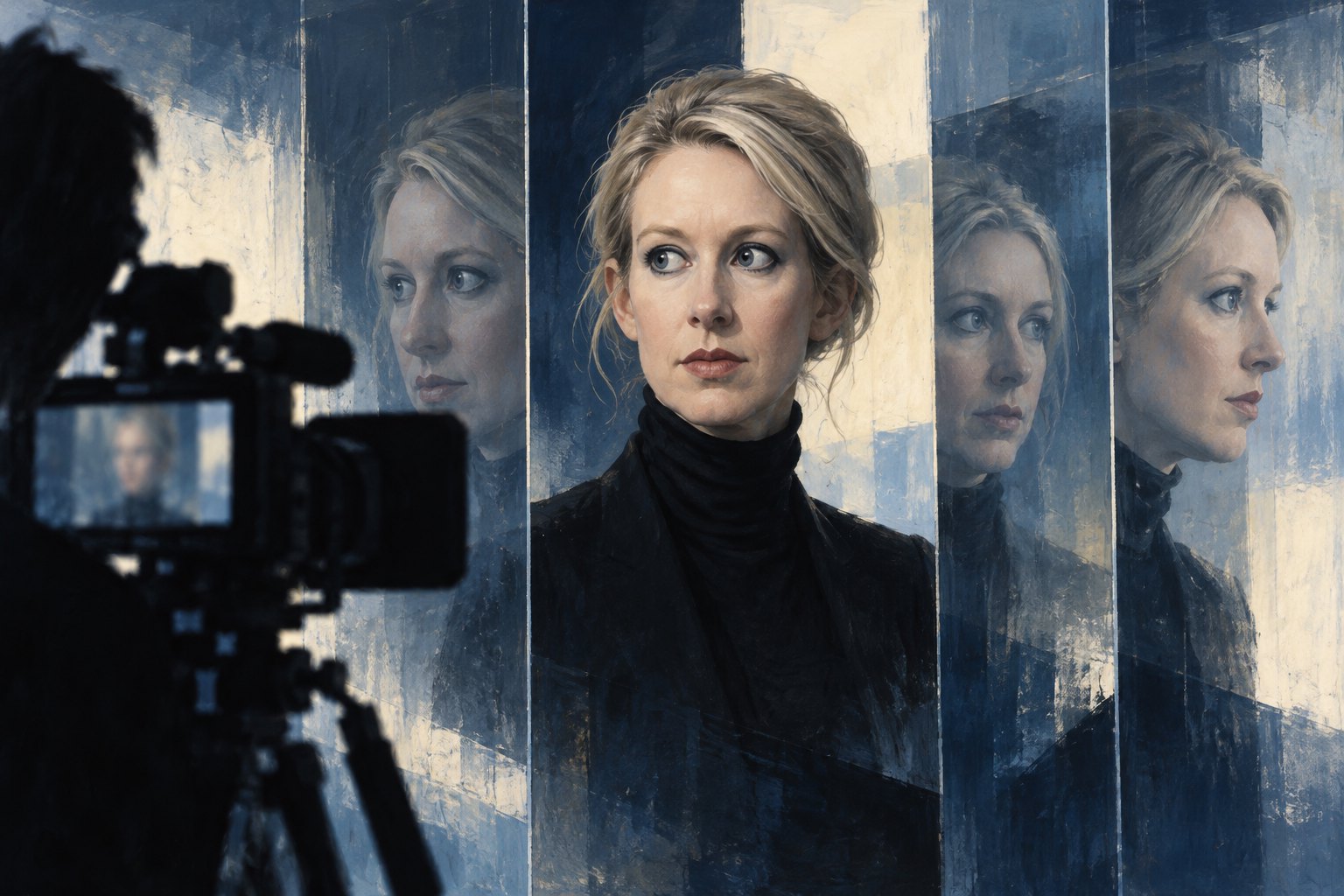
Elizabeth Holmes remains a compelling documentary subject because the public story of her downfall leaves a more intimate question unresolved: how does she understand herself? You Can See Everything brings that question into focus by following the Theranos founder ahead of prison. Its premise puts personal exposure beside public accountability, inviting viewers to consider whether familiarity actually improves their judgment.
My reading of that premise is that Holmes’s continuing fascination depends partly on an uncomfortable gap. Knowing the outcome of a fraud case does not necessarily explain the person at its center. Yet the desire for that explanation can become its own distraction, making a famous subject’s personality seem more consequential than the actions under examination.
Critical preview: This article examines the documentary’s verified premise and publicly reported material, rather than presenting a firsthand assessment of the complete film. Discussion includes its setup and a line from its teaser, without revealing later developments.
A countdown changes the shape of the story
According to the official synopsis, Holmes invites a skeptical film crew to document her life 34 days before she is sent to prison. Nathan Fielder and Lance Oppenheim direct the documentary, whose scope extends beyond that initial countdown. [A24’s official film synopsis](https://a24films.com/films/you-can-see-everything)
That starting point matters dramatically. A story organized around an approaching departure has pressure built into it. Ordinary time becomes limited time. Viewers enter knowing that whatever the subject says, the immediate future will not simply bend to her preferred account.
From Holmes’s perspective, agreeing to be filmed creates an opportunity to become more than a name associated with Theranos. A camera can register hesitation, humor, frustration, and the unremarkable business of being alive. Those details may complicate a public image. They cannot, by themselves, settle questions about the conduct that produced it.
The distinction is essential to watching this kind of documentary fairly. A person can be recognizable and emotionally understandable while remaining responsible for wrongdoing. If an audience treats every humanizing detail as an argument for innocence, it asks ordinary behavior to carry a burden of proof it cannot support.
The question inside “Why would I deceive you?”
One especially revealing line appears in the film’s teaser: Holmes asks Fielder, “Why would I deceive you?” The Associated Press identifies the exchange in its review and cautions that the teaser’s presentation differs from how the moment plays within the film. That qualification matters: promotional editing is already an interpretation. [Associated Press film review](https://apnews.com/article/ac3b02f8f2a80fad8d73a78ff020a37a)
Consider the sentence on its own. It asks the listener to imagine a motive for dishonesty. That is different from supplying evidence that a particular statement is accurate. An interviewer can struggle to explain why someone would mislead him and still have sound reasons to question what she says.
As a piece of dialogue, the question also makes trust personal. The emphasis shifts toward the relationship between speaker and listener: what do you believe about me, and what would make you doubt me? That shift gives the exchange dramatic force without making it a reliable test of truth.
For viewers, the temptation is to study the delivery until certainty arrives. A steady gaze can look reassuring to one person and calculated to another. Neither interpretation becomes evidence simply because the face fills a screen. The useful question concerns what supports the statement, not how confidently we think we can read the speaker.
Holmes’s perspective deserves attention, not automatic agreement
A character-centered approach to nonfiction requires care. Holmes is a real person, not a fictional figure whose motives can be established by a screenwriter. Her participation gives viewers access to an account of herself; it does not provide unrestricted access to her thoughts.
That leaves room for a more demanding kind of interpretation. We can ask what a statement accomplishes in a conversation without claiming to know the private intention behind it. Does it address a specific question? Does it broaden the discussion into a dispute about reputation? Does it invite sympathy before establishing facts? Those are observable distinctions when the relevant material is available.
They also help explain why defiance can sustain attention. A conventional downfall narrative prepares audiences for confession, remorse, and closure. A subject who resists that expected progression keeps the narrative unsettled. The resulting tension may be compelling, but an unsettled story does not necessarily mean the underlying evidence is unsettled.
The same distinction between public presentation and larger conclusions informs our examination of how a public appearance becomes a story about identity and reconciliation. A visible moment can be meaningful while still supporting fewer conclusions than audiences want to draw.
Intimacy is a filmmaking resource, not a guarantee

The title You Can See Everything makes an expansive promise. Taken literally, it is a promise no documentary can fulfill. Cameras occupy particular positions. Filming begins and ends. An edited sequence gives some moments duration and removes others entirely.
That limitation does not make documentary inherently untrustworthy. It makes the filmmaker’s choices part of the meaning. The most productive approach is to distinguish access from verification: being allowed close to someone and being able to substantiate that person’s account are separate achievements.
From the filmmaker’s position, proximity creates both opportunities and obligations. Familiarity may reveal contradictions that a short interview would miss. It may also encourage identification with a subject whose everyday presence becomes easier to understand than the experiences of people outside the frame.
For that reason, a useful standard for evaluating the complete film is whether its intimacy produces clarification. Does a personal exchange illuminate a substantive issue? Does an unresolved question remain visibly unresolved? Does the filmmaking acknowledge when emotional force exceeds what the available evidence can establish?
Why fascination can become a blind spot
There is nothing inherently wrong with wanting to understand Holmes. The problem begins when her ability to hold attention becomes the main measure of the story’s importance. A compelling face, an uncomfortable pause, or an unexpected answer can dominate a discussion while leaving the practical meaning of fraud in the background.
This is also a problem of narrative distribution. The person with the most screen time becomes the person whose feelings viewers know best. Other people’s interests can become abstract simply because the film has given them less space. Recognizing that possibility does not require assuming how this documentary handles every perspective.
Our discussion of how films establish perspective through lived circumstances offers a related principle: representation depends on whose experience organizes the story. Here, the critical task is to notice when understanding Holmes expands understanding of the issue, and when it merely returns attention to Holmes.
The deeper question is what we expect visibility to prove
The most interesting interpretation of You Can See Everything begins with the audience’s wish for a decisive revelation. We want the revealing sentence, the unmistakable reaction, the moment when a complicated person becomes legible. That wish helps explain Holmes’s enduring hold on viewers.
But understanding another person rarely arrives as a single visual discovery. More footage can produce more context without eliminating ambiguity. More sympathy can deepen moral understanding without changing responsibility. More confidence in an impression can simply make an impression harder to question.
Holmes’s return to the screen therefore invites a demanding form of attention: listen to her account, examine what supports it, and notice what the documentary’s presentation encourages you to feel. The lasting question is whether we can remain curious about her without mistaking that curiosity for evidence that she has become more credible.
Original content by this site's editorial team. Published: October 15, 2026 at 06:32:43 PDT (Los Angeles time)