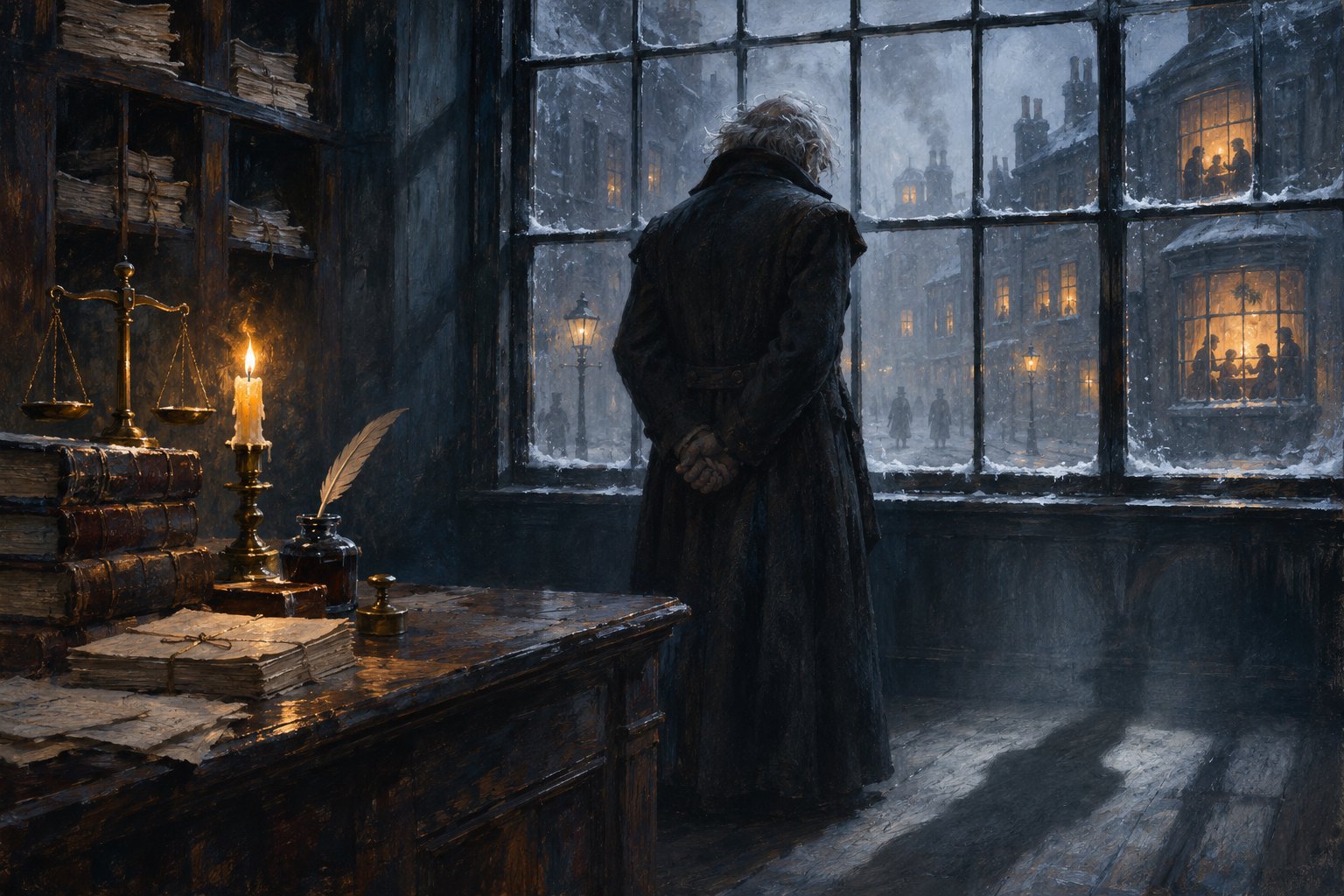
Ebenezer brings together two challenges that do not automatically solve each other: making Scrooge’s world frightening and making his transformation persuasive. Ti West’s Gothic approach offers a clear reason to revisit the Christmas ghost story. Johnny Depp’s central performance raises the harder question: can an audience move beyond watching a recognizable star play a miser and begin caring about a man learning to care?
The review published by Roger Ebert’s critical outlet foregrounds precisely that division, favoring West over Depp. That is a useful starting point, rather than a verdict this essay can independently certify. The analysis below draws on documented scenes and published criticism to examine the film’s dramatic choices. [The original critical assessment](https://www.rogerebert.com/reviews/ebenezer-scrooge-johnny-depp-film-review-2026) establishes the debate.
Spoilers follow for the story’s supernatural encounters and redemption arc.
A familiar story changes the burden of proof
Despite its shortened title, Ebenezer follows the familiar framework of Charles Dickens’s A Christmas Carol. West and screenwriter Nathaniel Halpern retain its five-part structure and journey through successive ghostly visitations. This is an adaptation of Scrooge’s reckoning, rather than a separate adventure explaining how he acquired his name. [Published plot coverage](https://bloody-disgusting.com/reviews/3975556/ebenezer-review-ti-west-brings-gothic-atmosphere-to-a-christmas-carol-but-little-else/) confirms that basic fidelity.
Familiarity places unusual pressure on the acting. The destination is already visible; the interest lies in each reluctant step toward it. A convincing Scrooge must possess more than a disagreeable manner. His cruelty needs an internal logic, something he regards as prudence or self-protection, so that surrendering it feels genuinely difficult.
From his perspective, generosity threatens an orderly arrangement. Money can be counted, doors can be locked, and obligations can be refused. Other people introduce demands he cannot completely control. The ghost story becomes compelling when those methods of keeping life manageable cease to work.
That is also why another adaptation need not justify itself through novelty alone. As our discussion of the enduring pleasure of familiar movie storytelling suggests, knowing where a story goes can make us more attentive to how it earns the journey.
The ghosts take away Scrooge’s authority
The supernatural casting gives each encounter a distinct potential emphasis: Ian McKellen plays Jacob Marley, Andrea Riseborough the Ghost of Christmas Past, and Tramell Tillman the Ghost of Christmas Present. Published coverage describes Riseborough’s spirit as unsettlingly inhuman and Tillman’s as an imposing presence. Those observations suggest an important advantage of West’s approach: the visitors do not have to feel like agreeable guides. [The supporting performances are discussed here](https://bloody-disgusting.com/reviews/3975556/ebenezer-review-ti-west-brings-gothic-atmosphere-to-a-christmas-carol-but-little-else/).
For Scrooge, their essential power is control over attention. He can dismiss a living person. He cannot so easily dismiss an encounter that determines where he goes, what he sees, and how long he must remain with it. The ghosts overturn the usual distribution of power in his life.
Marley carries a particularly uncomfortable implication. A warning from a former business partner reaches Scrooge through the language of shared experience. Here is someone whose understanding of success once resembled his own. The possibility that their entire arrangement was mistaken becomes harder to dismiss as sentimental interference.
The progression through past, present, and future also prevents a single explanation from becoming an escape route. Memory can illuminate why someone became defensive, but it cannot settle what that person owes others now. The future then removes the consoling assumption that there will always be another opportunity to change.
Fear is immediate; remorse takes longer
West’s horror vocabulary makes Scrooge’s loss of control physical. The Associated Press describes extinguishing street lamps, ominous birds, and a bed that swallows its occupant. It also records his protest, “This nightmare has run its course,” and his later insistence, “I’m not the man I was.” [The reported scenes and dialogue](https://apnews.com/article/0808613f3bbfac8cd0639038e69a908e) place resistance and promised transformation at opposite ends of the ordeal.
The first line is revealing because it attempts to declare the experience finished. Even under supernatural pressure, Scrooge wants the authority to close the conversation. His suffering has become intolerable to him; that does not yet establish that anyone else’s suffering has become important.
The second line makes a much larger claim. A frightened man may sincerely wish to escape punishment without having reconsidered his behavior. Remorse requires an outward movement: recognition that other people possess lives whose value does not depend on their usefulness to him.
My reading is that this distinction explains the appeal—and the limitation—of emphasizing horror. Terror can strip away Scrooge’s defenses with extraordinary efficiency. It cannot, by itself, show what replaces them. The actor must make curiosity, shame, and tenderness legible after the spectacle has done its work.
Why Depp’s presence becomes the decisive issue
The response to Depp is not uniform. Some critics describe an overly theatrical Scrooge; others find the performance comparatively restrained. Bill Bria’s assessment emphasizes a largely grounded interpretation that remains insufficiently distinctive. [That alternative reading](https://www.slashfilm.com/2314564/ebenezer-review-johnny-depp-a-christmas-carol-movie/) complicates any easy claim that the problem is simply excessive eccentricity.
Underplaying and overplaying can nevertheless produce a similar distance. A performance can remain closed behind mannerisms, or behind a careful refusal to reveal much at all. The useful question is whether Scrooge’s responses accumulate: does each encounter alter how he receives the next?
A recognizable star adds another layer. Audiences bring memories of earlier performances, making it easier to notice the performer’s repertoire than the character’s changing attention. That tension also runs through our examination of star presence and dramatic intimacy. Recognition attracts us to a film; sustained belief asks something further.
The ending must belong to other people, too
Bria also reports that Ebenezer spends an unusually extended stretch on Scrooge’s reparations. That choice deserves consideration on its own terms: it gives changed behavior time beyond the revelation that supposedly causes it. [The discussion of the closing sequence](https://www.slashfilm.com/2314564/ebenezer-review-johnny-depp-a-christmas-carol-movie/) identifies this departure in emphasis.
Duration alone cannot establish sincerity, but the underlying dramatic instinct is sound. A declaration changes the speaker’s account of himself. An act of generosity can change someone else’s circumstances. Scrooge’s redemption becomes meaningful when the second matters more than the first.
The deeper interpretation, then, concerns attention as much as wealth. Scrooge begins from the assumption that his comfort determines which claims deserve acknowledgment. His ordeal forces him to encounter experiences he cannot price, dismiss, or command. The moral achievement would be continuing to acknowledge those experiences once the ghosts stop compelling him.
That is the strongest standard for assessing the divide between West’s atmosphere and Depp’s performance. A frightening world makes avoidance impossible. A moving Scrooge makes continued openness believable. The lasting Christmas miracle is a man choosing responsibility after fear has released its grip.
A possible horror-film echo
The bed-abduction sequence has also been read as a nod to Depp’s screen debut in A Nightmare on Elm Street. Bria explicitly draws that connection. It is best treated as a critical interpretation of the visual resemblance, rather than confirmed filmmaker intent. For viewers who recognize it, the moment adds a second kind of haunting: an actor’s cinematic past briefly intruding on Scrooge’s nightmare. [The comparison appears in this review](https://www.slashfilm.com/2314564/ebenezer-review-johnny-depp-a-christmas-carol-movie/).
Original content by this site's editorial team. Published: November 12, 2026 at 21:39:13 PST (Los Angeles time)