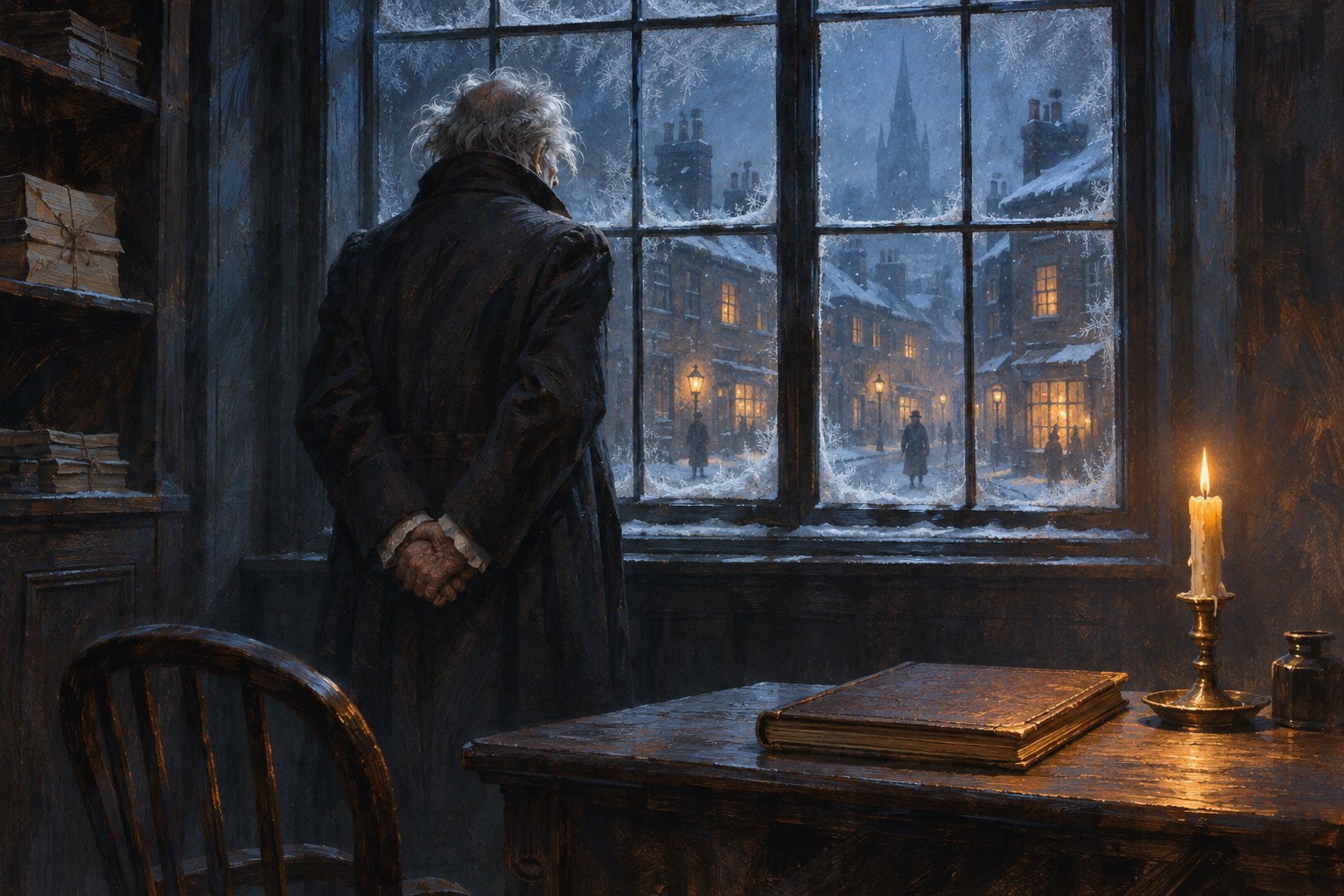
Johnny Depp’s Ebenezer is attracting early attention for a combination that makes sense for a Christmas ghost story: mischievous entertainment and the promise of emotional depth. Variety’s first-reaction headline highlights praise describing it as a “wickedly fun holiday treat” with “refreshing new layers,” while framing the film around Depp’s Hollywood comeback. Those phrases offer an encouraging first impression, but they leave the most interesting question open: what does the fun reveal?
For a story associated with Scrooge, darkness is more than seasonal atmosphere. It gives the warmth something to overcome. The strongest critical angle on this early enthusiasm is therefore tonal: whether laughter, discomfort, and festive pleasure strengthen one another, or simply take turns occupying the screen.
This is first-reaction commentary, not a review based on a screening. The discussion below includes spoilers for Charles Dickens’ original A Christmas Carol. Literary examples and quotations refer to that work; they are not claims about scenes or dialogue confirmed in Ebenezer.
What the early praise tells prospective viewers
The headline’s two expressions of enthusiasm make different promises. Calling a film a holiday treat suggests immediate enjoyment. Praising additional layers suggests something more interpretive: a familiar story might acquire meaning through a performance, a shift in emphasis, or a different emotional perspective.
Neither description identifies precisely how that happens. Enjoyment does not establish originality, and originality does not automatically produce insight. A new scene can add information without changing our understanding of anyone. Conversely, a familiar exchange can become newly unsettling through a pause, a reaction, or the decision to stay with the person receiving an insult.
For viewers deciding whether to follow Ebenezer, the useful takeaway is modest but concrete: its early framing promises pleasure and renewed interest in the material. It does not, by itself, establish the film’s suitability for younger children, the intensity of its frightening moments, or the quality of its complete dramatic arc.
Why Scrooge’s comedy has an uncomfortable edge
In Dickens, Scrooge’s “Bah! Humbug!” is funny partly because it is so aggressively insufficient. Other people bring him invitations, goodwill, and requests for help; he answers with a verbal door slam. The phrase turns a complicated social world into something he can dismiss without examining.
That creates two possible kinds of laughter. We can enjoy the extravagance of his refusal, recognizing a man whose hostility has become absurd. Or we can begin admiring the hostility itself, treating everyone who interrupts him as an annoyance. The distinction matters because the second response puts the audience comfortably inside his worldview.
My critical preference is for comedy that makes Scrooge’s certainty look increasingly fragile. A funny miser can command a scene, but the scene becomes richer when we also register what another person must endure to remain polite around him. The joke then exposes power instead of merely decorating it.
This is a useful way to assess the holiday entertainment promised by Ebenezer’s early reception. Does the humor broaden our attention, or concentrate it entirely on the star? An amusing expression may be memorable. An amusing expression that changes how we understand a relationship does more dramatic work.
The ghost story makes ordinary life visible
The supernatural machinery of Dickens’ novella gives Scrooge something his everyday habits prevent: sustained exposure to other people’s experience. He cannot simply end the conversation, send someone away, or retreat into business. He becomes a witness.
Marley’s declaration, “Mankind was my business,” makes the failure explicit. The problem is not merely that the dead man worked too much. It is that he understood responsibility too narrowly. The language of commerce turns against him, exposing everything his definition of business excluded.
Read this way, the frightening material does not interrupt the Christmas message. It creates the conditions under which Scrooge can finally hear it. Fear breaks his confidence in the arrangements that have kept him comfortable.
For a screen adaptation, visual spectacle can serve that process when it changes what the protagonist notices. A threatening apparition matters most when its presence forces attention toward a neglected life. Our discussion of why human stories matter in Godzilla films considers a related principle: overwhelming imagery gains force through the people who must live with its consequences.
Holiday warmth should belong to the whole room
The other essential part of Dickens’ tonal design is pleasure. Meals, jokes, company, and celebration give the story positive substance. They show what participation in life can feel like. Without that pleasure, Scrooge would have little to discover beyond reasons to be afraid.
Yet warmth becomes sentimental in the weakest sense when material hardship disappears beneath it. The Cratchits’ affection does not make their financial vulnerability harmless. Their happiness and their precarious circumstances coexist. Preserving both gives their domestic life dignity without turning deprivation into picturesque decoration.

That balance also explains why humor need not weaken serious material. Laughter can express intimacy, persistence, or a shared understanding of difficult circumstances. The question is who gets to make the joke and whose experience it acknowledges. Our analysis of humor and vulnerability in Onwards and Sideways explores this distinction from another dramatic context.
Applied to Ebenezer, this offers a specific standard for evaluating the promised fun: the supporting characters should feel capable of enjoying life beyond their usefulness to the central performance.
Fresh layers need not mean extra explanation
A familiar Christmas story does not necessarily need a new secret or an elaborate explanation for every behavior. Sometimes greater depth comes from allowing an existing contradiction to remain uncomfortable. Someone can be wounded and still responsible for wounding others. A household can be loving and still need practical help.
The comeback framing adds another layer of expectation around Depp. It encourages audiences to watch for signs of renewed screen presence. That may explain some of the interest, but it is separate from the film’s dramatic achievement. The actor’s career narrative cannot establish whether the comedy, atmosphere, or relationships work.
The deeper promise of a Christmas ghost story is a change in attention. Its darkness makes ordinary comforts look precious; its comedy exposes habits that once seemed reasonable; its warmth imagines a life shared with others. If Ebenezer brings those elements into a productive relationship, its holiday pleasures could carry real weight. The early praise invites that possibility. A full critical judgment still depends on what the film actually does with it.
Original content by this site's editorial team. Published: November 10, 2026 at 00:21:00 PST (Los Angeles time)