
Tom Cruise’s Digger turns out to contain a performance inside a performance. Its apparent environmental disaster story becomes a theatrical rehearsal, making the man at its center both a destructive oil billionaire and an actor trying to understand that billionaire. The interesting question is what this revelation does to responsibility: does exposing the performance help us understand the catastrophe, or move our attention away from the people facing its consequences?
Spoiler warning: This article discusses the film’s early structural reveal and central character conflicts, without explaining its ending. It offers an interpretation of published plot accounts, rather than a firsthand screening verdict.
Digger Rockwell mistakes influence for control
In Alejandro González Iñárritu’s film, Cruise plays Digger Rockwell, an oil magnate whose drilling operation precipitates an Arctic disaster. A huge mass of ice threatens Europe, bringing scientific warnings and political leadership into his orbit. Published accounts describe an early interruption that reveals Cruise is also playing Curtis Markson, an actor rehearsing the part of Rockwell in a production called Fossil Fuels. These narrative details are outlined in [Robert Daniels’s review](https://www.rogerebert.com/reviews/digger-tom-cruise-alejandro-gonzalez-inarritu-film-review-2026).
Rockwell’s predicament reverses the reassuring logic of an action hero. Resources, access, and force of personality ordinarily help a protagonist overcome danger. Here, those advantages belong to someone implicated in creating it. His prominence does not establish his competence, and his ability to dominate a conversation cannot establish that he understands the problem.
My reading is that this mismatch supplies the story’s most useful character insight. A man accustomed to having his wishes implemented may experience unwelcome information as insubordination. The disaster therefore confronts him with something his social position has trained him to resist: a consequence that cannot be negotiated into agreement.
That is a different question from whether Cruise can sell an unconventional movie. Our examination of Digger’s commercial prospects and the limits of star power addresses audience demand. Within the story, the issue is how readily charisma gets mistaken for authority.
Curtis wants to understand what Digger never questions
The theatrical reveal introduces a productive contrast. Rockwell’s defining problem is excessive certainty; Curtis has doubts about the performance he is being asked to give. Slate critic Dana Stevens quotes his question: “Is this funny? Is it meant to be funny?” Her account identifies the rehearsal as the mechanism that changes how the preceding scenes should be understood. [Dana Stevens’s review](https://www.khanlist.com/story/tom-cruises-big-new-movie-isnt-what-it-appears-its-e9c33fb8).
The first question concerns an effect: are people laughing? The second concerns an intention: what response is this material supposed to produce? Those are different concerns, and an actor can reasonably need answers to both. Playing a ridiculous person is not the same task as making that person’s conduct seem harmless.
For Curtis, understanding the tone also means understanding his relationship with the audience. Should spectators recognize something seductive in Rockwell, recoil from him, or alternate between those reactions? Without that relationship, exaggeration can become a display of effort rather than an interpretation of a person.
The danger is that Curtis’s uncertainty may become more compelling than the catastrophe being represented. Once a story asks us to care about whether an actor can make a scene work, it has introduced a fresh emotional priority. That priority needs to illuminate the original stakes. Otherwise, the threatened world becomes scenery for a performer’s professional anxiety.
Ganesh exposes the difference between knowing and deciding
Riz Ahmed’s scientist, Ganesh, supplies the counterweight to Rockwell’s authority. Across published accounts, his essential function is consistent: he brings scientific reality into a conversation governed by powerful people’s preferences. Owen Gleiberman’s review also describes Rockwell’s major assembly speech, in which he shifts attention toward society’s dependence on oil. [Gleiberman’s review](https://au.variety.com/2026/film/global/digger-review-tom-cruise-alejandro-g-inarritu-40826/).
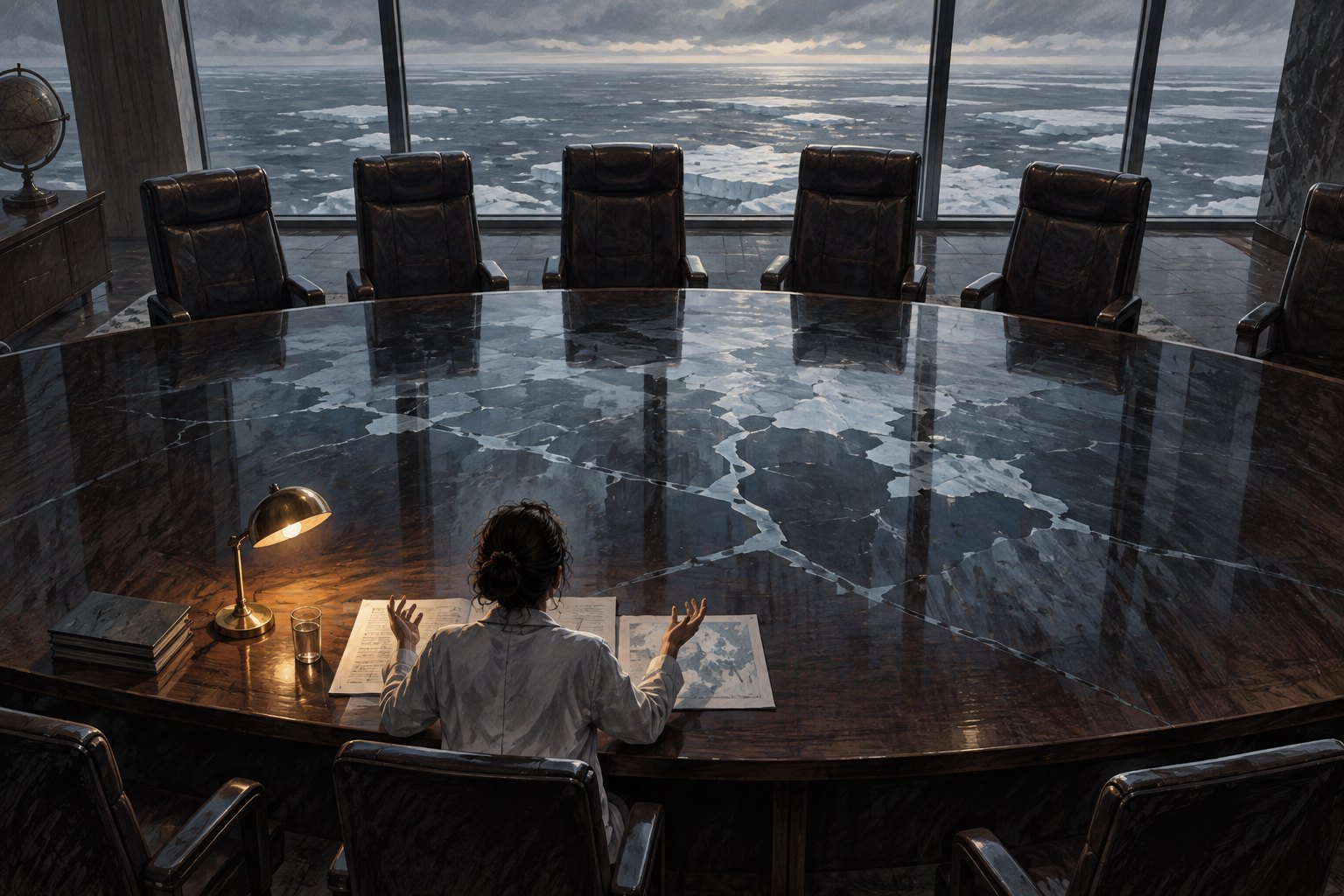
Ganesh’s position matters because possessing an explanation is different from possessing decision-making power. He can describe consequences without being able to compel an adequate response. That imbalance makes him more than a convenient delivery system for exposition: his predicament concerns what happens to knowledge when its audience has reasons to reject it.
Seen from his perspective, every attempt to turn the emergency into a contest of personalities wastes attention. He needs others to respond to conditions outside the room. Rockwell needs the room to keep responding to him.
This is where a character-centered reading can sharpen the environmental argument. Denial does not always require somebody to misunderstand a warning. It can also involve understanding enough to recognize that accepting the warning would mean surrendering status, convenience, or control.
For viewers, the useful distinction is between being heard and being obeyed. A scientist can receive ample speaking time while remaining politically powerless. The mere presence of expertise does not make a decision rational.
The speech about oil raises a question it cannot settle
Rockwell’s appeal to public dependence on oil deserves scrutiny as an argument made by a character. A claim can identify a real contradiction and still function as an evasion. Acknowledging widespread participation in a system does not establish that everyone possesses equal power over it.
My interpretation is that the speech becomes most interesting when treated as an attempt to redistribute blame. Rockwell’s advantage is rhetorical: he can point toward the audience’s comforts and invite viewers to feel implicated. The next question must be whether that implication explains his decisions or merely distracts from them.
Consumer dependence, corporate choices, and political authority operate at different scales. Collapsing them into universal guilt risks making responsibility impossible to assign. If everybody is equally guilty, the person with the greatest capacity to act may conveniently become no more accountable than anybody else.
That distinction also connects with our discussion of the distance between performing a role and taking responsibility: occupying a position within a system does not exhaust the moral questions about what someone chooses to do there.
What the twist needs to accomplish
A theatrical reveal earns its place when it changes our understanding of a choice. Discovering that Rockwell is being performed can expose how authority itself depends on rehearsed gestures, persuasive speech, and an audience willing to accept the role. That is a potentially rich connection between Curtis’s work and Rockwell’s power.
But recognizing artificiality is only a beginning. “Is it meant to be funny?” remains an unresolved challenge to the film’s method. Satire needs some relationship between its target, its exaggeration, and the understanding it creates. Announcing that a performance is deliberately excessive does not automatically establish that the excess reveals anything.
The deepest reading available here concerns the temptation to confuse recognizing a problem with answering it. Rockwell can recognize society’s dependence on oil; Curtis can recognize uncertainty in the production; spectators can recognize the story’s construction. None of those recognitions, by itself, constitutes responsibility.
That is the standard by which I would judge Digger’s central device: whether stepping outside one fiction brings its people and consequences into sharper focus. A curtain opening can reveal the machinery behind an illusion. It can also give everyone another spectacle to watch while the original emergency continues.
Original content by this site's editorial team. Published: October 2, 2026 at 06:08:38 PDT (Los Angeles time)