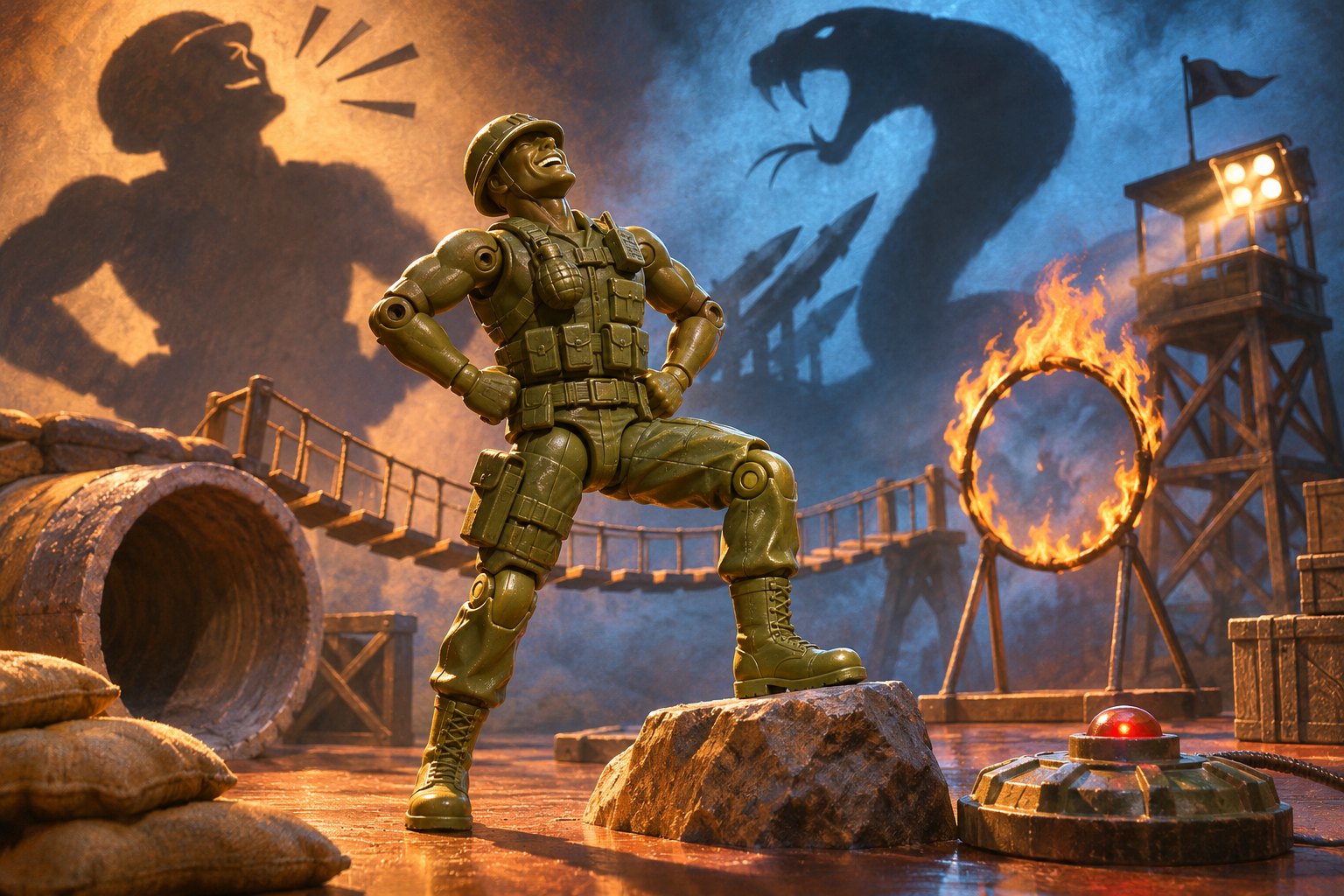
Danny McBride’s G.I. Joe movie has landed a 2028 release from Paramount, according to The Hollywood Reporter. That answers the immediate calendar question. The more interesting creative question is what kind of emotional contract this version will make with its audience: can it invite laughter while still asking us to believe that its characters have something to lose?
The announcement does not answer that question, and McBride’s name alone should not be treated as confirmation of a particular tone. Still, the prospect offers a useful starting point for criticism. My preference would be an action movie comfortable enough with its larger-than-life world to find humor inside it, while taking the people who inhabit that world seriously.
This is a spoiler-free critical preview, not a review of a screened film. The discussion below concerns storytelling possibilities rather than confirmed scenes, character arcs, or dialogue. A release announcement cannot establish whether the finished movie succeeds.
What the 2028 announcement tells viewers
The central reported development is straightforward: Paramount has placed the McBride-associated G.I. Joe movie on its 2028 release calendar. That gives audiences a year to watch for. It does not, by itself, establish the film’s rating, comic intensity, visual approach, or emotional center.
Those distinctions matter because expectations can harden surprisingly quickly around a familiar name. Viewers may begin imagining either broad parody or stern military spectacle before there is enough evidence to judge either possibility. Neither assumption is a substitute for seeing how the movie actually handles a scene.
Our earlier discussion of what would make the new G.I. Joe ensemble compelling focused on shared decisions and meaningful relationships. Tone raises a separate question: when those characters are embarrassed, frightened, or challenged, does the filmmaking stay with their experience, or step outside it to get an easy laugh?
The useful target for a joke is a hero’s self-image
An action hero can be capable and ridiculous at the same time. Competence does not eliminate vanity, defensiveness, or the desire to look impressive. In fact, the distance between genuine ability and an inflated self-image can make a character more interesting than either effortless perfection or constant incompetence.
For this G.I. Joe, that distinction would offer a productive approach to humor. A character’s confidence could become funny without making their skills worthless. The audience could recognize a pose, a bad excuse, or an unnecessary display of authority while continuing to believe that the person can act decisively under pressure.
Consider the general mechanics, rather than an imagined scene from this film: a boast establishes how someone wants to be seen; an unexpected difficulty exposes the gap; the response reveals character. Someone who admits the mistake becomes different from someone who blames a subordinate. The joke has then done dramatic work.
That is more valuable than giving every character the same supply of sarcastic remarks. When everyone responds with identical detachment, dialogue stops distinguishing personalities. Humor becomes background noise instead of evidence about the person speaking.
Let the danger survive the punch line
The placement of a joke can matter as much as its wording. A laugh before an action sequence may reveal nervous anticipation. A laugh afterward may release tension that the scene has earned. A joke at the instant of someone else’s suffering can change the audience’s relationship to the entire situation.
None of those choices is automatically wrong. Their effects are simply different. If a movie repeatedly treats danger as an inconvenience to be mocked, it teaches viewers to stop worrying. Later requests for grief or suspense then have to overcome the habits the film itself established.
My standard would be consequence. An amusing mistake should still leave a problem to solve. A narrow escape should still register as narrow. A character who uses humor to avoid acknowledging fear should eventually encounter a moment when the performance fails.
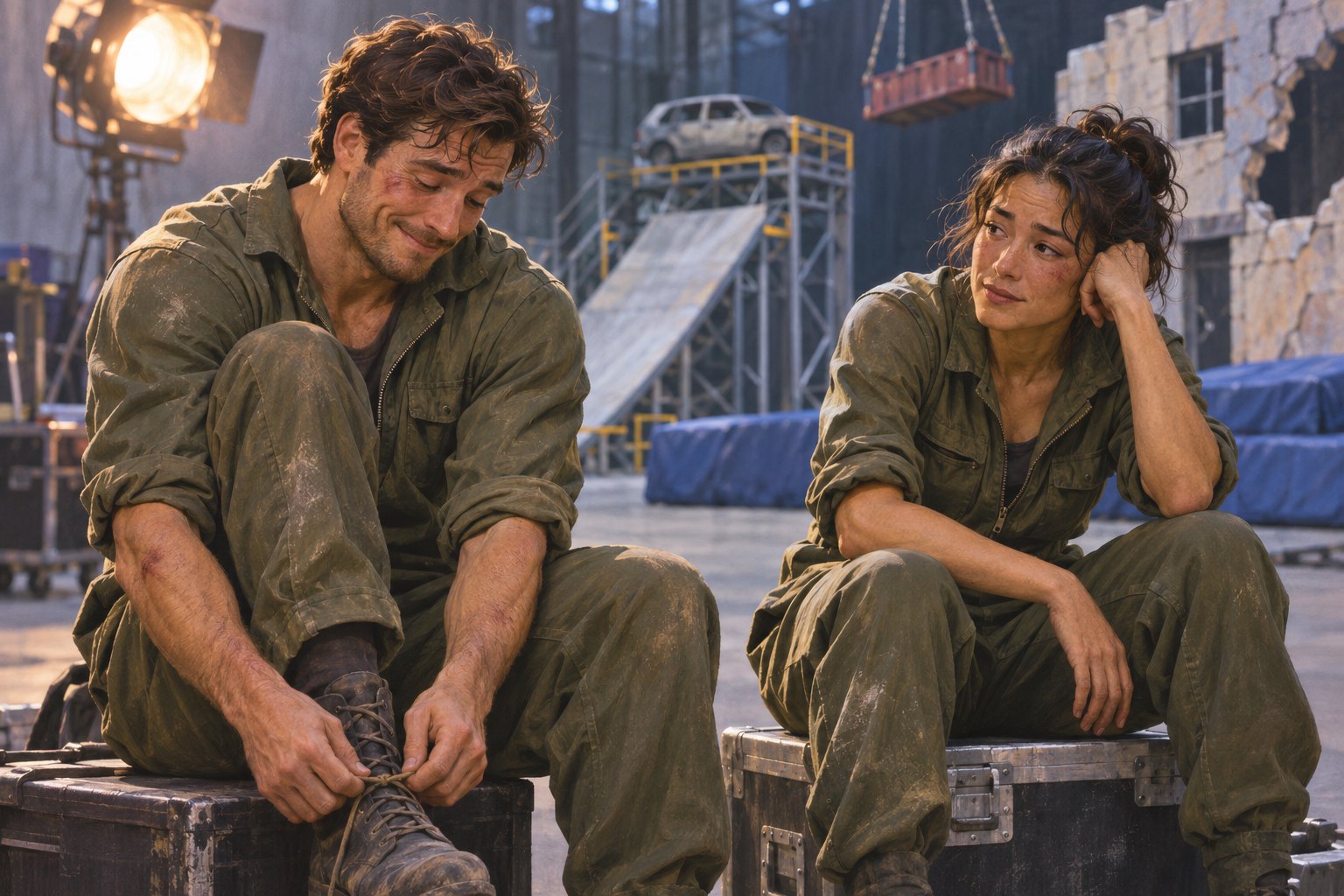
Quiet reactions can preserve those consequences without slowing a film to a crawl. A delayed answer, an uncomfortable glance, or someone checking whether another person is hurt can tell us that the characters experienced something the spectacle alone could not express. Such details give the next joke a human context.
Exaggeration works best when the characters believe it
There is considerable pleasure in an action movie that commits to its own heightened reality. Elaborate equipment, imposing spaces, and theatrical behavior can become part of a coherent style. The crucial question is whether the film establishes rules and gives its characters reasons to act within them.
Constantly acknowledging that something looks absurd can interrupt that pleasure. It places the audience at a distance, as though participation requires an apology. A more confident approach allows an extravagant image to be exciting, funny, and a little strange without immediately explaining how we should react.
This also affects newcomers. As our commentary on the franchise homework problem argues, recognition should not become an entrance requirement. Here, the equivalent tonal test is whether a joke works through behavior and context, even for someone who misses a reference.
A familiar detail might give longtime fans an additional smile. The scene still needs an immediate purpose: establish a desire, complicate an encounter, or change what a character understands. Otherwise, recognition supplies a brief reaction while the story stands still.
What to listen for when the movie’s dialogue arrives
There are no verified lines from the forthcoming film quoted here. Treating an invented quip as a memorable movie quotation would create a false impression of access. The meaningful question, for now, is what would make its eventual dialogue worth remembering.
A strong comic line usually belongs to a specific speaker. Its vocabulary, timing, and degree of honesty tell us something about that person. An evasive character may answer a direct question with a performance. A more secure character may need only a few words. Someone frightened may talk too much.
Repetition can also acquire meaning. A phrase used confidently early in a story might sound defensive later, then become sincere after a difficult choice. The words need not change for the character’s relationship to them to change. That is how dialogue can contribute to an arc rather than simply decorate an action sequence.
The deeper opportunity: courage without perfect composure
The most promising thematic possibility is a distinction between appearing fearless and acting despite fear. Humor can expose the first; action can demonstrate the second. Together, they can let a movie question heroic posturing while retaining an appetite for heroism.
That would give McBride’s G.I. Joe a richer emotional register than a contest between seriousness and silliness. A person can be vain, awkward, or easily embarrassed and still make a brave decision. Allowing both sides to remain visible would make courage feel chosen rather than automatic.
For now, the reported 2028 release is the concrete news. The artistic verdict must wait. What I would hope to find is a film whose laughter brings us closer to its characters—and whose action makes that closeness matter.
Original content by this site's editorial team. Published: November 7, 2026 at 10:59:25 PST (Los Angeles time)