
Daniel and the Fiery Furnace has attracted attention for an experience its filmmakers describe as spiritually significant. Brothers Daniel and Matthew Kooman told CBN’s Faith in Culture that wind, rain, and thunder arrived while Mena Massoud, playing Daniel, delivered a passage about an everlasting kingdom. Daniel Kooman interpreted the timing with the phrase “the natural realm responded.” Their account concerns a moment during production; the supernatural meaning they attach to it remains their interpretation. [CBN’s interview report](https://cbn.com/news/entertainment/filmmakers-detail-spiritual-manifestation-set-new-movie-natural-realm-responded).
That distinction opens an interesting way into the movie. Daniel’s story turns on questions about who can interpret an event, whose authority deserves obedience, and what conviction costs when someone powerful demands surrender. The production anecdote invites attention, but those human conflicts offer the stronger foundation for film analysis.
Spoiler note: This commentary discusses the publicly described premise and the dream-interpretation sequence identified in the filmmakers’ interview. It is a reading of those documented elements, not a verdict based on a complete screening. Unverified dialogue, performance details, and additional scenes are not presented as established features of the film.
What the filmmakers’ account establishes
The Koomans locate the incident during filming in India, as Massoud’s Daniel explained Nebuchadnezzar’s dream to the king, played by Elijah Alexander. Daniel Kooman recalled wind moving tents behind the camera, followed by rain and thunder. He connected those conditions to the words being spoken.
For readers, the useful distinction is between a reported observation and an explanation of its cause. The brothers describe weather and explain why it mattered to them. Their testimony gives access to their experience of making the movie; it does not independently demonstrate what caused the weather.
That still makes the account relevant to criticism. A filmmaker’s understanding of a project can shape its emphasis: which moments receive solemnity, which conflicts seem central, and what an audience is invited to recognize as meaningful. Here, the account suggests that the Koomans approached biblical language as something with continuing force in their own lives.
A viewer can take that commitment seriously while reserving judgment about the finished filmmaking. Personal conviction can motivate a work. Its dramatic expression must still reach the audience through characters, relationships, images, and consequences.
Daniel’s position: Speaking truth while depending on power
The production’s synopsis places Daniel and his friends in Babylonian exile, where they win royal trust while also acquiring enemies. Its official trailer description identifies the central crisis: a king demands worship under threat of death, and Shadrach, Meshach, and Abednego refuse. These are the documented foundations for the character reading that follows. [The filmmakers’ synopsis](https://unveiltv.com/pages/daniel) and [official trailer description](https://www.youtube.com/watch?v=hLhsAThjo4c).
From Daniel’s perspective, proximity to a ruler creates a difficult kind of insecurity. Being useful to authority does not necessarily mean being safe from it. Royal favor can provide opportunity while leaving a person dependent on decisions he cannot control.
That makes the reported dream sequence particularly rich material. Daniel stands in the presence of someone with immediate power over him while interpreting a vision that places earthly kingdoms within a larger order. My reading is that the scene’s potential tension comes from this unequal relationship: the vulnerable speaker carries a message that limits the powerful listener.
The question for a character-centered viewing is how clearly the film lets us feel that vulnerability. Does Daniel’s conviction leave room for the difficulty of speaking? Does the encounter register as a dangerous exchange between people? Those questions matter more to the scene’s dramatic success than the intensity of any weather surrounding its production.
There is a related concern in our analysis of Bruce Wayne’s conscience and moral choices: a character becomes compelling when belief has consequences. Daniel’s situation gives that principle unusually direct stakes.
Nebuchadnezzar’s demand exposes the limits of control
Viewed from the king’s side, the premise raises a different question. Why would a ruler who can command behavior also need to command worship? An order can produce an outward gesture. It cannot guarantee the inward allegiance that gesture is supposed to express.
My interpretation is that this gap makes Nebuchadnezzar more interesting than a simple obstacle. A demand for universal submission can reveal anxiety beneath apparent confidence. Someone’s refusal becomes intolerable because it exposes a boundary: political power has encountered a conscience it cannot automatically possess.
This is an interpretive possibility within the documented conflict, not a claim about Alexander’s specific acting choices. A full performance review would need to examine his delivery, reactions, and changing relationships across the movie.
For viewers, however, the distinction offers a useful focus. Watch for whether the king treats disagreement as a practical problem, a personal humiliation, or a challenge to his entire understanding of authority. Each possibility would give the same decree a different emotional weight.
The three friends carry the furnace’s human stakes
Although Daniel supplies the title’s central name, the official premise places Shadrach, Meshach, and Abednego at the furnace crisis. Their refusal deserves attention as a shared human decision. Three people standing together can make courage feel less solitary, but companionship does not erase the danger each person faces.
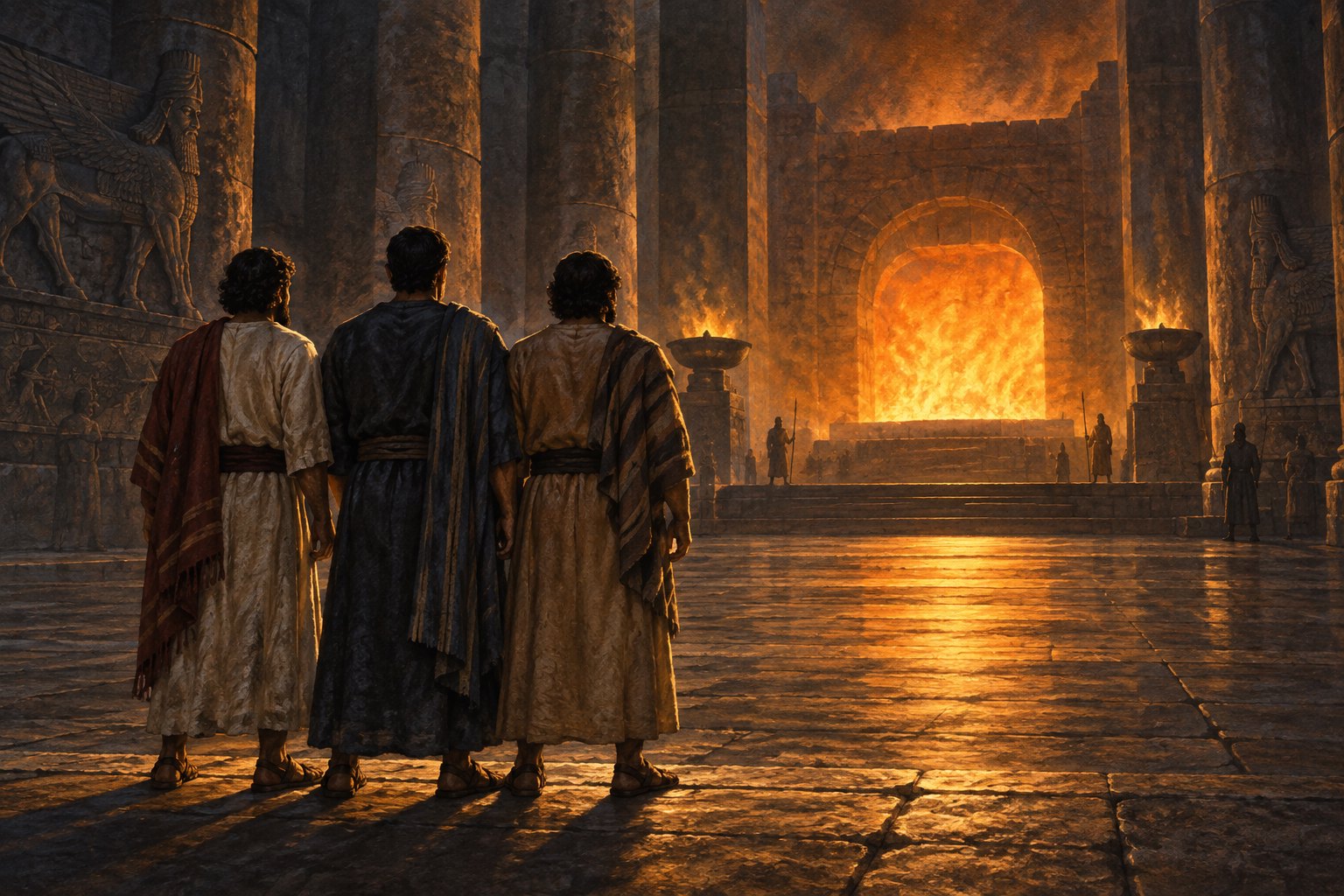
The crucial dramatic interval is the space between the demand and its consequence. An audience familiar with the biblical story may anticipate deliverance. The characters’ choice still needs to carry the weight of threatened loss. Otherwise, conviction risks appearing effortless precisely where the story asks us to recognize its cost.
I find the premise most compelling when understood through responsibility: what does each man owe his companions, his conscience, and the God he worships? Their solidarity invites a film to explore courage as something people sustain together, rather than merely announce.
That attention to personal stakes also informs our commentary on the human experience beneath cinematic spectacle. Across very different genres, danger matters most when viewers understand the people exposed to it.
A deeper reading: Conviction before confirmation
The on-set account and the film’s premise approach faith from different directions. The filmmakers describe an occurrence they experienced as confirmation. The characters face a demand that makes allegiance costly. One concerns recognizing reassurance; the other concerns deciding how to act under pressure.
For me, the second question offers the more enduring dramatic meaning. If courage matters only after a reassuring sign, uncertainty disappears from the moral decision. A story about threatened people standing firm becomes richer when it allows us to understand why their choice matters before we reach its outcome.
The Koomans’ experience may deepen some viewers’ interest in Daniel and the Fiery Furnace. The strongest reason to engage with its characters remains their confrontation with coercion: Daniel speaking within an unequal relationship, a king demanding what force cannot truly secure, and three friends discovering the price of refusing. That is where a story of extraordinary belief can become recognizable human drama.
Original content by this site's editorial team. Published: September 20, 2026 at 18:13:39 PDT (Los Angeles time)