Dan Trachtenberg is developing an original film inspired by Sleeping Beauty at Disney, according to Deadline. The intriguing possibility is how that familiar association might shape the experience of watching it. A recognizable fairy tale gives audiences expectations before the first scene begins. Used thoughtfully, those expectations can become a source of suspense.
The distinction between an original film inspired by a story and a straightforward remake matters here. The announcement establishes a creative starting point, not a finished narrative. It does not justify assuming particular characters, scenes, dialogue, or an ending. This is development-stage commentary rather than a review of a completed movie; the possibilities discussed below are critical judgments, not descriptions of Trachtenberg’s plans.
A familiar story gives suspense a head start
Surprise depends on withholding information. Suspense often works by letting viewers know enough to worry. The association with Sleeping Beauty offers an immediate vocabulary of sleep, enchantment, vulnerability, and awakening. An original film could draw on that vocabulary without following every familiar narrative step.
For viewers who recognize those associations, an ordinary action could acquire a second meaning. Entering a quiet room or approaching an unfamiliar object might feel momentous before anything visibly threatening happens. The audience supplies part of the tension, bringing its memory of the fairy tale into the scene.
That is also a trap. If recognition does all the work, a film becomes an exercise in waiting for references. The screenplay still needs an immediate dramatic question: what does someone want in this moment, what stands in the way, and what might a decision cost? Familiarity can intensify a scene, but it cannot provide the scene’s entire reason to exist.
My interest in this project rests on that distinction. A successful reinterpretation could make recognition emotionally complicated. Viewers might understand the apparent danger while also understanding why a character would move toward it.
Let the audience understand the room
One promising approach would be to make physical space carry the tension. A room becomes dramatically useful when viewers understand its entrances, its distances, and the obstacles between a person and an exit. Without that clarity, an ominous setting can remain attractive scenery.
Consider a hypothetical scene built around a doorway. An early wide shot could establish that reaching it takes several seconds. A later close-up could withhold the doorway while preserving the audience’s awareness of its location. The resulting unease would come from an understood situation, rather than from a sudden noise instructing viewers to be frightened.
This would be particularly valuable in a fairy-tale setting, where visual spectacle can overwhelm practical relationships. Towers, chambers, and forests should affect what people can do. A beautiful location earns its place when its shape changes a decision, delays help, or makes an apparently simple action difficult.
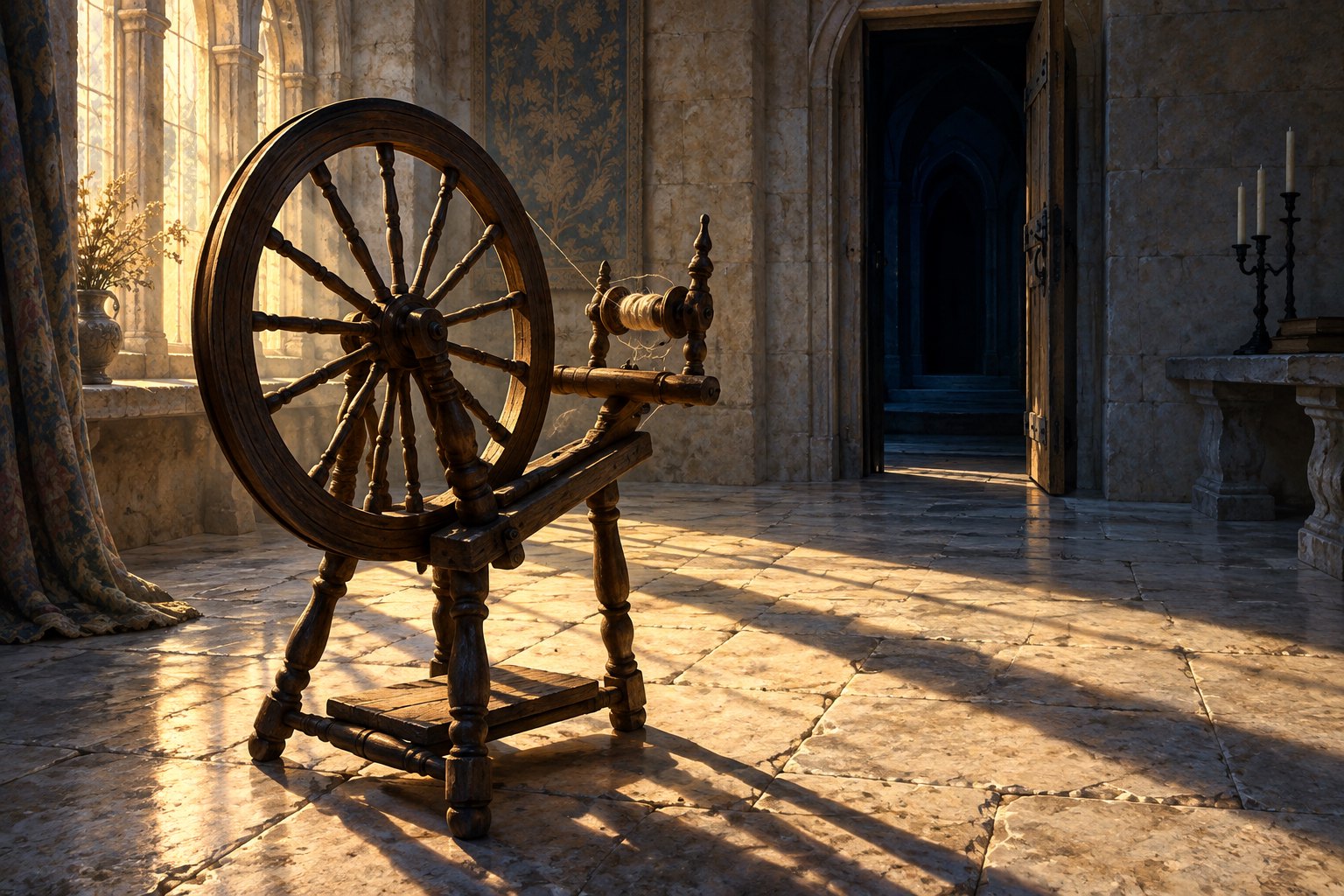
The illustration above offers a visual thought experiment, not a depiction of the production. Daylight makes the chamber legible, while the open doorway leaves something unresolved. That contrast suggests how unease can emerge from a space viewers can clearly see.
Our discussion of how place can shape a thriller considers a related principle: locations become expressive when they influence behavior. For Trachtenberg’s project, that could help turn fairy-tale imagery into active storytelling.
Sound could make stillness feel consequential
Sleep presents an interesting formal challenge because cinema usually emphasizes movement. Stillness becomes compelling when the film first establishes something that can stop, change, or disappear. Sound offers a precise way to create that expectation.
A repeated household noise, for example, could establish the rhythm of an environment. Its absence could later make the same environment feel altered. This is a hypothetical technique, not a reported feature of the project, but it illustrates the opportunities contained in the premise.
The crucial element would be preparation. Silence has little meaning if the audience has never learned what normally fills it. Similarly, a sound introduced only to announce danger may deliver a momentary jolt without changing our understanding of the scene.
There is room for restraint here. A fairy tale does not need constant musical emphasis to communicate wonder or threat. Allowing viewers to listen closely could make them more attentive to the world and to the people moving through it.
A darker appearance is only one creative choice
It would be premature to classify this project as horror or assume its intended audience from the announcement. Still, the material invites a useful distinction between a dark visual treatment and a dramatically unsettling one.
Dim lighting, distressed costumes, and severe architecture can establish a mood. They do not automatically produce tension. A brightly lit space can be disturbing when viewers understand the danger within it; a shadowy corridor can feel empty when nothing meaningful is at stake.
My preference would be for a film willing to preserve beauty alongside apprehension. If an environment initially feels inviting, an emerging threat has something to disrupt. When every image announces menace, the audience may have less reason to feel that anything precious is being endangered.
That balance also matters emotionally. Warmth, humor, and ordinary affection give viewers reasons to care about what happens. Sustained seriousness can flatten a fairy tale as easily as excessive spectacle can. A reinterpretation needs a range of feelings if its most intense moments are going to register.
Originality should change how scenes work
The most useful test of an original idea is whether it changes the drama. A new setting or an unexpected visual motif may be appealing, but what consequences follow? Does the change force a different choice, complicate an apparent solution, or make a familiar situation harder to read?
Our earlier examination of whose perspective should anchor the Sleeping Beauty project focused on narrative ownership. The complementary question is formal: how will framing, editing, sound, and duration make that perspective perceptible?
A camera that remains beside a character can restrict our knowledge. A cut away can give us information that character lacks. Holding a shot can make waiting uncomfortable. Those choices determine whether a familiar premise becomes a lived experience or remains an illustrated concept.
The promise is in making us look again
The strongest possibility in Trachtenberg’s Disney project is a renewed relationship between recognition and attention. Fairy tales can become so familiar that audiences remember their symbols more readily than they experience their uncertainty. An original film could interrupt that automatic recognition and make viewers examine what an image means in the present scene.
That would be a meaningful form of reinvention: making a quiet room worth studying, a pause worth listening to, and an anticipated event emotionally uncertain. For now, the development news offers a premise worth considering. The eventual film’s achievement will depend on whether its familiar inspiration produces fresh, specific moments of cinema.
Original content by this site's editorial team. Published: September 28, 2026 at 16:13:22 PDT (Los Angeles time)