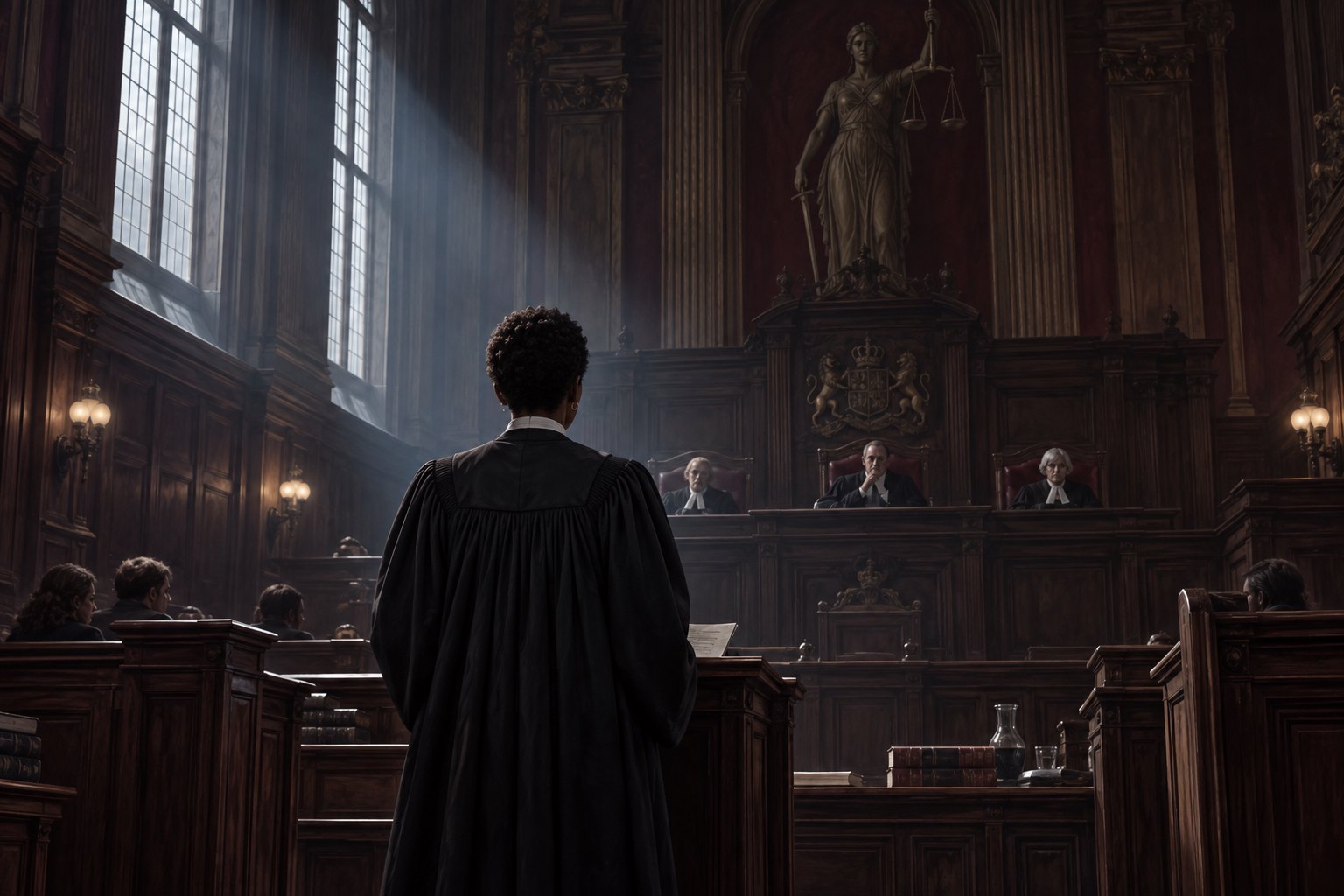
Cynthia Erivo’s move from Wicked to Prima Facie places her in a story where commanding a room and being believed become painfully different things. Directed by Susanna White and adapted by Suzie Miller from her play, the film stars Erivo as Tessa, a successful barrister whose trust in the legal system is challenged when she becomes the accuser in a sexual assault case. The dramatic hook is immediate: someone accustomed to controlling questions must experience the vulnerability of answering them.
Erivo’s account of making the film adds another dimension. Speaking to The Hollywood Reporter, she described moments when she would “feel sick and angry.” Those words describe the demands of performing the material; they are not Tessa’s dialogue or, by themselves, evidence of the film’s artistic success. Their value is in directing attention toward the difficult experience this character must carry.
Content note: Discussion of sexual assault and its aftermath. This is a spoiler-light critical companion based on verified reporting and the film’s announced premise, rather than a screening review. It does not reveal the ending or attribute unverified dialogue to the film.
Tessa’s confidence is part of the story
The British Film Institute’s synopsis describes Tessa as an ambitious barrister who wins cases defending men accused of sexual assault. That professional identity matters. She begins with expertise, authority, and a record of success. Understanding her means taking those accomplishments seriously before considering how her circumstances change.
My reading of this premise is that the most interesting tension lies between competence and security. Knowing how an institution operates can feel like protection. Tessa understands its procedures and knows how to perform effectively within them. Becoming an accuser tests whether that knowledge gives her the control she previously associated with it.
It would be reductive to read this reversal as a punishment for her career. A defense lawyer’s work cannot fairly be reduced to endorsing an accused person’s conduct, and suffering is not a lesson someone deserves. The richer character question is what happens when a professional method becomes a personal ordeal. Tessa can understand why a question is being asked while finding its assumptions unbearable.
That distinction preserves her complexity. She need not have been foolish before the assault to discover something she could not previously understand from her position. A person can believe sincerely in a system and still have mistaken their own success within it for evidence that it treats everyone well.
What Erivo’s account reveals about the role
The Hollywood Reporter describes the film as Erivo’s first release after the Wicked movies, while noting that she had filmed other unreleased projects in between. The distinction matters: this is a change in what audiences encounter next, not a claim that she moved directly from one set to another.
In the interview, Erivo discussed support from an intimacy coordinator and a therapist. Her description of the emotional demands deserves to be read alongside that support. Publicity often turns an actor’s distress into a badge of seriousness. A more useful response is to consider the care that demanding work requires, then assess the resulting performance on what it communicates.
For Tessa, intensity alone would not tell the whole story. The character’s established confidence gives an audience something specific to understand: a working identity, a practiced way of speaking, and expectations about how others will respond. The challenge suggested by the premise is to preserve that recognizable person as her relationship to her surroundings changes.
That is also why the comparison with Wicked has limits. A major star’s next role attracts attention through contrast, but the character needs space beyond a career narrative. As our discussion of finding the character behind Tom Cruise’s star power in Digger argues, visibility can begin the conversation without supplying the interpretation.
The witness stand changes the meaning of expertise
According to The Hollywood Reporter, the production involved extended takes of Tessa’s cross-examination. This reported detail helps explain the sustained emotional pressure Erivo described. It does not establish how long those passages last in the finished edit, or whether their cinematic effect matches the experience of filming them.
As a dramatic situation, however, cross-examination makes Tessa’s reversal unusually precise. Her expertise remains available to her, but her position has changed. She may recognize the direction of a question without having the authority to redirect it. Knowledge and power, which once appeared closely connected, can separate.

For a viewer, that creates a demanding question about listening. Are we attending to what Tessa communicates, or assessing whether she communicates it in a manner we find reassuring? Confidence, hesitation, anger, and composure can all become shortcuts for judgment. Character-centered criticism should examine those shortcuts rather than quietly reproduce them.
This connects with the concern explored in our analysis of audience judgment in Woman Unknown: how quickly watching someone becomes deciding what kind of person they must be. In Tessa’s case, the premise makes that habit especially uncomfortable because evaluating other people’s accounts is already part of her professional world.
What the move from stage to screen must accomplish
Miller’s source play is a one-woman work. A screen adaptation therefore faces a substantial artistic choice about how to retain proximity to Tessa while building a world beyond her speech. More locations or additional characters do not automatically create greater intimacy.
My critical standard would be whether the filmmaking helps us understand the difference between Tessa’s outward behavior and her private experience. A courtroom can be shown as a workplace, a public institution, or a place of exposure. Framing and editing determine whose attention organizes the scene and how much freedom the viewer has to look away.
The same standard applies to dialogue. Memorable lines matter when their delivery and circumstances give them force. Without verified film dialogue, borrowing quotations from the play and presenting them as Erivo’s lines would blur the distinction between two separate performances. Here, the confirmed premise provides a firmer basis for interpretation than an assumed speech.
The deeper question: who gets to remain complicated?
The strongest interpretive possibility in Prima Facie is that Tessa should not have to become an idealized person for her experience to matter. Ambition, pride, professional aggression, and vulnerability can belong to the same character. None cancels the others.
That makes the story more demanding than a straightforward fall from confidence. It asks whether an audience can recognize harm without first requiring a woman to become modest, agreeable, or easy to understand. Tessa’s earlier authority should remain part of her humanity rather than become evidence against it.
Erivo’s description of the role’s emotional cost brings attention to that struggle. The deeper reason to engage with Prima Facie, though, is the contradiction inside Tessa’s position: she knows how to make an argument heard, yet must discover whether the room can hear her as a person. That is the character question on which a meaningful assessment of the film should turn.
Original content by this site's editorial team. Published: September 13, 2026 at 14:44:54 PDT (Los Angeles time)