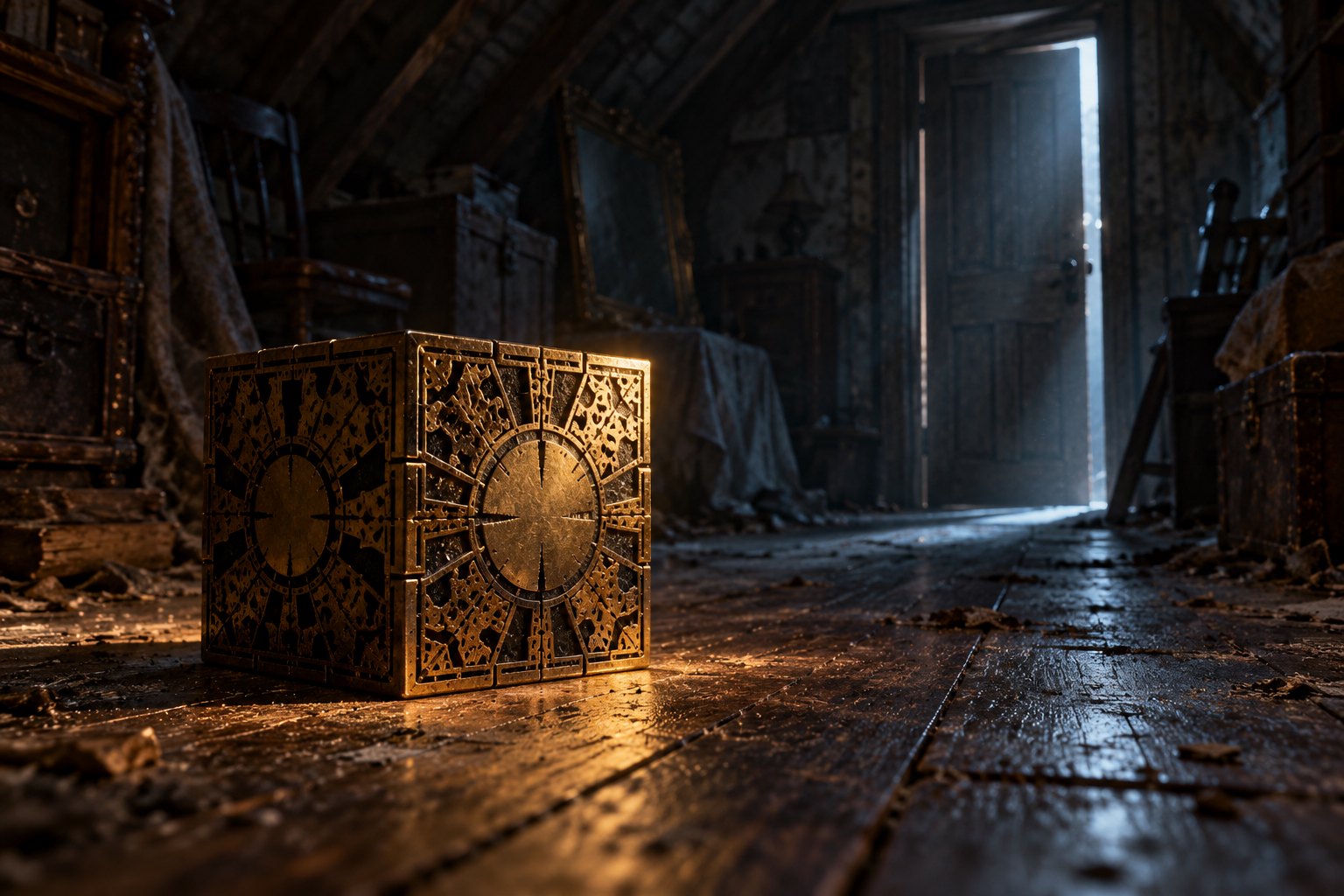
Clive Barker says Hellraiser: Revival has sparked movie ideas, according to Deadline. For film fans, the intriguing possibility is that working within this world through another medium has suggested something worth bringing back to the screen. The report’s central claim concerns inspiration; it does not, by itself, establish an announced film, a completed screenplay, or a production schedule.
What could make that inspiration valuable? Barker’s original Hellraiser offers a persuasive answer. Its most disturbing invention is the relationship between ordinary longing and extraordinary cruelty. Beneath the puzzle box and the Cenobites sits a household in which people turn intimacy into permission to use one another.
Spoiler warning: The following retrospective discusses major events and the ending of Hellraiser (1987). The discussion of possible future films is critical interpretation, not a description of Barker’s undisclosed ideas.
What the Revival news means for movie audiences
A game inspiring a filmmaker need not result in a direct adaptation. Inspiration might involve a dramatic situation, a character’s relationship to danger, or simply renewed interest in a fictional world. Barker’s reported response leaves those possibilities open. Assigning him a particular storyline would turn an encouraging creative signal into an unsupported announcement.
The distinction resembles the one explored in our commentary on what a new Tarantino screenplay can tell us about a future film: a development milestone invites questions about storytelling, while judgments about execution require the actual work.
For Hellraiser, the useful question is whose desire will drive the story. Recognizable imagery creates anticipation, but a character’s decisions give that imagery consequence. The original film remains compelling because its horrors emerge from several incompatible versions of what a better life might look like.
Julia makes the impossible feel emotionally plausible
Written and directed by Barker, the 1987 film follows a family whose home conceals a monstrous return. Larry’s brother Frank has escaped the Cenobites in an incomplete physical form. Julia, Larry’s wife and Frank’s former lover, supplies victims whose deaths help restore him. That premise makes the supernatural dependent on a human relationship.
Clare Higgins gives Julia a troubling emotional continuity. The creature she encounters is appalling, but her attachment reaches backward toward the man she remembers. She sees the promise of a recovered experience. The audience sees what she must do to pursue it.
My reading is that Julia’s strongest scenes turn nostalgia into an active moral danger. Remembering an affair becomes a reason to arrange another person’s death. Every return to the attic tests whether she will acknowledge what her longing now requires. Her continuing participation makes her more frightening than a character possessed by an outside force would be.
The house sharpens this effect. Its familiar rooms allow domestic routine and concealed violence to exist almost side by side. Julia has to move between them, carrying the knowledge that one life is being maintained through the destruction of others. The distance upstairs feels small; the ethical distance is enormous.
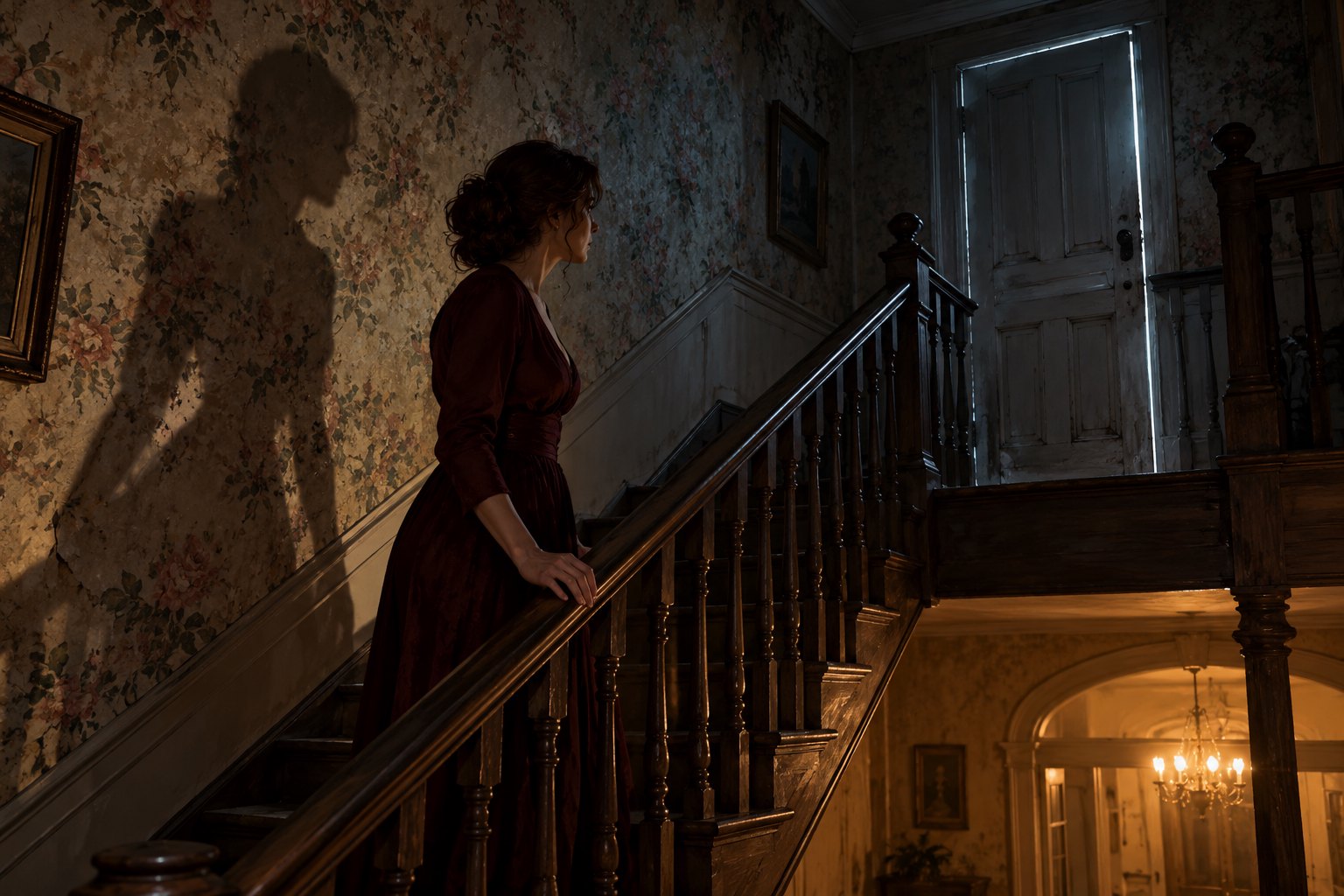
This is a valuable standard for any future film inspired by Revival: make the audience understand the temptation before asking it to absorb the consequences. Understanding Julia does not excuse her. It makes the moment when she chooses cruelty harder to dismiss.
Frank treats other people as resources
Frank’s pursuit of extreme experience establishes his appetite, but his return exposes its practical meaning. Other people become material for his reconstruction. Julia imagines a relationship worth recovering; Frank needs someone who can provide bodies. Their apparent partnership contains a profound imbalance.
The film makes that imbalance literal when Frank takes Larry’s skin. From Kirsty’s perspective, the appearance of her father briefly promises safety. The person beneath it turns that recognition into a trap. A familiar face becomes an instrument of exploitation.
That transformation is, for me, the film’s most effective fusion of bodily horror and character drama. The disguise matters because Kirsty loves her father. Without that relationship, the effect would still be grotesque, but it would lose the emotional violation that makes it linger.
Frank’s final “Jesus wept” compresses his defiance into two words. Even at the point of destruction, he seems determined to retain some ownership of the experience. The line is memorable because it belongs to his personality: appetite, mockery, and self-dramatization survive almost to the last instant.
Kirsty exposes the difference between curiosity and consent
Ashley Laurence’s Kirsty provides a different relationship to the unknown. She encounters the box amid the danger surrounding her family, then opens it without understanding what she is summoning. Her circumstances challenge any comfortable assumption that everyone caught in this world has knowingly asked for what happens.
“You solved the box. We came.” The Cenobites’ explanation has the chilling economy of an administrative decision. It treats an action as sufficient authorization while disregarding the person’s understanding of it. Doug Bradley’s measured delivery makes that indifference feel established and impersonal.
Kirsty survives by observing, bargaining, and acting under pressure. Her offer to lead the Cenobites to Frank buys a possibility of escape, but it does not turn them into dependable protectors. The danger continues after they reclaim him. She must keep responding to what they actually do.
Her role gives the film an essential moral counterweight. Frank seeks experience; Julia seeks a lost attachment; Kirsty seeks survival and the protection of someone she loves. Those motives cannot fairly be treated as equivalent merely because all three characters encounter the same supernatural machinery.
What a game might help a film reconsider
Interactive horror can make handling an object feel consequential because the player performs the action. Cinema creates that tension differently: it can show a hand approaching the box while allowing us to study the hesitation on a face. Both forms can build dread around the gap between wanting an answer and understanding its cost.
That comparison is a possibility suggested by the news, not a claim about Revival’s specific mechanics or Barker’s plans. A future film could explore the same underlying problem through entirely new characters. It would need people whose reasons for approaching danger are distinct enough to sustain more than a sequence of punishments.
Our discussion of why familiar characters need more than nostalgia in Street Fighter raises a related adaptation challenge. Recognition gets an audience through the door. Relationships and choices determine whether it cares what happens inside.
The original’s deeper horror is the transfer of suffering
Hellraiser is most powerful when its physical transformations expose what its characters already believe. Frank behaves as though other lives exist to sustain his own. Julia accepts increasing harm as the price of recovering desire. Kirsty must resist a system that mistakes contact with danger for agreement to endure it.
The film’s closing return to the box’s circulation extends that pattern beyond one household. One person’s escape does not end the invitation. There will be another customer, another private dissatisfaction, another chance to confuse access with control.
That is why Barker finding movie ideas through Hellraiser: Revival is an appealing prospect. The original leaves a demanding creative example: give desire a recognizable human face, then show who pays for it. Its lasting terror comes from the discovery that someone else has decided your suffering is an acceptable price for their fulfillment.
Original content by this site's editorial team. Published: October 18, 2026 at 05:58:28 PDT (Los Angeles time)