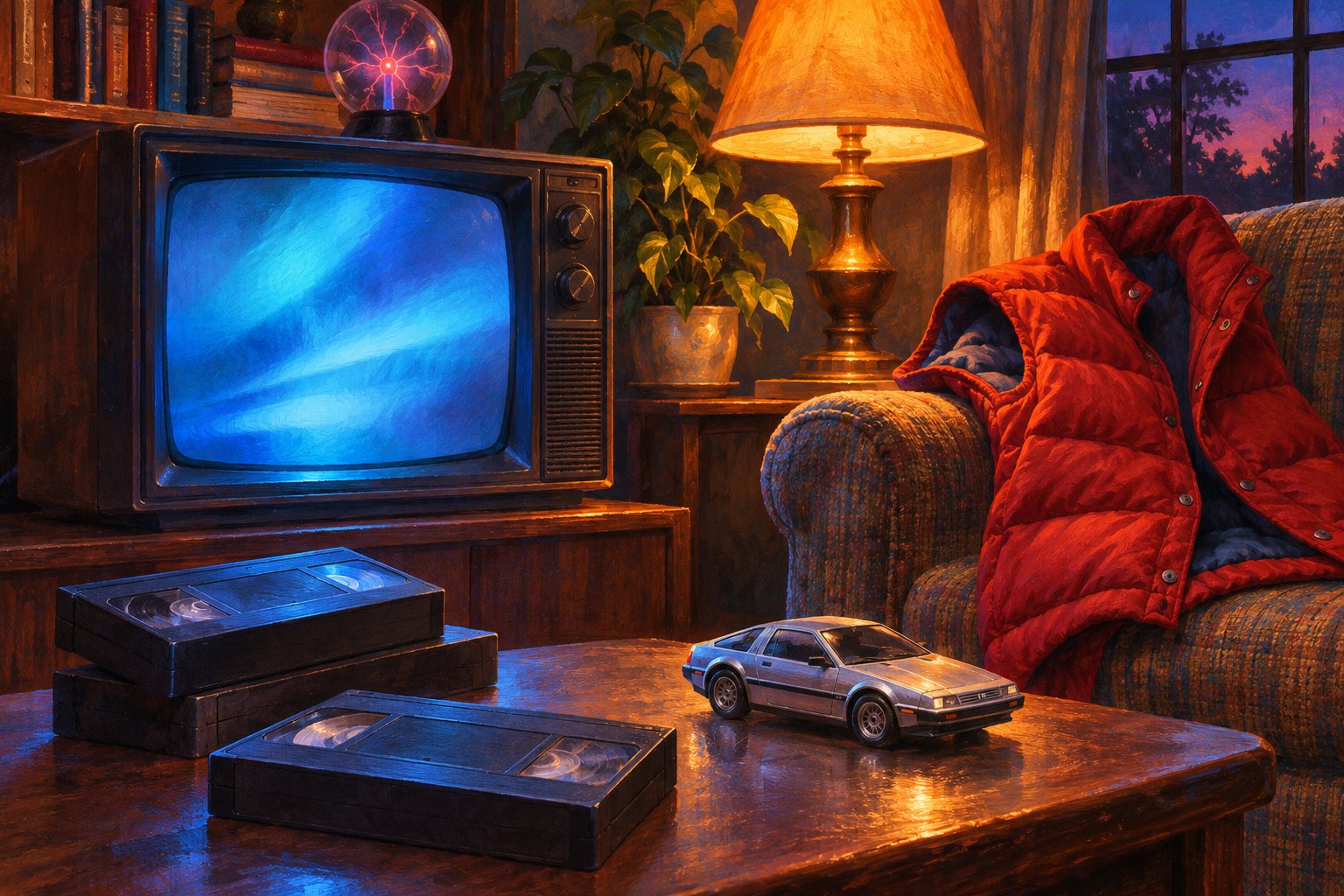
A silver DeLorean, a red puffer vest, a clock tower: sometimes identifying an ’80s movie takes less than a second. The appeal of a screenshot challenge aimed at Gen X is that little rush of recognition. You see a fragment, and your memory supplies the movement, music, and dialogue around it.
But naming the movie is the easy part. The more interesting challenge is explaining why that particular image stayed with you. Back to the Future offers an especially rewarding answer. Its recognizable objects do real dramatic work, turning a complicated time-travel premise into a story about a teenager discovering that his parents were once uncertain teenagers themselves.
This is a closer look at that visual storytelling, rather than an answer key to a particular quiz. Spoilers follow for Back to the Future, including its ending. The accompanying illustrations are conceptual artwork, not film screenshots.
How to Read an ’80s Movie Screenshot
Before guessing from an actor’s face, look at the relationship between the person and the setting. A costume can place someone in a decade; a costume that clashes with everything around it can tell you the premise. Marty’s vest becomes especially useful in 1955 because the people around him do not read it the way he does.
Three questions make a screenshot challenge more satisfying:
- What looks distinctive? Notice silhouettes, clothing, vehicles, and architectural shapes before small background details.
- What does the character want? An anxious expression beside an extraordinary object often tells you more than the object alone.
- What happens immediately afterward? Remembering the next action tests your knowledge of the scene rather than your familiarity with promotional imagery.
This attention to readable action also helps explain the pleasures discussed in our review of Hundreds of Beavers and its visual comedy. A strong image gives the viewer something to anticipate.
Back to the Future: The Teenager Who Cannot Simply Drive Away
Released in 1985, directed by Robert Zemeckis, and written by Zemeckis and Bob Gale, Back to the Future builds its adventure around an appealing contradiction. Marty McFly has the energy and confidence of someone ready to escape his surroundings. Yet his journey makes him dependent on understanding the family he finds embarrassing.
Michael J. Fox makes Marty’s quick thinking entertaining without making him all-knowing. His instinct is to intervene, improvise, and keep moving. That works beautifully for physical comedy. It becomes dangerous when other people’s feelings resist his attempts to organize them.
From Marty’s perspective, the time machine initially promises mobility. Once he reaches 1955, mobility becomes the problem: getting home requires more than starting an engine. The film’s smartest move is to make the spectacular vehicle depend on relationships. Scientific ingenuity can address the journey, but it cannot perform the emotional work for him.
The Family Photograph Is the Real Countdown
The DeLorean announces the movie. The photograph explains its stakes.
As Marty’s interference threatens his parents’ relationship, the picture of him and his siblings begins to change. It gives an abstract possibility—never having existed—a small, personal surface. We do not need a lecture about competing timelines. We need to look at the people disappearing.
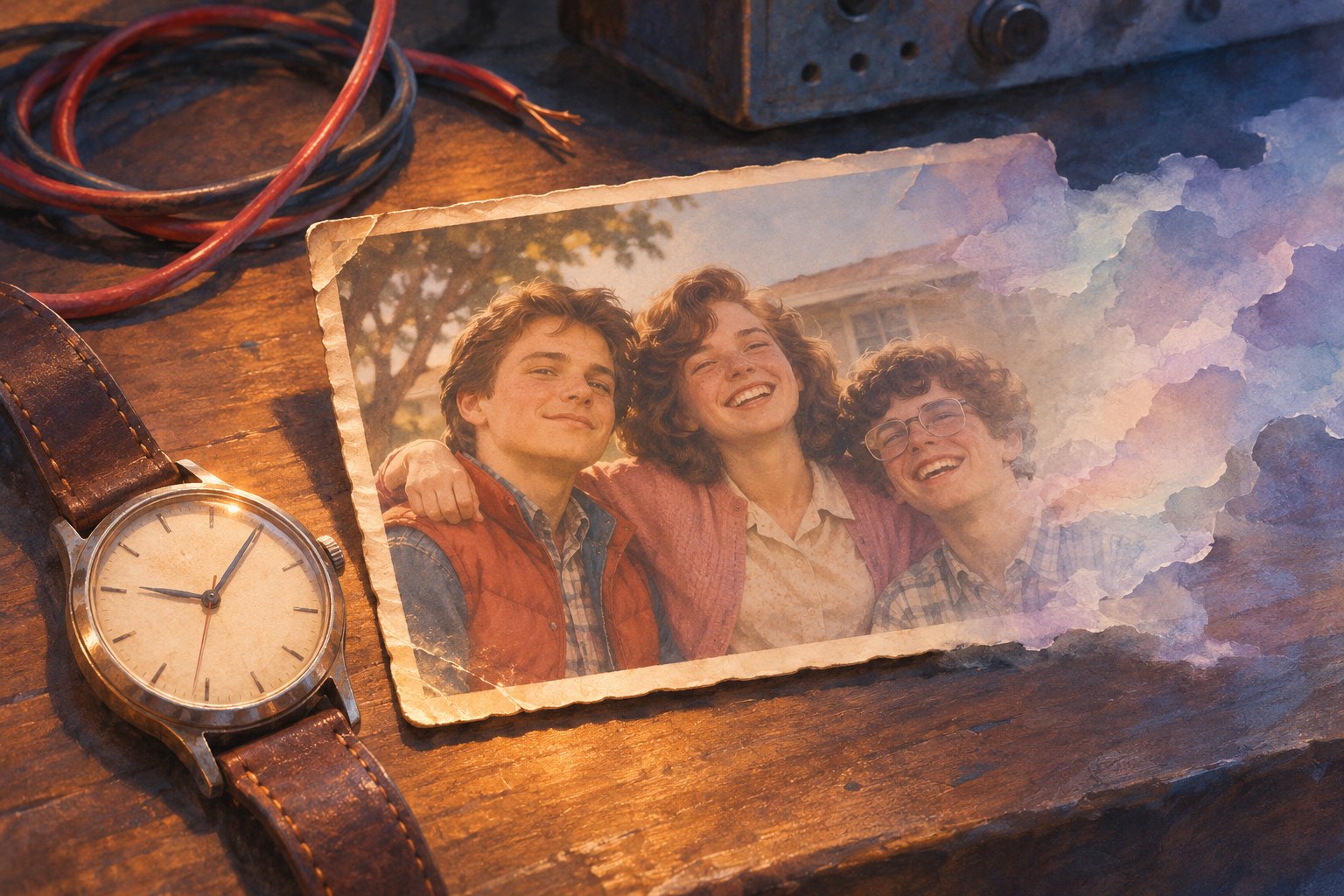
My favorite aspect of this device is how it reduces Marty’s apparent freedom. A teenager who seems capable of outrunning almost anything cannot outrun the consequences inside his own wallet. The object is intimate enough to hold, but its meaning is beyond his control.
That makes it a particularly good test of film memory. Recognizing a futuristic car identifies a franchise. Recognizing the photograph’s significance means remembering the vulnerability beneath the adventure.
George and Lorraine Complicate Marty’s Family Story
George: Confidence Cannot Be Borrowed Forever
Crispin Glover’s George makes withdrawal physically visible. His posture and hesitant delivery suggest someone who expects humiliation and tries to make himself a smaller target. Marty initially treats that fear as an obstacle he can solve with instructions.
The film becomes more emotionally convincing when George must act without relying on Marty’s management. His confrontation with Biff matters because courage finally becomes his own decision. The shift is legible through performance before the altered future explains its consequences.
There is a limitation here, too. The movie compresses a lifetime of insecurity into a decisive confrontation, then rewards the change extravagantly. As comic wish fulfillment, it is effective. As an account of how confidence develops, it is deliberately simplified.
Lorraine: A Mother Before She Became “Mom”
Lea Thompson gives Lorraine desires that disrupt Marty’s comfortable assumptions. Her younger self does not behave like the moral authority he knows at home. For Marty, that discovery is mortifying; for the audience, it exposes the distance between a parent’s remembered youth and a child’s imagined version.
The uncomfortable attraction at the center of their scenes is more than a provocative joke. It forces Marty to confront how little he understands about his mother as a person. Thompson’s directness prevents Lorraine from becoming merely an item on his repair checklist, even when the plot treats her romantic choices as something he needs to steer.
Doc Brown Makes Exposition Feel Like Emotion
Christopher Lloyd’s Doc gives technical explanations the urgency of personal revelation. His exclamation “Great Scott!” captures the performance’s essential quality: discovery is something that happens to his whole body.
Doc also changes the emotional temperature around Marty. Where the family scenes invite embarrassment and frustration, their friendship permits enthusiasm. Marty takes an eccentric adult seriously, and Doc treats a teenager as a collaborator. That mutual attention makes the machinery feel human.
Even the closing promise, “Where we’re going, we don’t need roads,” works because Lloyd delivers possibility as an invitation. The line belongs to a relationship we want to continue watching.
The Ending Is Exhilarating—and Worth Questioning
My judgment is that Back to the Future remains an exceptionally well-constructed comedy, although its final rewards deserve scrutiny. The improved family situation is expressed partly through greater prosperity and status. Emotional recovery becomes visibly attached to material success.
That does not erase the pleasure of George finding self-respect. It does make the ending narrower than the film’s richest discovery: parents have private fears and unrealized possibilities. Understanding those possibilities is valuable even when it does not produce a better car.
The tension between youthful adventure and inherited expectations also runs through our analysis of growing up in The Transformers: The Movie. Familiar entertainment can preserve anxieties that become clearer when its original young audience revisits it as adults.
A Background Detail That Rewards a Second Look
Watch the mall’s name. Twin Pines Mall becomes Lone Pine Mall after Marty knocks down one of the trees during his arrival in the past. It is a compact visual joke with a serious storytelling function: the environment remembers something the protagonist has done.
That detail gets at the deeper pleasure behind an ’80s screenshot challenge. A frame can contain evidence of a whole chain of decisions. In Back to the Future, the most memorable images connect spectacular possibilities to ordinary fears: disappointing your family, becoming your parents, or discovering you never fully knew them. Identifying the title opens the door. Looking again reveals why the movie stayed.
Original content by this site's editorial team. Published: November 27, 2026 at 22:45:28 PST (Los Angeles time)