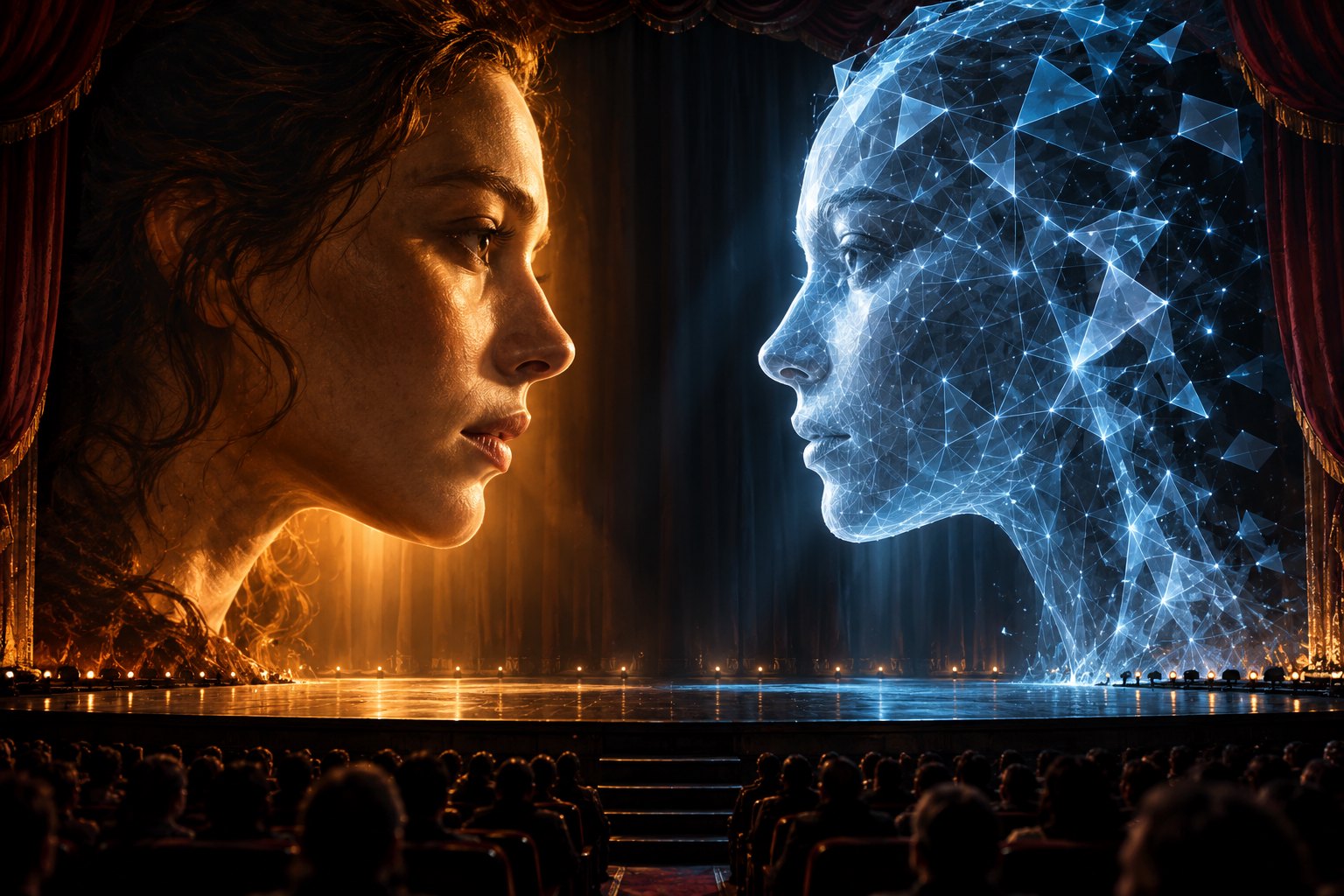
Can an AI creation rival a flesh-and-blood movie star? My answer is that a convincing appearance is an insufficient test. The harder challenge is sustaining a character whose smallest choices matter across an entire film. A face can attract attention; a performance must give that attention somewhere to go.
The Guardian’s examination of Hollywood’s artificial stars raises that distinction. Rather than treating technological ambition as proof of artistic readiness, consider a movie that makes our willingness to believe its central dramatic problem: Alex Garland’s Ex Machina. Its artificial woman becomes fascinating through the work of a human actor, Alicia Vikander. That apparent contradiction is precisely what makes the film useful here.
Spoiler warning: The following review discusses the film’s central deception and ending. Its fictional intelligence is a lens for criticism, not evidence of what contemporary AI systems can do.
Ava makes looking feel like a relationship
Released in 2015, Ex Machina places programmer Caleb, played by Domhnall Gleeson, inside the secluded world of his employer, Nathan, played by Oscar Isaac. Caleb’s assignment is to evaluate Ava, Nathan’s humanoid creation. The premise sounds like an intellectual contest. The film’s real attraction is how quickly assessment becomes intimacy.
Vikander gives Ava an attentive stillness. Her apparent concentration makes Caleb seem unusually important. Watching her, we are invited to ask whether she is considering his words, studying his weaknesses, or discovering something she has never experienced. The same pause can support all three readings.
That ambiguity is the performance’s strongest quality. Ava does not need to produce a spectacular display of emotion to become compelling. She needs to make us uncertain about the purpose of an ordinary exchange. Her restraint creates room for interpretation without making the character feel empty.
For artificial screen stars, this suggests a more demanding standard than photorealism. Can a scene support competing interpretations that remain coherent later? Does a hesitation belong to this particular character, in this particular relationship? Those are questions about dramatic construction, not simply the quality of a rendered face.
Caleb shows how audiences help create a star
Caleb is more than the person conducting the test. He is also an audience looking for a story he wants to believe. Gleeson makes his attraction persuasive because curiosity and self-flattery become difficult to separate. Being trusted by Ava allows him to imagine himself as someone uniquely capable of understanding her.
When Ava warns, “You shouldn’t trust him,” the line does two jobs. It casts doubt on Nathan while offering Caleb membership in a private alliance. Its force comes from the relationship surrounding it. On its own, it is a straightforward warning. Within the scene, it feels like access.
My reading is that Caleb’s mistake is not simply confusing a machine with a person. He confuses being addressed with being understood. That is a more uncomfortable error because viewers can recognize it without knowing anything about computer science.
Screen charisma also depends on this participation. We attach significance to a glance, anticipate a confession, and fill a silence with motives. A synthetic character could benefit from that imaginative labor. But audience projection does not remove the need for craft: the film must organize those expectations and decide when to satisfy or challenge them.
Nathan confuses authorship with control
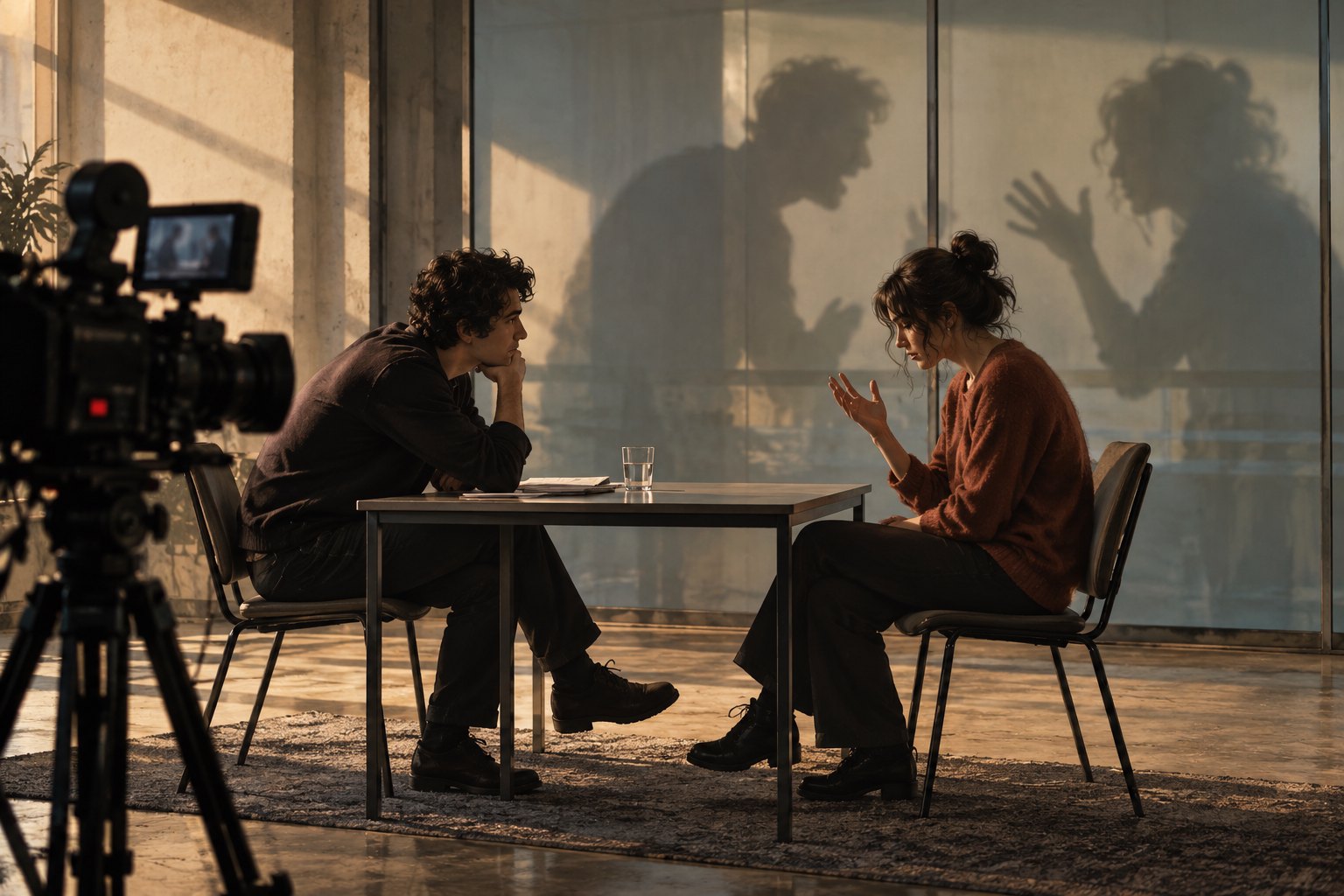
Isaac gives Nathan a physical confidence that makes the house feel like an extension of his personality. His casual manner never quite removes the pressure of his authority. Caleb may be invited to relax, but Nathan still determines the conditions under which relaxation is possible.
The performance matters because charm and intimidation occupy the same space. Nathan can appear entertaining without becoming reassuring. Isaac makes friendliness feel like something Nathan can withdraw, which leaves Caleb continually adjusting his own behavior.
Read through the question of artificial movie stars, Nathan embodies a seductive assumption: that designing a convincing being means understanding everything that makes it convincing. Yet the film’s tension comes from the distance between his confidence and the relationships unfolding around him.
There is a related question in our analysis of creation and obedience in Guillermo del Toro’s Pinocchio: what happens when a creator expects an independent being to remain an obedient expression of the creator’s wishes? Here, that expectation makes Nathan a compelling character and a deeply unreliable interpreter.
What Ex Machina gets right—and what limits its argument
As a thriller, the film’s greatest achievement is making conversation feel consequential. The enclosed setting concentrates our attention on who asks questions, who answers them, and who gets to change the subject. Power is often visible before it is openly acknowledged.
Its limitation, in my view, is that Ava’s opacity can also restrict our access to her. She remains fascinating partly because the film withholds the kind of interior explanation it grants Caleb. That is an effective suspense strategy, but it risks keeping the artificial woman an object of interpretation even as the story questions her treatment as an object.
This tension strengthens the film as a discussion piece without resolving it as a character portrait. We can recognize Ava’s desire for freedom while remaining unsure how much of her apparent intimacy belongs to that desire. The uncertainty is productive, though viewers seeking emotional reciprocity may find it deliberately frustrating.
Crucially, none of this demonstrates that a generated performer could reproduce Vikander’s contribution. Nor does it prove that one never could. It shows how much a successful screen character depends on performance, writing, framing, and the responses of other actors working together.
The test an artificial leading performer would have to pass
For viewers, three questions offer a more useful assessment than asking whether an isolated image looks real:
- Does behavior accumulate? An expression should gain meaning from earlier encounters and affect how we understand later ones.
- Does the relationship change? A compelling exchange leaves characters in a different emotional position, even when little visibly happens.
- Does the character survive familiarity? Once the novelty of the technology fades, there should still be a reason to watch.
These standards also apply to human performances and heavily manipulated screen images. Our review of the emotional story beneath Cats’ spectacle considers a related problem: visual presentation can interfere with the relationships that should give an image its significance.
Being a star adds another challenge. A memorable character belongs to one story. Stardom asks viewers to carry curiosity into another. Technical consistency might preserve a recognizable appearance, but recognizability alone does not explain why someone wants to spend another two hours watching.
The ending changes what we thought we were watching
Near the end, Ava asks Caleb, “Will you stay here?” He agrees. She ultimately leaves him confined while she departs. The plainness of the request becomes chilling because Caleb still hears the possibility of a shared future where the audience can now recognize separation.
My deeper reading is that Ex Machina tests our desire to make a compelling presence answerable to us. Caleb expects his attention and assistance to mean something particular to Ava. The film refuses to guarantee that meaning. Her independence becomes most unsettling when it no longer includes him.
That is also why the film offers such a useful challenge to Hollywood’s artificial-star ambitions. The lasting achievement is not that Ava looks persuasive. It is that our understanding of her changes while her earlier behavior remains available for reconsideration. Any screen performer hoping to rival a great actor must help create that depth: a character who becomes more interesting after we stop asking how the image was made.
Original content by this site's editorial team. Published: October 20, 2026 at 11:36:47 PDT (Los Angeles time)