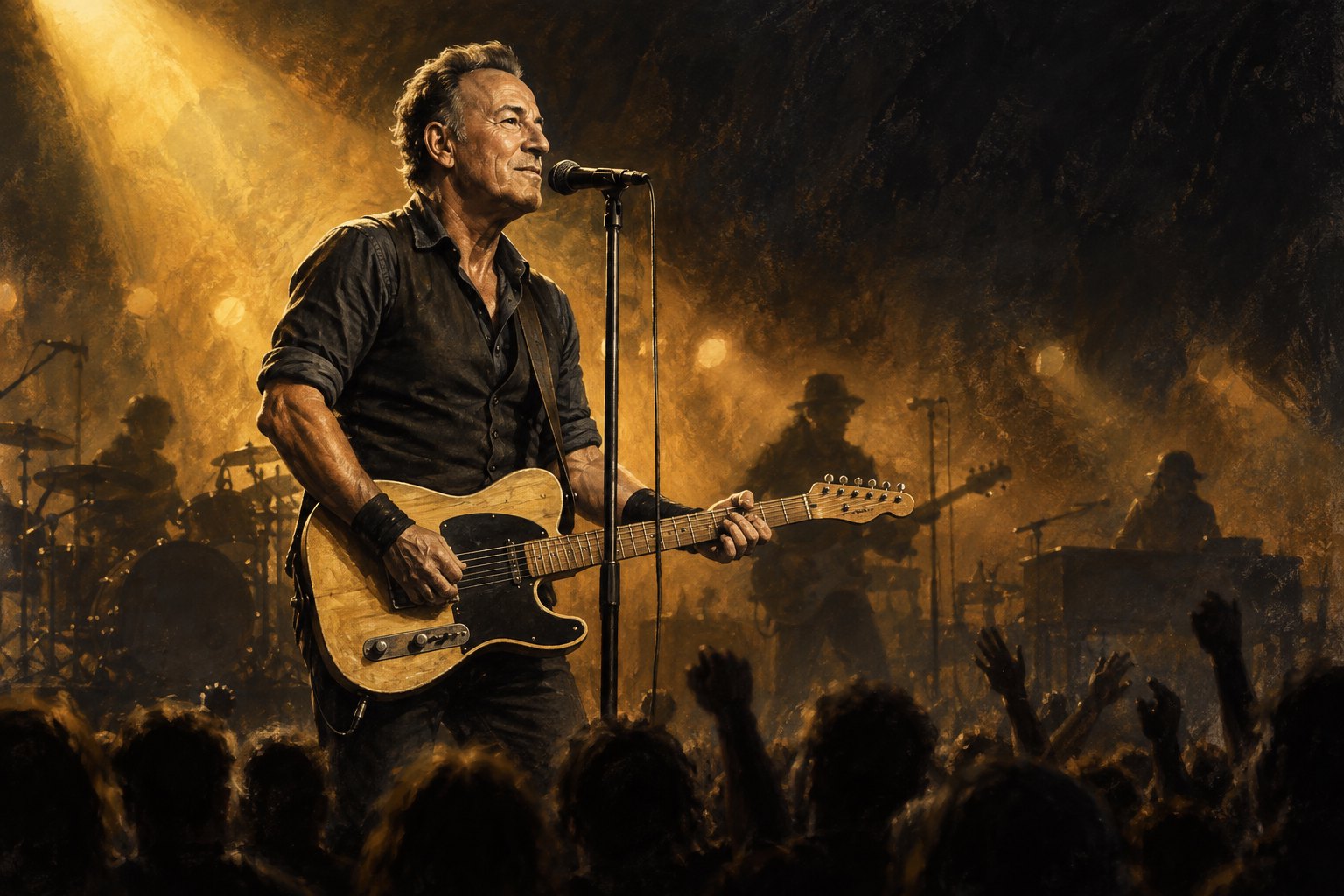
Bruce Springsteen is releasing opening songs from a new concert film. For viewers interested in the film as much as the music, the choice to foreground the beginning creates a useful question: how does a performance introduce itself when a camera becomes part of the relationship between singer and audience?
An opening can establish more than volume and excitement. It can show who commands attention, how musicians communicate, and whether the viewer feels invited into an event or positioned outside it. That makes these songs an interesting entry point for film commentary, even before a judgment about the complete work is possible.
This is a spoiler-free critical preview of the announcement and its cinematic implications, not a review based on viewing the finished film. Specific shots, spoken remarks, and performance details are not assessed here.
Why the opening matters more than a highlight reel
A highlight reel can borrow its emotional peaks from anywhere. An opening has a different job: it must make the next moment matter. Releasing the beginning directs attention toward the performance’s initial relationship with its audience, although the announcement alone does not establish how much uninterrupted material the release preserves.
That distinction matters. An individual song may work beautifully in isolation while revealing little about the film’s overall rhythm. A sequence can offer more: the move from anticipation into sound, a change in intensity, or the space between one musical idea and the next. Those connections are where a concert recording can begin to acquire dramatic shape.
My critical preference is for openings that allow viewers to discover their own interest. A film does not need to announce significance through constant crowd shots or aggressive cutting. Sometimes the more persuasive invitation is simply enough time to notice a performer listening before responding.
Springsteen as a screen presence
A character-centered approach to a concert film requires care. Springsteen is a real performer, not a fictional protagonist whose private thoughts a critic can supply. What can be analyzed is the public presence the film constructs through framing, duration, sound, and the selection of visible behavior.
Consider the difference between a close-up and a wide shot. A close-up can make physical effort legible: breath, concentration, the preparation for a phrase. A wider view can place that effort inside a network of other people. Neither perspective is inherently more truthful. Each answers a different question about what the performance asks us to notice.
For this release, the useful question is whether the opening lets Springsteen’s presence develop or assumes that recognition is enough. A familiar face provides immediate orientation, but a compelling film still needs to reveal something through observation. Recognition gets a viewer through the door; a meaningful action gives that viewer a reason to stay.
This relationship between public identity and cinematic presentation also informs our discussion of Charli xcx’s Music, Fashion, Film tour. In both cases, the interesting critical issue is how performance becomes expressive screen language.
The musicians should be more than background
A camera can make a concert seem to originate entirely from its central singer. That is an efficient way to organize attention, but it can obscure the exchanges that make live music interesting. A glance, a held beat, or a response from another player can carry the dramatic function that dialogue serves in a narrative film.
These are possibilities to watch for, not descriptions of verified moments in Springsteen’s new film. The distinction is essential: a promising subject does not automatically produce observant filmmaking. The finished images must earn any claim that they reveal collaboration.
From the musicians’ perspective, screen time is less important than intelligible participation. A brief shot that makes a response clear can tell us more than several decorative close-ups of instruments. The strongest ensemble coverage helps a viewer understand how an individual decision changes the shared sound.
That would also deepen Springsteen’s portrayal. Showing a frontman receiving musical information, rather than only projecting it, makes leadership visible as a relationship. It gives the performance something more specific than generalized charisma.
The audience is part of the story
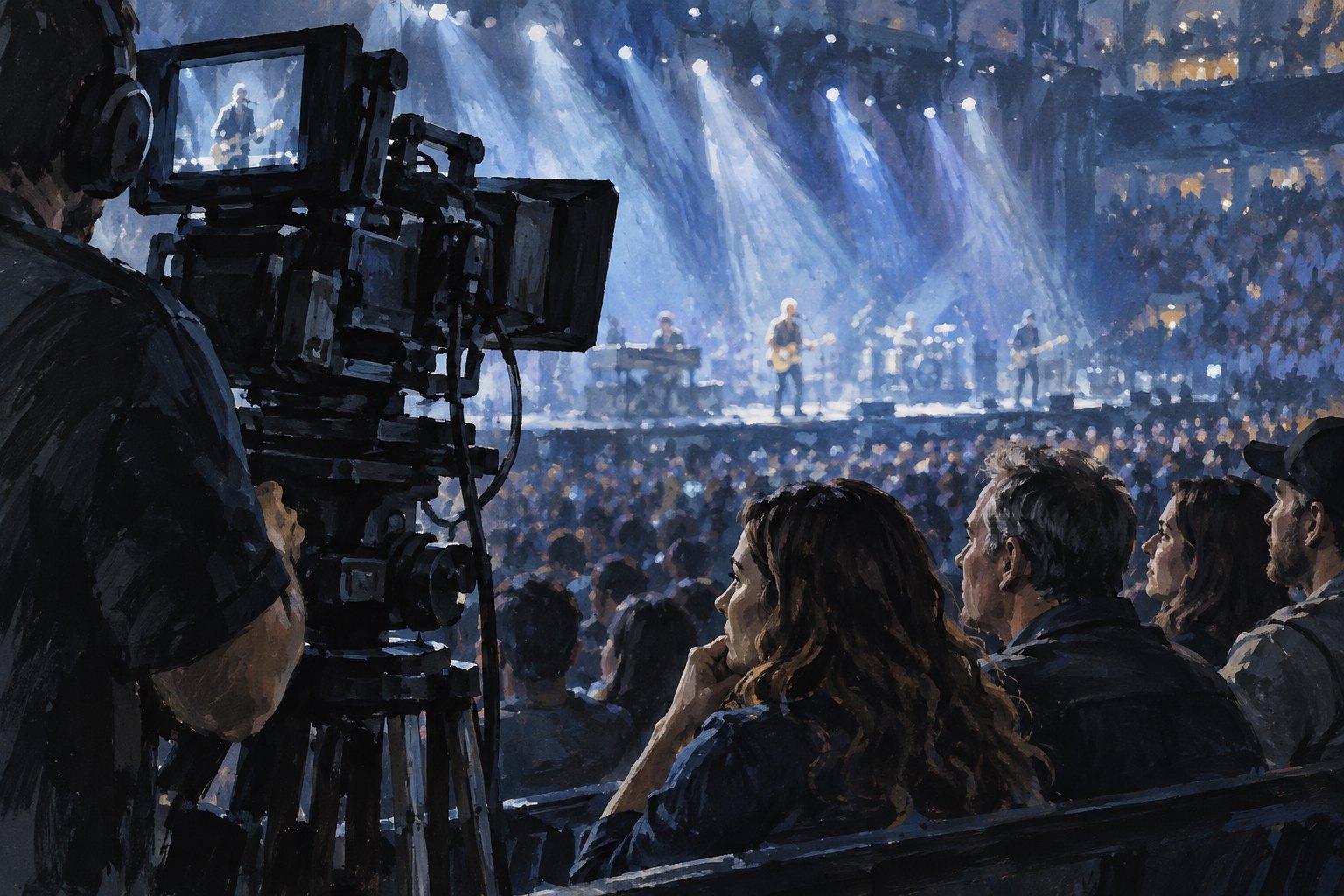
For someone in the venue, the stage is only one part of the experience. Nearby voices, bodies, and reactions contribute to the sense of being there. A concert film must decide how much of that surrounding experience to translate for someone watching elsewhere.
Audience shots can establish that relationship, but their placement matters. Cutting to applause can document a response; repeated too insistently, it can also instruct the home viewer how to feel. A quieter face may introduce another kind of engagement, provided the film gives that expression context rather than treating it as proof of an emotion.
The camera’s access does not settle the meaning of what it records. That question also runs through our commentary on documentary visibility and interpretation in You Can See Everything. Seeing a person closely is the beginning of interpretation, not its conclusion.
What to listen for beneath the spectacle
The sound deserves the same attention as the images. When watching the opening songs, listen for whether individual musical contributions remain understandable, whether the vocal sits naturally within the ensemble, and how crowd sound changes the apparent distance between viewer and stage.
There is no single correct balance. A prominent audience can convey collective participation, while a more focused musical mix can reveal detail. The critical issue is consistency: does the sound support the space suggested by the picture, or does the relationship feel arbitrary?
Transitions are especially revealing. The end of a song may leave anticipation, relief, or unresolved energy. If that interval is retained, it can help the next song feel consequential. If it is shortened, the sequence may gain momentum while losing some sense of shared time. Either choice needs to serve the film.
The deeper promise of a filmed beginning
The most interesting possibility in Springsteen’s opening-song release is an encounter between two kinds of attention: the immediate pull of live performance and the camera’s ability to make a small gesture available for closer consideration. A concert film succeeds when those forms of attention enrich each other.
For now, releasing the opening songs offers an entry point, not evidence of the complete film’s achievement. The appropriate verdict remains open. What will matter is whether the beginning establishes relationships that the film can develop—between Springsteen and the musicians, the stage and the crowd, and the recorded event and its new viewers.
That is the deeper test: whether watching gives us a clearer sense of people making and receiving music together. If the film can make that exchange perceptible, its opening will do more than introduce songs. It will teach us how to pay attention.
Original content by this site's editorial team. Published: September 12, 2026 at 09:49:02 PDT (Los Angeles time)