Charli xcx has announced U.K. and European dates for her Music, Fashion, Film tour, with Audrey Hobert opening, according to Variety. For listeners, the immediate news is the opportunity to see that pairing live. For film-minded audiences, the title creates an additional point of interest: it places cinema alongside music and clothing as part of the invitation.
That wording deserves attention without being treated as a production synopsis. A tour called Music, Fashion, Film does not, by its name alone, announce a concert movie, establish a narrative, or promise particular screen imagery. What it does offer is a useful starting point for considering how a performer becomes a character in the audience’s imagination—and how visual choices can deepen or flatten that character.
This is commentary on the announcement and its artistic framing, not a review of a performance or a finished film. The distinction matters because the most interesting possibilities here remain possibilities.
What the announcement establishes
The central information is straightforward: Charli xcx is bringing the named tour to the U.K. and Europe, and Audrey Hobert is the announced opening performer. Those facts establish the geographical scope and the billing. They do not explain how the two sets will relate musically, whether the evening will have a shared visual concept, or what role film will play in the experience.
Readers seeking booking information should consult the artist’s official announcements and their chosen venue’s ticketing information for the exact date, location, sale conditions, and opening-act details attached to a particular show. This commentary does not provide a verified itinerary or ticket-sale schedule.
The editorial interest lies in the three-part title. Music unfolds through time. Fashion works through the dressed body. Film selects what we see, for how long, and from whose position. Bringing those forms into one phrase invites a question more specific than whether the show will look impressive: will its visual language change how we understand the person performing?
The performer as a character, without an invented backstory
Character analysis begins with observable decisions. In a film, a person’s entrance, posture, distance from others, and response to pressure can reveal as much as dialogue. A concert can invite a comparable kind of attention, even when there is no fictional protagonist or conventional plot.
For Charli, the productive critical question would be how the performance organizes our access to her. Does a particular moment make the performer seem commanding, exposed, playful, remote, or difficult to read? What creates that impression: the vocal delivery, the arrangement, a gesture, the lighting, or the image on a screen?
These are questions for an eventual assessment, not descriptions of an unseen show. They also prevent an easy mistake: equating a stage persona with a complete account of the person behind it. A tightly controlled image can express something emotionally precise without giving viewers unrestricted access to private life.
That distinction connects with our discussion of how performance constructs screen authority in Primetime. In both contexts, recognition is only the beginning. The richer question is what a familiar presence makes the audience believe, and which formal choices give that belief its force.
What would make the tour cinematic?
My critical standard would be whether the images create a point of view. Large screens, dramatic lighting, and elaborate transitions can be pleasurable in themselves, but the adjective cinematic becomes more useful when it describes how attention is directed.
Consider a hypothetical performance filmed first in a close-up and then in a wide shot. The close-up might make a tightened hand feel emotionally significant. The wide shot might reveal that the same performer is standing alone in an enormous space. Neither image needs a different song to change the scene’s meaning; the relationship between body and surroundings does the work.
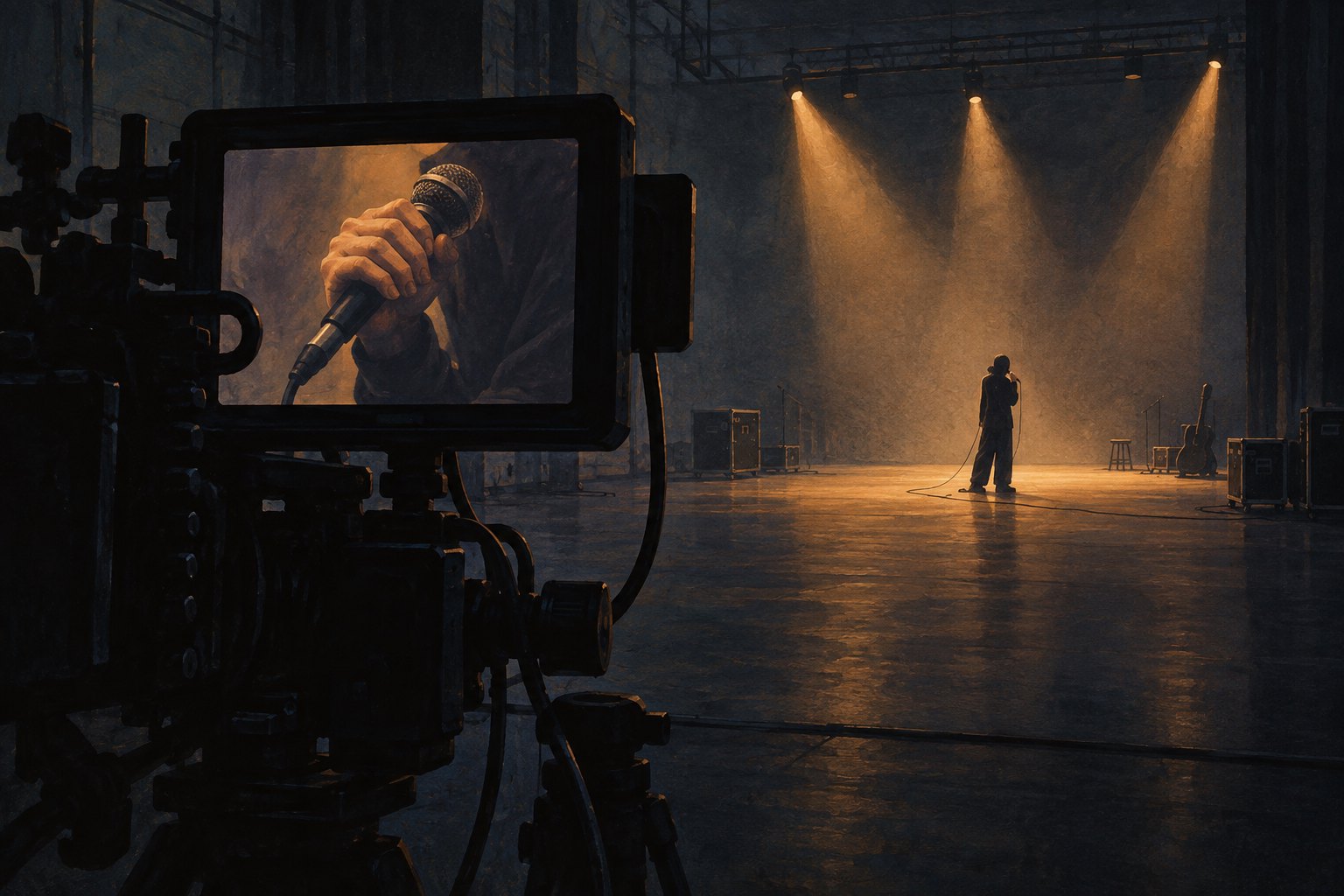
Duration matters, too. Holding an image can let viewers notice hesitation, effort, or a gesture that does not resolve neatly. Cutting rapidly can create momentum or make the body seem fragmented. Neither method is inherently more sophisticated. Its value depends on what it allows the audience to experience.
For a tour bearing this title, I would look for relationships between sound and image that reward attention. An image might complicate a lyric’s apparent confidence, or a visual transition might make a musical shift newly legible. Those would be substantive grounds for film commentary because they concern meaning, rhythm, and perspective.
Fashion can do the work of characterization
Clothing offers another way to develop a stage presence. In character-focused film criticism, costume becomes interesting when it affects how someone occupies a scene: whether they seem protected, conspicuous, constrained, or able to move freely.
The same approach would serve Music, Fashion, Film. Rather than treating each outfit as an isolated reveal, a reviewer could ask how fabric, shape, and movement interact with the performance. Does a garment extend a gesture? Does it create distance? Does it appear different when the camera moves closer?
No specific wardrobe is established here. The point is to set a useful standard for evaluating whatever emerges. Fashion earns its place in the interpretation when it contributes to the performance’s emotional or visual logic. Expense and recognizability cannot answer that question on their own.
Audrey Hobert’s opening slot deserves its own attention
Hobert’s presence is a concrete part of the announcement, but the billing alone cannot establish why she was chosen or how her set will complement Charli’s. Reading a complete artistic manifesto into the pairing would get ahead of the evidence.
A more useful approach is to treat the opener as a performer with an independent claim on the audience’s attention. In an eventual review, Hobert’s set should be assessed through its own pacing, delivery, and relationship with the room before being folded into an account of the headliner’s evening.
Comparison becomes valuable once there is something specific to compare. Similar choices might create continuity; different approaches might sharpen the audience’s perception of each artist. Either outcome could be effective. The task for criticism is to explain the experience rather than assume that a shared bill guarantees a shared aesthetic.
The deeper promise is a way of seeing
My reading of Music, Fashion, Film is that its strongest potential lies in the interaction between its three terms. Sound can change the emotional weight of a gesture. Clothing can change its silhouette. A camera can make that gesture feel public, intimate, monumental, or fleeting.
This is also why cinema should not function merely as a badge of artistic seriousness. As our commentary on movie taste and the limits of prestige branding argues, attentive judgment requires more than a prestigious label. A direct, exuberant performance can be deeply expressive; an elaborate visual concept still has to earn its effects.
Charli’s announcement gives audiences a pairing and an evocative title. The eventual artistic test is whether music, clothes, and images make one another more revealing. If they do, the reward will be more than a collection of striking moments: it will be a performance whose details change how we see the figure at its center.
Original content by this site's editorial team. Published: September 12, 2026 at 05:58:59 PDT (Los Angeles time)