Brad Pitt’s return in The Further Mis-Adventures of Cliff Booth brings a compelling character question back into focus: what happens when the man hired to make other people look heroic becomes the person responsible for cleaning up their problems? Cliff’s appeal has always involved a gap between his reassuring competence and the less reassuring uses to which that competence can be put. His new occupation makes that gap especially interesting.
This is a character-focused critical preview, not a firsthand screening review. It examines the confirmed story setup and identifies the questions that setup raises. Minor premise spoilers follow; the ending is not discussed.
Cliff’s New Job Changes the Meaning of His Old Skills
Directed by David Fincher from a screenplay by Quentin Tarantino, the film returns to Los Angeles in 1977. Cliff now works as a fixer alongside bartending and projectionist jobs. Talent agent Karen Crosby, played by Elizabeth Debicki, contacts him on behalf of television star Charlie Peters, played by Scott Caan. Those details come from the film’s [official synopsis](https://media.netflix.com/en/only-on-netflix/82054606?countryCode=DK).
The occupational shift is more than a convenient way to generate another adventure. A stunt performer absorbs physical danger so that somebody else can retain the image of mastery. A fixer performs a related service: he takes responsibility for an uncomfortable situation while the person who benefits may remain at a distance. Both jobs create a division between the person doing the work and the person whose reputation survives it.
From Cliff’s perspective, that continuity could make the transition feel practical rather than dramatic. He possesses abilities people will pay for. The deeper question is whether being useful gives him an excuse to avoid examining the purpose of the assignment. Competence can become a private moral code: if he handles the problem efficiently, he can consider the job well done. Everyone else must live with the definition of “handled.”
Charlie Peters and the Performance of Self-Sufficiency
The official premise identifies Charlie as a star known for performing his own stunts. It also places his wife, Toni, played by Carla Gugino, and football champion turned screen actor Roderick “Hot Rod” Harrison, played by Yahya Abdul-Mateen II, within his circle.
Charlie’s professional image makes his need for Cliff particularly suggestive. Doing your own stunts advertises independence. Calling someone to solve a dangerous personal problem exposes dependence. The interesting tension is not simply whether Charlie is brave. Courage in a controlled professional environment does not necessarily prepare someone for situations where the consequences cannot be reset between takes.
Seen through Charlie’s position, Cliff represents both relief and embarrassment. Needing expert help is reasonable; needing help while selling an image of complete self-reliance is more complicated. That is a productive foundation for character drama because it places the star’s public identity in conflict with the machinery required to maintain it.
This distinction between dominating attention and carrying a story also informs our discussion of how star presence can reshape a film’s dramatic center. Here, the question is built into the characters’ professions: who appears to be in charge, and who actually makes the situation manageable?
Karen Crosby Connects Image to Consequences
Karen’s position as the agent initiating contact matters. An agent works where a person’s abilities, commercial value, and public identity intersect. Bringing Cliff into a client’s world makes her the connection between a marketable image and the less presentable work needed to protect it.
That does not establish her motives beyond the premise. It does, however, suggest a useful way to read her decisions: whom does she understand, whom does she protect, and what does she consider negotiable? A character in that position can recognize the difference between what a star wants and what a star needs without necessarily having the freedom to say so.
Toni and Hot Rod should likewise be judged as participants with their own interests, rather than treated as accessories to Charlie’s trouble. The synopsis alone cannot establish their emotional arcs. The meaningful test is whether the finished film allows their choices to complicate Cliff’s understanding of the assignment. A fixer who never has to revise his reading of another person risks becoming a delivery system for solutions.
The Projectionist Job Offers a Different View of Cliff

Cliff’s projectionist work supplies a quieter counterweight to the fixer premise. A projectionist makes the spectacle available while remaining outside the audience’s field of attention. The work requires care, timing, and familiarity with equipment; successful execution usually makes the worker less noticeable.
As a character detail, this is rich without requiring an invented symbolic scene. Cliff occupies another position behind the image. He helps movies happen, yet his usefulness does not depend on being recognized by the people enjoying them. That creates an intriguing tension in a film whose central attraction is a highly recognizable movie star.
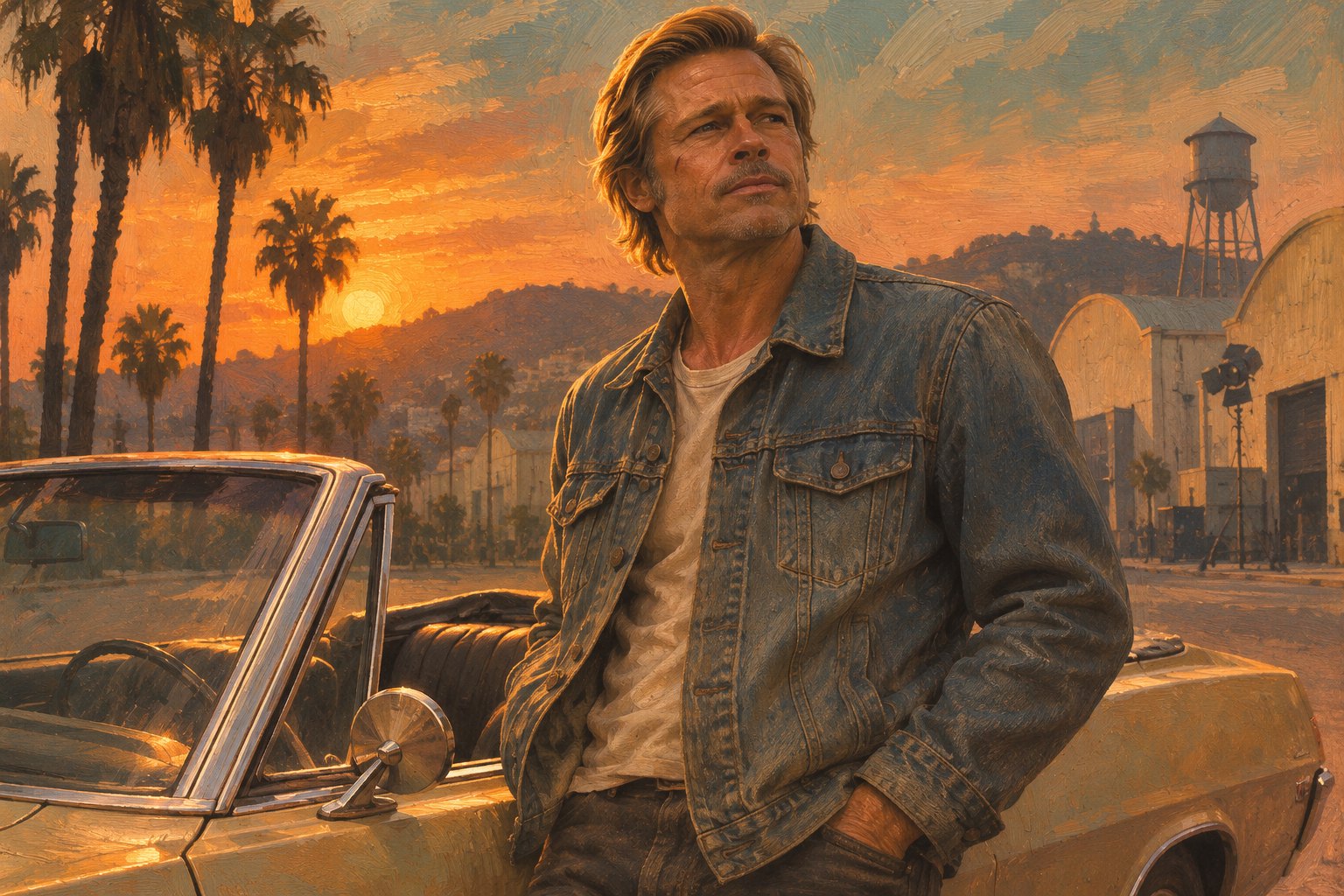
The illustration above is conceptual artwork, not a reproduction of a scene. Its emphasis on the space behind the screen reflects the distinction at the heart of this reading: Hollywood’s visible glamour depends on people whose work happens elsewhere.
What the Reported Dialogue Suggests—and What It Cannot Prove
The Associated Press review describes Cliff saying “scooch” while holding a shotgun and reports Karen dismissing movies as “hamburgers shoveled to the undeserving masses.” It also identifies a Big Kahuna Burger bag, a recurring reference in Tarantino’s films. These details are reported in the [Associated Press review](https://apnews.com/article/9d3efdf82c5742162de9bda64fb06361).
Those brief lines suggest different relationships to power. The first places everyday politeness beside coercion. The second turns cultural judgment into a gesture of superiority. Neither quotation, isolated from its delivery and surrounding scene, can establish whether the film endorses the speaker’s attitude.
That distinction matters particularly with Cliff. A relaxed manner can make force seem less disturbing without making it less consequential. Humor may reveal that contradiction, or it may help an audience overlook it. A responsible assessment of the finished film needs to examine what happens around the joke: whose discomfort registers, whose perspective disappears, and whether charm receives any resistance.
The Deeper Question: Is Usefulness Enough?
The strongest interpretive possibility here is a story about belonging through service. Cliff has skills that keep him connected to an industry whose most visible rewards go to others. Being needed can provide purpose, but it can also become a reason to accept terms that deserve scrutiny.
Our character-focused reading of Casablanca considers how personal allegiance acquires meaning through a difficult choice. That is a useful standard here, too: loyalty becomes dramatically revealing when serving someone carries a cost beyond inconvenience.
Brad Pitt’s return makes Cliff immediately recognizable. The more substantial opportunity is to make his usefulness morally legible. Whose interests does his competence serve? What does he overlook to remain comfortable with himself? The premise earns attention because those questions arise naturally from his work. Whether the film confronts them or simply enjoys his company remains the distinction a full screening review must resolve.
Original content by this site's editorial team. Published: November 19, 2026 at 12:54:30 PST (Los Angeles time)