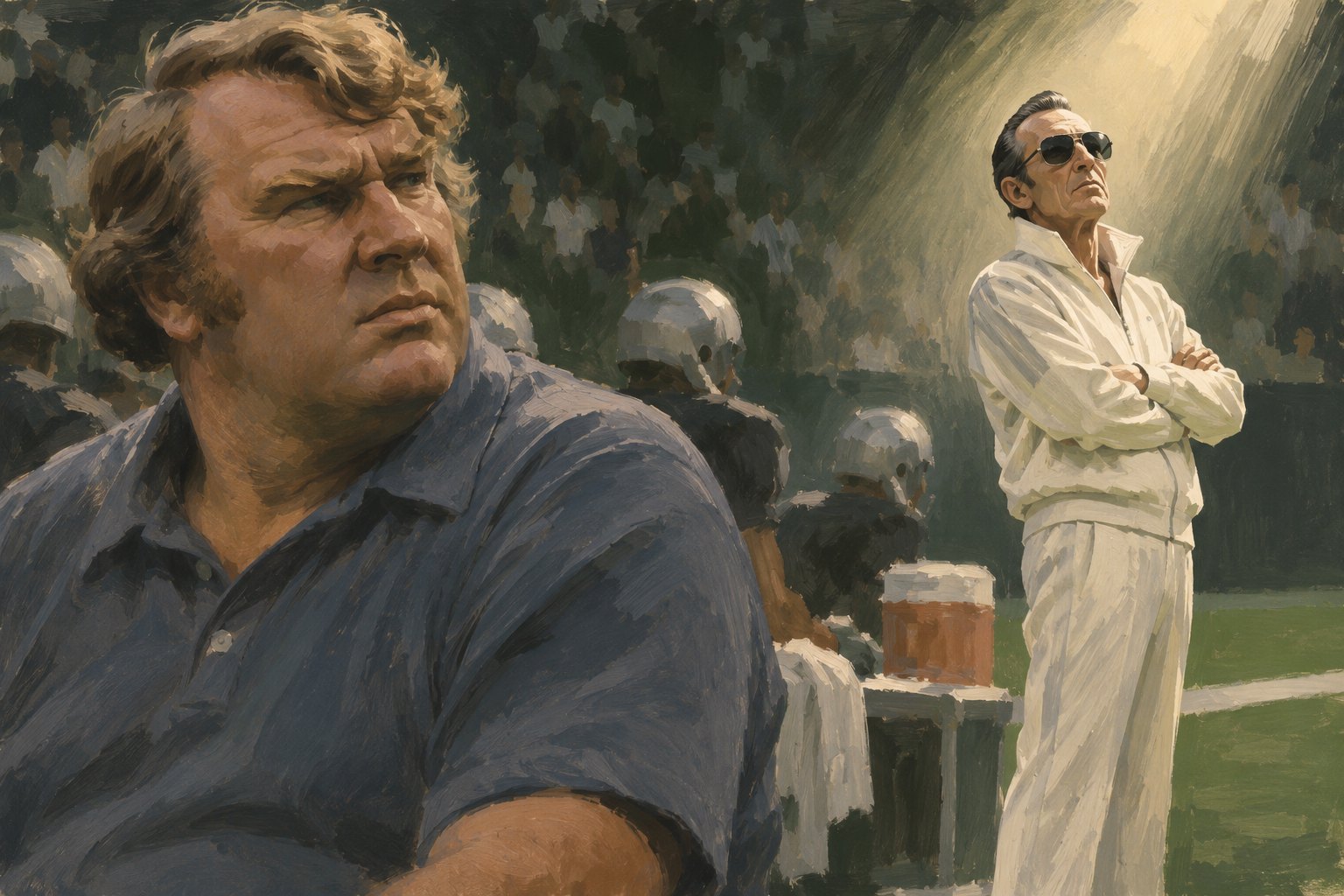
Madden has a problem that no amount of recognizable casting can automatically solve: its title character must remain the most revealing person in his own story. Nicolas Cage plays John Madden, while Christian Bale portrays Al Davis, and the sharpest criticism of that pairing suggests the supporting figure supplies the personality the central performance struggles to establish.
Armando Salguero’s review, published by Fox News, strongly favors Bale’s interpretation and argues that Cage never convincingly inhabits Madden. That is one critic’s judgment, rather than an objective measure of either performance. But it offers a productive way into the film: when Davis captures attention, does he deepen our understanding of Madden, or expose how little the biography has given its protagonist? [Salguero’s review, republished](https://nytimespost.com/nicolas-cages-madden-biopic-fails-the-coach-and-the-movie-while-christian-bales-al-davis-steals-the-show/)
Scope and spoilers: This is an analysis of the film’s reported characterization and critical reception, rather than a firsthand screening review. It discusses broad career developments and a small visual joke. Unverified dialogue is not presented as movie quotations.
Cage’s challenge is familiarity, not just resemblance
Playing a familiar public figure creates two simultaneous jobs. An actor has to establish enough recognition for viewers to accept the person, then introduce something that recognition alone cannot provide. Makeup can help with the first task. The second depends on behavior: what the character notices, how he listens, and what changes when another person challenges him.
Salguero’s central objection is that Cage remains too conspicuously Cage. His praise for Bale emphasizes the opposite experience: the actor’s voice and presence make Davis recognizable. Those observations describe different degrees of immersion, but they do not establish that close imitation is the only valid approach to biography.
A performance can depart from a historical figure’s exact sound and still illuminate the person. Conversely, an excellent impersonation can reveal very little. The useful question for Madden is whether Cage’s choices create a coherent character beneath the familiar surface. Does an outburst express fear, pleasure, frustration, or a need to take charge? If those differences remain indistinct, volume becomes a substitute for psychology.
That distinction matters especially here. A viewer who already knows Madden’s public personality brings an emotional relationship to the screen. The film has to engage that relationship while giving an unfamiliar viewer a reason to care. Nostalgia cannot perform both tasks indefinitely.
Why Davis can become the easier character to read
A forceful supporting character has an immediate structural advantage: he can enter with a clear objective, disrupt an exchange, and leave before the film asks him to sustain its entire emotional argument. The protagonist must carry the transitions, uncertainties, and consequences.
This makes the enthusiasm for Bale interesting without making it conclusive. A memorable Davis could function as a dramatic counterpart, forcing Madden to expose convictions he otherwise leaves unspoken. It could also become an attractive distraction, supplying a burst of personality whenever the central story loses definition.
The difference lies in what happens after the scene. Has Madden made a decision? Has his understanding of Davis changed? Does their relationship acquire an obligation or a wound? If the answer is merely that Davis was entertaining, the supporting performance has succeeded locally while the biography remains underdeveloped.
Our discussion of why a powerful performance cannot always carry a film explores a related problem. Here, the issue is more specific: the performance attracting attention needs to return that attention to the person whose name gives the movie its title.
The critics disagree about what Bale achieves
Bale’s reception is not uniformly enthusiastic. In his review, Robert Daniels finds the portrayal exaggerated without sufficient emotional substance. That differs sharply from Salguero’s admiration. The disagreement is useful because it separates two questions frequently collapsed into one: whether an actor is enjoyable to watch, and whether the character becomes understandable. [Robert Daniels’s review](https://www.rogerebert.com/reviews/john-madden-nicolas-cage-christian-bale-amazon-david-o-russell-prime-video-movie-review-2026)
Both responses can arise from the same kind of performance. Assertive delivery and conspicuous physical choices may feel like vivid characterization to one viewer and an accumulation of effects to another. The decisive issue is whether those choices reveal an intention that changes with the situation.
My reading of this critical divide is that Bale’s prominence should be treated as a question about the film’s construction, not a simple acting contest. Declaring a winner between two stars risks overlooking the screenplay’s responsibility to give each of them meaningful work.
A career transition needs an interior transition
The film moves through Madden’s coaching, broadcasting, and video-game chapters. Tim Grierson’s review describes a narrative that covers these developments but finds insufficient insight into the coach’s abilities and personality. His criticism points toward the distinction between showing a new occupation and dramatizing a changed relationship with the world. [Tim Grierson’s review](https://www.screendaily.com/reviews/madden-review-david-o-russell-fumbles-glib-biopic-of-iconic-nfl-coach-commentator-john-madden/5222487.article)

Consider the dramatic possibilities of moving from coaching to explaining. A coach addresses people expected to execute an instruction. A broadcaster addresses people who may need help understanding what they have just witnessed. Those positions require different forms of authority. A biography can use that difference to reveal patience, adaptability, or the pleasure of making expertise accessible.
This is an interpretive standard, not a claim about an undocumented scene. It explains why a sequence of professional milestones may still feel emotionally static. The job changes, but the audience needs to experience what changes inside the person doing it.
Readers interested in the film’s broader tensions can turn to our earlier analysis of Madden’s competing ideas of success. The narrower concern here is performance: whether Cage’s characterization makes different phases feel like discoveries rather than costume changes.
A small visual joke—and its limits
Salguero describes an appearance by a young Mark Davis whose bowl haircut anticipates his recognizable adult look. That functions as a visual recognition gag for football followers. It should not be inflated into evidence of a hidden narrative or an elaborate Easter-egg system.
Such details can reward familiarity, but recognition is a brief pleasure. A biopic becomes more interesting when viewers understand a relationship they previously knew only as a name or an image. The haircut can earn a smile; it cannot supply that understanding.
The deeper issue is who gets to feel human
The most revealing interpretation of Madden’s casting divide is that supporting characters are often allowed sharper edges than celebrated protagonists. The central figure carries the burden of representing a legacy. Everyone around him may have greater freedom to be abrasive, peculiar, or difficult.
That is the danger suggested by the criticism here. If Davis is permitted more specificity while Madden remains broadly admirable, Bale receives the more playable character. Cage’s challenge then extends beyond resemblance: he must find an individual where the film may be protecting an icon.
A satisfying Madden biography would let his personality generate understanding, not merely recognition. Bale’s ability to attract attention matters most when it helps that happen. Otherwise, the supporting character’s vividness becomes a reminder that the man at the center still needs a more searching portrait.
Original content by this site's editorial team. Published: November 19, 2026 at 08:40:18 PST (Los Angeles time)