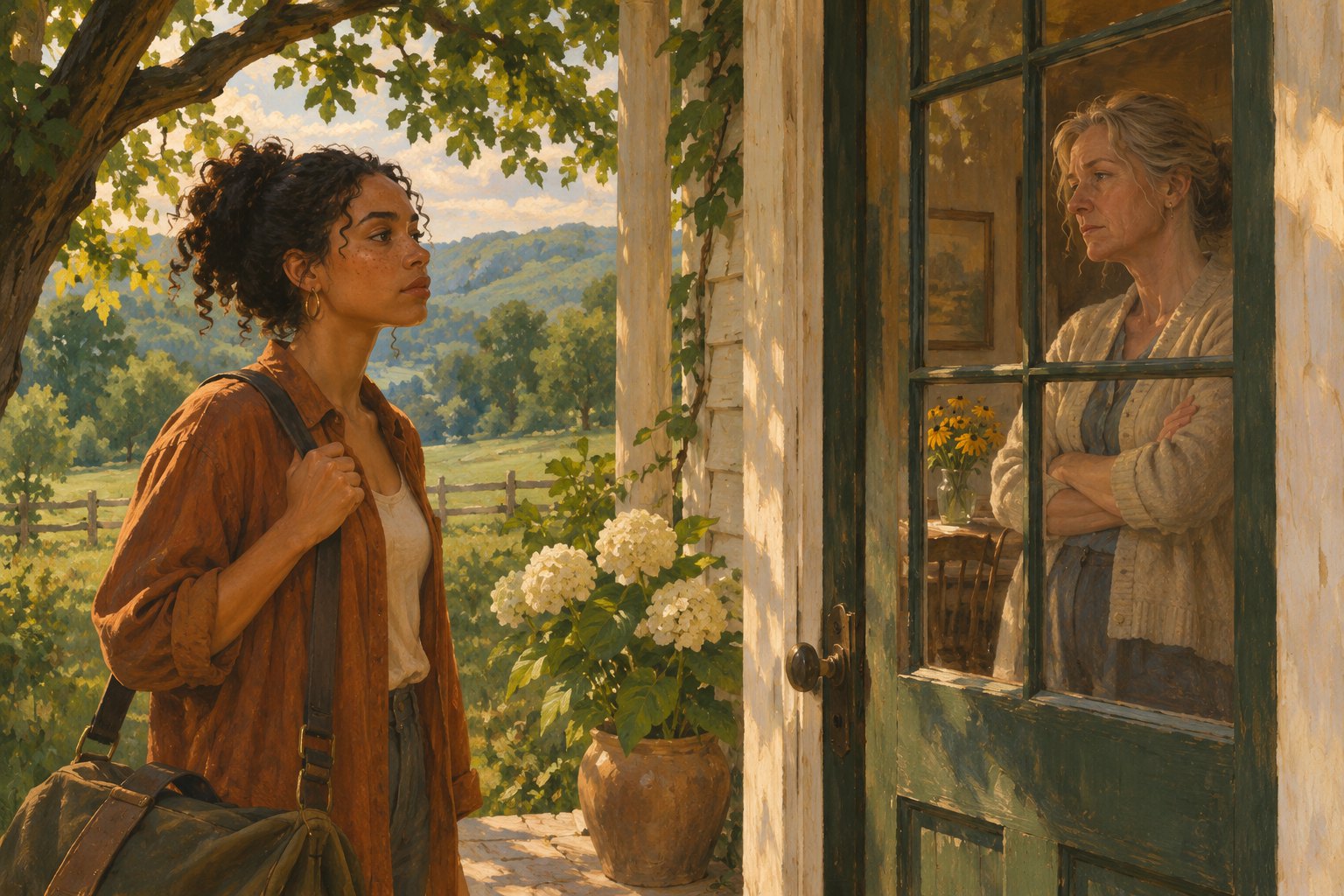
Bird in Hand makes wedding planning an elaborate way of asking a much more vulnerable question: will my family show up for me? Written and directed by Melody C. Roscher, the comedy-drama follows Bird Rowe, played by Alisha Wainwright, as she returns to her mother’s rural home with wedding news and a concealed purpose. Her search for a venue masks a search for her biological father. The revealing contradiction is that Bird wants an honest connection while trying to engineer the circumstances under which it happens.
That contradiction offers the strongest route into the film. Bird’s behavior can be manipulative, but treating her simply as a troublesome daughter misses what her schemes are protecting. Asking someone to attend a wedding is easier than asking why they have been absent from your life.
Spoiler warning: This analysis discusses Bird’s hidden agenda, significant family conflicts, and the circumstances of her encounter with her father. It examines documented story details and dialogue rather than offering a firsthand assessment of every performance or filmmaking choice.
Bird turns an emotional need into a practical assignment
The wedding supplies Bird with socially acceptable reasons to ask questions, visit properties, and investigate musicians. Her absent father, Bower, belongs to a wedding band. Booking entertainment therefore becomes a possible route to arranging the meeting she cannot bring herself to request straightforwardly.
Viewed from Bird’s perspective, the plan has a defensive logic. An ordinary task gives her somewhere to put feelings that would otherwise leave her exposed. She can act busy instead of admitting that she feels abandoned. The trouble is that logistical success cannot guarantee emotional recognition. Getting somebody into a room does not determine what they will say once they arrive.
This is also where sympathy needs a limit. Bird’s longing helps explain the deception; it does not erase its consequences for everyone drawn into it. The film’s central predicament becomes more interesting when we allow both ideas to remain true. She deserves answers about her family, and other people deserve relationships that are not secretly organized around an undisclosed test.
Carlotta’s boundaries have unequal terms
Christine Lahti plays Carlotta, Bird’s mother, whose commitment to personal freedom runs into her daughter’s need for reassurance. One especially pointed line captures the problem: “I have boundaries now, your emotions are yours to own.” In isolation, that could sound like reasonable advice. Within a parent-child relationship already burdened by unanswered questions, it can also become a way of ending a conversation before responsibility enters it.
The distinction matters. A boundary describes what someone can reasonably offer or accept. It becomes something less constructive when it implies that another person’s distress has nothing to do with your behavior. Bird is an adult responsible for her choices, but adulthood does not retroactively settle childhood grievances.
Carlotta’s perspective deserves attention without becoming an excuse. She seems invested in preserving a self beyond motherhood, a legitimate wish that can coexist with failures of care. The conflict arises when independence requires Bird to stop needing anything inconvenient. Mother and daughter then experience the same conversation differently: one hears an accusation, while the other believes she is finally making a request.
Bird’s terse “Stop being comfortable!” makes that collision explicit. Her demand is not merely for information. She wants the people who helped shape her uncertainty to experience some of its discomfort.
The horse incident complicates the mother-daughter divide
An encounter involving the neighbors’ horse provides an illuminating counterweight to the arguments. Carlotta decides to ride it without permission. When challenged, she and Bird improvise a justification together. Their cooperation reveals a shared instinct for getting out of trouble, even when they struggle to speak honestly in private.
My reading is that this complicity matters more than a simple demonstration that they still love each other. Bird knows how to participate in Carlotta’s version of events. They can become a team when facing an outsider, suggesting that their estrangement exists alongside considerable familiarity.
That makes the relationship harder to resolve through a clean assignment of blame. Bird is resisting a family pattern while also knowing its methods intimately. The same interest in separating a character’s defensive behavior from the needs beneath it informs our analysis of resentment and responsibility in Steps.
Dennis and Leigh make belonging a public problem
The neighbors, Dennis and Leigh, played by James Le Gros and Annabelle Dexter-Jones, are attempting to give a plantation property a new identity. Bird’s growing involvement with Dennis pulls her personal search into a setting where history itself is being made more comfortable for its current occupants.
For a biracial woman looking for her Black father, that setting carries implications beyond picturesque wedding scenery. A celebration promises continuity: families gathering, histories joining, a future beginning. A plantation introduces a much harsher question about whose history gets acknowledged when a property becomes a desirable backdrop.
There is a useful thematic parallel here, although the situations are not morally equivalent. Bird manages the story of her visit; the neighbors manage the story of their property. Both arrangements become unstable when inconvenient realities demand attention. The plantation context prevents the film’s interest in identity from remaining exclusively personal.
Dennis’s attention also raises a difficult distinction between feeling welcomed and being understood. For someone starved of recognition, warmth can acquire enormous importance very quickly. Yet attraction cannot reliably supply the parental acknowledgment Bird came home seeking. Her vulnerability makes the connection understandable without making it a solution.
Why the father’s arrival cannot finish the emotional work
When Bower arrives, the wedding arrangement exposes its actual purpose. Bird explains, “Because I wanted you to show up this time.” The sentence compresses her scheme into a recognizable wish: she wants an absence corrected through a visible act of presence.
The important interpretive limit is that arrival and repair are different achievements. A meeting can provide information or open a relationship, but it cannot automatically deliver the years of attention Bird has imagined. Her plan gives her a measure of control over an encounter; it cannot guarantee the father she hoped to find.
That distinction is worth carrying into conversations after the film. As our piece on giving films room for reflection argues, an immediate emotional response becomes more useful when followed by specific questions. Here, ask what Bird has actually received, what she still wants, and whether those things can come from the same person.
A deeper reading: accepting the present without excusing the past
Roscher has described choosing older music partly to express characters romanticizing the past, with a shift toward accepting the present near the end. That creative intention offers a productive lens for Bird’s journey. The past contains necessary answers, but it can also become an imagined place where every present difficulty would disappear if one missing person finally behaved correctly.
To my mind, the film’s most substantial idea lies in challenging that expectation without belittling it. Bird’s need for recognition is real. Her attempts to choreograph recognition reveal how frightening it is to ask freely and risk an unsatisfactory answer. Moving forward would mean surrendering the fantasy of a perfectly managed reunion while retaining the right to name what hurt her. That is a more demanding possibility than either total forgiveness or permanent escape.
Original content by this site's editorial team. Published: November 20, 2026 at 07:27:15 PST (Los Angeles time)